Motherships in Aviation: From Airborne Carriers to Composite Aircraft
In the world of aviation, a mothership is a large aircraft designed to carry, launch, or recover smaller aircraft. These specialized platforms serve various strategic roles, ranging from the early days of rigid airships to the cutting-edge transport of spaceplanes. Whether acting as an airborne aircraft carrier, a launch platform, or a component of a composite aircraft, motherships extend the range and capability of the smaller craft they carry.
Key Facts
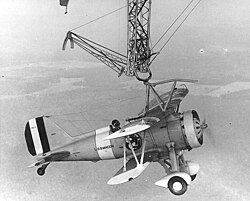
- Airborne Carriers: Early US rigid airships like the USS Akron and USS Macon used internal hangars and "trapeze" systems to deploy fighters.
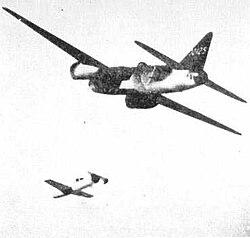
- Air Launch: Large aircraft carry payloads to a specific point before release, as seen with the X-15 and the Japanese Ohka.
- Captive Carry: A configuration where the payload remains attached to the carrier for testing or ferry flights.
- Parasite Aircraft: Smaller planes that support a mothership's mission, such as providing reconnaissance or fighter defense.
- Composite Aircraft: Two or more aircraft that take off as a single unit and separate mid-flight.
Airborne Aircraft Carriers
The concept of the airborne aircraft carrier reached a peak during the era of great rigid airships. The United States developed the USS Akron (ZRS-4) and USS Macon (ZRS-5), which featured onboard hangars capable of housing Curtiss F9C Sparrowhawk biplane fighters. These airships utilized a specialized "trapeze" apparatus to securely hold and release their aircraft.
Air Launch Systems
Air launch involves a large carrier aircraft transporting a smaller payload aircraft to a designated launch point before releasing it into free flight. This method is often used to give the smaller craft a head start in altitude and speed.
During World War II, Japan utilized the Mitsubishi G4M bomber to carry the Yokosuka MXY7 Ohka—a rocket-powered aircraft used for kamikaze attacks—bringing it within striking distance of target ships. Similarly, Germany planned the Daimler-Benz Project C, a bomber designed to carry a jet aircraft.
In the United States, NASA employed converted bombers as launch platforms for experimental flight. A notable example from the 1960s was the use of a modified Boeing B-52 Stratofortress to repeatedly launch the North American X-15.
Captive Carry and Ferry Flights
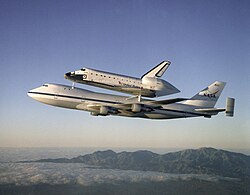
Captive carry occurs when a payload—such as a rocket, missile, or spaceplane—is attached to a carrier aircraft but does not separate during the flight. This arrangement is primarily used for initial airframe testing before a craft is cleared for free flight, or for ferry flights to transport a vehicle to a specific location.
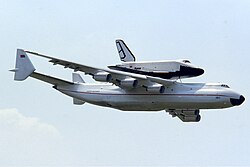
NASA utilized a pair of modified Boeing 747s, known as the Shuttle Carrier Aircraft, to transport the Space Shuttle orbiter and conduct flight tests. While the test frame Enterprise was used for air launch experiments, the operational Space Shuttle fleet was not launched this way. Similarly, the Soviet Union used the massive Antonov An-225 Mriya to ferry the Buran spacecraft.
Parasite Carriers
Parasite aircraft are smaller planes that support a long-range mothership, extending its operational role through reconnaissance or fighter defense. This concept began with World War I experiments using rigid airships.
The British experimented with 23-class airships and later the R33. In 1925, a de Havilland Humming Bird light aeroplane was successfully released from and reattached to the R33. By 1926, the R33 carried two Gloster Grebe fighters. In the U.S., the USS Los Angeles (ZR-3) served as a prototype for the later Akron and Macon carriers.
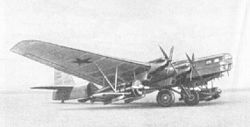
During World War II, the Soviet Tupolev-Vakhmistrov Zveno project converted Tupolev TB-1 and TB-3 aircraft to launch up to five smaller craft for fighter-bomber or escort roles.
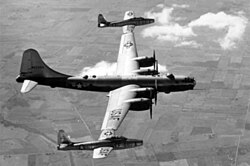
As the jet age began, long-range bombers like the B-29 Superfortress and B-36 Peacemaker were tested as carriers for the XF-85 Goblin and RF-84K Thunderflash (under the FICON project) to provide escort capabilities that early jets lacked due to limited range.
Modern applications continue through DARPA, which in 2014 requested proposals for systems where small unmanned aerial vehicles (UAVs) could be launched and recovered by conventional aircraft such as the B-52, B-1 Lancer, C-130 Hercules, and C-17 Globemaster III.
Composite Aircraft
A composite aircraft differs from a parasite arrangement in that two or more components take off as a single integrated unit before separating in mid-air. A prominent example from the 1930s was the Short Mayo Composite maritime trans-Atlantic project, which used the Short S.21 Maia experimental flying boat as the mothership component.
Summary of Mothership Roles
| Role | Primary Purpose | Example Aircraft/Project |
|---|---|---|
| Airborne Carrier | Housing and deploying fighters | USS Macon / Curtiss F9C Sparrowhawk |
| Air Launch | Transporting payload to launch point | Boeing B-52 / North American X-15 |
| Captive Carry | Testing or ferry transport | Boeing 747 / Space Shuttle Orbiter |
| Parasite Carrier | Support, defense, or reconnaissance | Tupolev TB-3 / Zveno project |
| Composite | Joint takeoff and later separation | Short S.21 Maia / Short Mayo Composite |
Frequently Asked Questions
What is the difference between a parasite aircraft and a composite aircraft?
A parasite aircraft is typically carried by a mothership that is already capable of independent flight and is released for a specific mission. In a composite aircraft, the components take off together as a single unit and separate later.
How did the USS Macon deploy its fighters?
The USS Macon used an internal hangar bay and a specialized "trapeze" apparatus to hold and release its Curtiss F9C Sparrowhawk biplanes.
What is captive carry used for in modern aviation?
Captive carry is primarily used to conduct initial testing on new airframes or systems before they are ready for free flight, or to transport aircraft and spacecraft on ferry flights.
Which aircraft were used by NASA to transport the Space Shuttle?
NASA used a pair of modified Boeing 747s, known as the Shuttle Carrier Aircraft, to transport the orbiters.
What was the purpose of the Soviet Zveno project?
The Zveno project converted Tupolev TB-1 and TB-3 aircraft to carry and launch up to five smaller craft, typically serving as fighter escorts or fighter-bombers.