Monophyly and the Classification of Biological Taxa
In the field of biological cladistics—the method of classifying organisms based on shared characteristics—scientists use specific terms to describe how groups of organisms are related. At the heart of this system is monophyly, a condition where a taxonomic grouping forms a clade. A clade is essentially a biological family tree that includes a common ancestor and every single one of its descendants.
To be considered monophyletic, a group must meet two strict criteria: it must contain its own most recent common ancestor (typically an ancestral population) and it must include all descendants of that ancestor without exception. These groups are often identified by synapomorphies, which are shared derived characteristics that distinguish the members of the clade from other organisms.
Key Facts
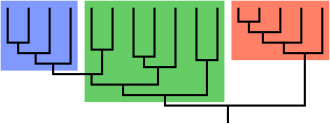
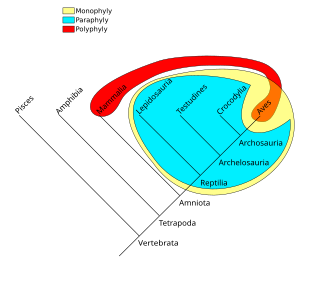
- Monophyletic groups (clades) include the most recent common ancestor and all its descendants.
- Paraphyletic groups include the common ancestor but exclude one or more descendant subgroups.
- Polyphyletic groups consist of organisms from multiple ancestral sources and do not include their most recent common ancestor.
- Synapomorphies are the shared derived traits used to characterize monophyletic groups.
- Modern systematics relies on these definitions to deduce key genes for species barcoding.
Comparing Monophyly, Paraphyly, and Polyphyly
While monophyly represents a complete ancestral lineage, other groupings are defined by what they lack. These distinctions are crucial for modern systematists to ensure that taxonomic units reflect actual genetic relationships rather than superficial similarities.
Paraphyly
A paraphyletic grouping occurs when a group contains a common ancestor but leaves out one or more monophyletic subgroups. In essence, it is "nearly" monophyletic. This often happens in traditional classification where a group is defined by the absence of a specialized trait found in a descendant group.
![A cladogram [citation needed]of the primates, showing a monophyletic taxon: the simians (in yellow); a paraphyletic taxon: the prosimians (in cyan, including the red patch); and a polyphyletic group: the night-active primates, i.e., the lorises and the tarsiers (in red).](/images/c3/66/c366168bf9783caf557a34c6fc591ddb04f34a03f9e577b59fa901e40f2f385c.webp)
Polyphyly
A polyphyletic grouping is one that meets neither of the criteria for monophyly. These groups do not share a single most recent common ancestor. Instead, they are usually grouped together because of convergent evolution—where unrelated species evolve similar features independently to adapt to similar environments. Examples include aquatic insects or night-active primates.
Etymology and Scientific Evolution
The terminology used in cladistics is rooted in Ancient Greek, providing a literal description of the group's structure:
- Monophyly: From mónos (alone/unique) and phûlon (genus/species), meaning "one-tribe."
- Paraphyly: From pará (beside/near), indicating a group that is nearly monophyletic.
- Polyphyly: From polús (many), referring to organisms arising from multiple ancestral sources.
These definitions became mainstream in the 1960s through the work of Willi Hennig. Before this, taxonomists often used these terms loosely, leading to confusion in early scientific literature. While most modern scientists restrict "monophyletic" to groups containing all descendants of one common ancestor, some debate persists. For instance, D.M. Stamos suggests that a perfect cladistic definition for species or genera is difficult because some species form via "budding" or hybrid speciation, which can leave parent species paraphyletic.
Summary of Phylogenetic Groupings
| Group Type | Includes Common Ancestor? | Includes All Descendants? | Basis of Grouping |
|---|---|---|---|
| Monophyletic | Yes | Yes | Synapomorphy (Shared derived traits) |
| Paraphyletic | Yes | No | Symplesiomorphy (Shared ancestral traits) |
| Polyphyletic | No | No | Convergence (Independent evolution) |
Frequently Asked Questions
What is the difference between a clade and a polyphyletic group?
A clade (monophyletic group) consists of a single common ancestor and all its descendants, reflecting a direct genetic lineage. A polyphyletic group consists of organisms from different ancestral lines that share similar traits due to convergent evolution, not a recent common ancestor.
Why is a population used instead of a single individual as the common ancestor?
For sexually reproducing species, it is unrealistic to assume a single individual or mating pair as the sole ancestor. Because species are defined as interbreeding populations, the common ancestor is more accurately described as an ancestral population.
What are synapomorphies?
Synapomorphies are shared derived characteristics. These are traits that evolved in the ancestor of a group and were passed down to its descendants, allowing scientists to distinguish that specific clade from other groups.
Is a paraphyletic group considered a valid taxon in modern systematics?
Modern systematists generally prefer monophyletic groups. Paraphyletic groups are often viewed as incomplete because they exclude certain descendants, though they may still appear in traditional classification systems.
What is holophyly?
Holophyly is an equivalent term for monophyly, referring to a group that includes the common ancestor and all of its descendants.