ModernismModern ArtModern ArchitectureCubismFauvism

Modernism: The Evolution of Art, Architecture, and Culture

Modernism: The Evolution of Art, Architecture, and Culture

Modernism is a global cultural and artistic movement that emerged around 1860, fundamentally altering how humanity perceives and represents reality. Breaking away from traditional forms of expression, Modernism sought to redefine the relationship between the artist and tradition, embracing experimentation and the avant-garde—works that are innovative or unconventional.

The movement was not a single style but a broad umbrella encompassing various shifts in painting, sculpture, architecture, literature, and music. It reflected a world undergoing rapid industrialization and social change, pushing creators to find new languages to describe the modern experience.

Key Facts

Jean Metzinger, 1913, En Canot (Im Boot), oil on canvas, 146 cm × 114 cm (57.5 in × 45 in), exhibited at Moderni Umeni, S.V.U. Mánes, Prague, 1914, acquired in 1916 by Georg Muche at the Galerie Der Sturm, confiscated by the Nazis circa 1936–1937, displayed at the Degenerate Art show in Munich, and missing ever since[99]
  • Timeline: Active from approximately 1860 through the mid-20th century.
  • Scope: A worldwide movement affecting visual arts, architecture, music, and literature.
  • Core Philosophy: A rejection of traditional realism and a drive toward abstraction and experimentation.
  • Key Figures: Includes Pablo Picasso, Henri Matisse, Frank Lloyd Wright, and Le Corbusier.
  • Legacy: Paved the way for Postmodernism and contemporary art.

Origins and Early History
André Masson, Pedestal Table in the Studio 1922, an early example of Surrealism

Romanticism and Realism

The roots of Modernism lie in the tension between Romanticism—which emphasized emotion and nature—and Realism, which sought to depict the world as it truly was. In the early 19th century, artists began to question the rigid constraints of academic art.
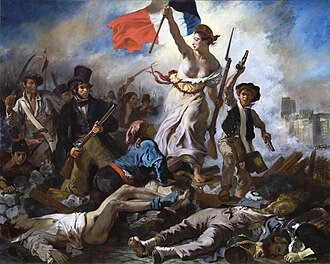
Eugène Delacroix's Liberty Leading the People, 1830, a Romantic work of art

By the late 19th century, the movement shifted. While Realism provided a foundation for observing the world, Modernist artists eventually rejected the strict adherence to visual accuracy seen in realist portraits.
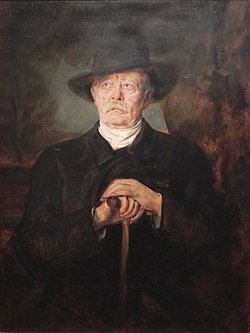
Franz von Lenbach, Fürst Otto von Bismarck, 1895. A realist portrait of Otto von Bismarck during his retirement. Modernist artists largely rejected realism.

The Emergence of the Modern Spirit

As the 20th century approached, the influence of industrialization became apparent in design and architecture. The use of new materials, such as glass and steel, allowed for unprecedented structural possibilities.
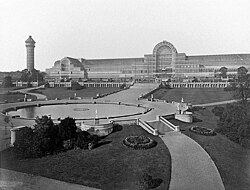
The Crystal Palace at Sydenham (1854). At the time it was built, the Crystal Palace boasted the greatest area of glass ever seen in a building.

In painting, controversy often signaled the birth of new movements. Works that challenged social norms or used "vulgar" subject matter, such as the depiction of courtesans, pushed the boundaries of what was acceptable in public salons.
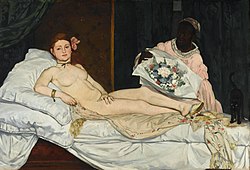
Édouard Manet, Olympia, 1863–65, Oil on canvas, Musée d'Orsay. Olympia's confrontational gaze caused great controversy when the painting was first exhibited at the 1865 Paris Salon, especially as a number of details identified her as a demi-mondaine, or courtesan. These include the fact that the name "Olympia" was associated with prostitutes in 1860s Paris. Conservatives condemned the work as "immoral" and "vulgar".

The Golden Age of Modernism (1901–1945)
London Underground logo designed by Edward Johnston. This is the modern version (with minor modifications) of one that was first used in 1916.

Fauvism and Cubism

At the start of the 20th century, the Paris art world was revolutionized by Fauvism, characterized by "wild," expressive colors and landscapes. Artists like Henri Matisse led this charge, moving away from naturalistic colors to convey emotion.
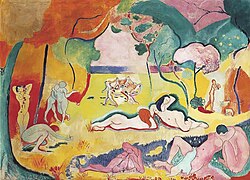
Henri Matisse, Le bonheur de vivre, 1905–1906, Barnes Foundation, Merion, PA. An Early Fauvist masterpiece.

Henri Matisse, The Dance, 1910, Hermitage Museum, St. Petersburg, Russia. At the beginning of the 20th century, Henri Matisse and several other young artists, including the pre-cubist Georges Braque, André Derain, Raoul Dufy and Maurice de Vlaminck revolutionized the Paris art world with "wild", multi-colored, expressive landscapes and figure paintings that the critics called Fauvism. Henri Matisse's second version of The Dance signifies a key point in his career and in the development of modern painting.[71]

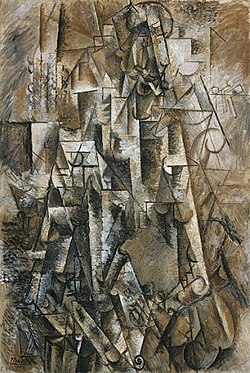
Simultaneously, Cubism emerged, led by Pablo Picasso. This style presented subjects from multiple points of view simultaneously, breaking objects into geometric shapes to challenge the traditional single-perspective view of the world.
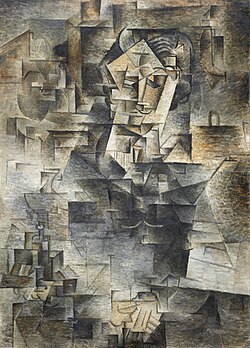
Pablo Picasso, Portrait of Daniel-Henry Kahnweiler, 1910, Art Institute of Chicago

Pablo Picasso, The Poet, 1911, Oil on canvas, Peggy Guggenheim Collection. Proto-Cubism was an early development within modernism that tended to present its subject from multiple points of view.

Other Early 20th Century Movements

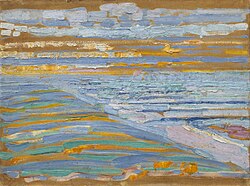
Modernism branched into various directions, including the atmospheric works of Odilon Redon and the early abstract explorations of Piet Mondrian.

Odilon Redon, Guardian Spirit of the Waters, 1878, charcoal on paper, Art Institute of Chicago. Describing his work, Redon explained, "My drawings inspire, and are not to be defined. They place us, as does music, in the ambiguous realm of the undetermined."[66]

Piet Mondrian, View from the Dunes with Beach and Piers, Domburg, 1909, oil and pencil on cardboard, Museum of Modern Art, New York City

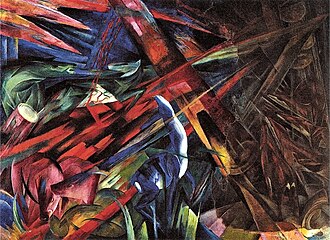
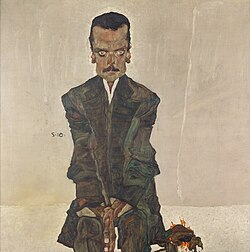
The movement also embraced Expressionism, as seen in the works of August Macke and Egon Schiele, and the bold visions of Franz Marc.
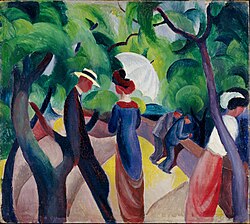
August Macke, Promenade, 1913, Städtische Galerie im Lenbachhaus, Munich

Portrait of Eduard Kosmack (1910) by Egon Schiele

Franz Marc, The fate of the animals, 1913, oil on canvas. The work was displayed at the exhibition of "Entartete Kunst" ("degenerate art") in Munich, Nazi Germany, 1937.

Modern Architecture

Architecture underwent a radical transformation, prioritizing function and clean lines over ornate decoration. Architects like Frank Lloyd Wright integrated structures with their natural surroundings, while Le Corbusier championed the "machine for living" concept.
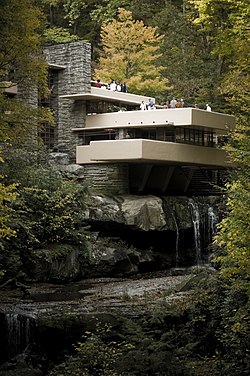
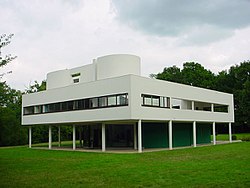
Frank Lloyd Wright, Fallingwater, Mill Run, Pennsylvania (1937). Fallingwater was one of Wright's most famous private residences (completed in 1937).

Le Corbusier, The Villa Savoye in Poissy (1928–1931)

Other influential designs included the Stoclet Palace by Josef Hoffmann and the later, iconic Solomon Guggenheim Museum.
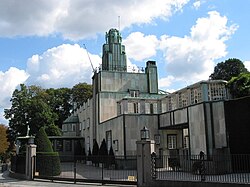
Stoclet Palace (1905–1911) by Modernist architect Josef Hoffmann

Solomon Guggenheim Museum completed in 1959,[14] designed by the American architect Frank Lloyd Wright

Evolution After 1945

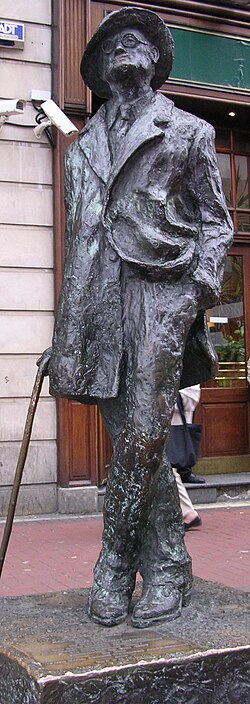
James Joyce statue on North Earl Street, Dublin, by Marjorie FitzGibbon

Abstract Expressionism and Pop Art

Following World War II, the center of the art world shifted. Abstract Expressionism emphasized spontaneous, non-representational creation. This was eventually followed by Pop Art, which drew inspiration from mass culture and commercial imagery, such as the use of Ben Day dots in sculpture.
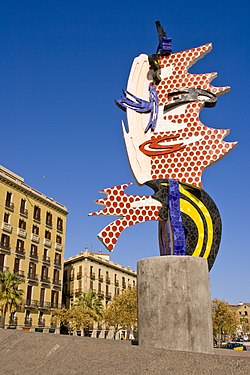
Roy Lichtenstein's sculpture El Cap de Barcelona recreates the appearance of Ben Day dots.

Minimalism and New Media

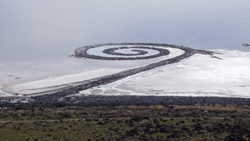
The latter half of the century saw the rise of Minimalism, which stripped art down to its most essential elements, and the emergence of performance art, happenings, and multimedia installations. This era also saw the rise of Land Art, where the environment itself became the medium.

Yves Klein, IKB 191, 1962

Smithson's Spiral Jetty from atop Rozel Point, Utah, US, in mid-April 2005. Created in 1970, it still exists although it has often been submerged by the fluctuating lake level. It consists of some 65,00 tons of basalt, earth and salt.

By the late 20th century, movements like Stuckism emerged as a reaction against the perceived excesses of postmodern art.
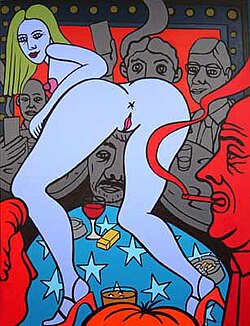
Strip Club, an early Stuckist work by Charles Thompson, who would later co-found the remodernist movement against postmodern art

Summary of Modernist Movements

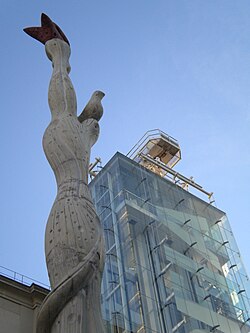
The Museo Nacional Centro de Arte Reina Sofía (MNCARS) is Spain's national museum of 20th-century art, located in Madrid. The photo shows the old building with the addition of one of the contemporary glass towers to the exterior by Ian Ritchie Architects with a closeup of the modern art tower.
Movement Primary Focus Key Example/Figure
Fauvism Bold, non-naturalistic colors Henri Matisse
Cubism Multiple perspectives, geometric forms Pablo Picasso
Surrealism Dream-like, subconscious imagery André Masson
Modern Architecture Functionality, minimalism, new materials Le Corbusier / Frank Lloyd Wright
Pop Art Mass culture and commercialism Roy Lichtenstein

Frequently Asked Questions

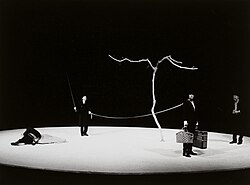
Samuel Beckett's En attendant Godot, (Waiting for Godot) Festival d'Avignon, 1978
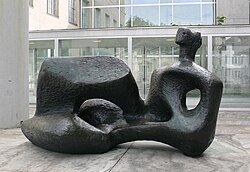
Henry Moore, Reclining Figure (1957). In front of the Kunsthaus Zürich, Switzerland.
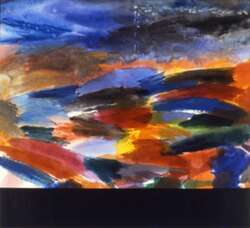
Ronnie Landfield, The Deluge, 1999, acrylic on canvas, 270 by 300 cm (9 by 10 ft)

What is the difference between Modernism and Modernity?

Modernity refers to the sociological period beginning with industrialization, while Modernism is the specific cultural and artistic movement that responded to the conditions of modernity.

How did Cubism change art?

Cubism rejected the traditional perspective of a single viewpoint. Instead, it presented subjects from multiple angles simultaneously, breaking them into geometric components to represent a more complex reality.

What defines Modernist architecture?

Modernist architecture is characterized by a rejection of ornament, an emphasis on function, and the use of industrial materials like reinforced concrete, glass, and steel.

What is the relationship between Modernism and Postmodernism?

While Modernism sought universal truths and purity of form, Postmodernism often critiques these ideals, embracing irony, fragmentation, and a mixture of high and low cultural styles.

Who were the leaders of the Fauvist movement?

Henri Matisse was a central figure, along with other artists such as Georges Braque, André Derain, Raoul Dufy, and Maurice de Vlaminck.

References

  1. Each of the types of repetition that we have examined is not limited to the mass media but belongs by right to the entire history of artistic creativity; plagiarism, quotation, parody, the ironic retake are typical of the entire artistic-literary tradition.Much art has been and is repetitive. The concept of absolute originality is a contemporary one, born with Romanticism; classical art was in vast measure serial, and the "modern" avant-garde (at the beginning of this the 20th century) challenged the Romantic idea of "creation from nothingness," with its techniques of collage, mustachios on the Mona Lisa, art about art, and so on.[7]
  2. The modernist movement which dominated art, music, letters during the first half of the century was, at critical points, a strategy of conservation, of custodianship. Stravinsky's genius developed through phases of recapitulation. He took from Machaut, Gesualdo, Monteverdi. He mimed Tchaikovsky and Gounod, the Beethoven piano sonatas, the symphonies of Haydn, the operas of Pergolesi and Glinka. He incorporated Debussy and Webern into his own idiom. In each instance, the listener was meant to recognize the source, to grasp the intent of a transformation that left salient aspects of the original intact.The history of Picasso is marked by retrospection. The explicit variations on classical pastoral themes, the citations from and pastiches of Rembrandt, Goya, Velázquez, Manet, are external products of a constant revision, a 'seeing again' in the light of technical and cultural shifts. Had we only Picasso's sculptures, graphics, and paintings, we could reconstruct a fair portion of the development of the arts from the Minoan to Cézanne.In 20th-century literature, the elements of reprise have been obsessive, and they have organized precisely those texts which at first seemed most revolutionary. The Waste Land, Ulysses, Pound's Cantos are deliberate assemblages, in-gatherings of a cultural past felt to be in danger of dissolution. The long sequence of imitations, translations, masked quotations, and explicit historical paintings in Robert Lowell's History has carried the same technique into the 1970s. [...] In modernism, collage has been the representative device. The new, even at its most scandalous, has been set against an informing background and framework of tradition. Stravinsky, Picasso, Braque, Eliot, Joyce, Pound—the 'makers of the new'—have been neo-classics, often as observant of canonic precedent as their 17th-century forebears.[78]
  3. In the twentieth century, the social processes that brought this maelstrom into being, and kept it in a state of perpetual becoming, came to be called 'modernization'. These world-historical processes have nourished an amazing variety of visions and ideas that aim to make men and women the subjects as well as the objects of modernization, to give them the power to change the world that is changing them, to make their way through the maelstrom and make it their own. Over the past century, these visions and values have been loosely grouped under 'modernism'.[16]
  4. The ground motive of modernism, Graff asserts, was criticism of the 19th-century bourgeois social order and its world view. Its artistic strategy was the self-conscious overturning of the conventions of bourgeois realism ... the antirationalist, antirealist, antibourgeois program of modernism ... the modernists, carrying the torch of Romanticism, taught us that linearity, rationality, consciousness, cause and effect, naïve illusionism, transparent language, innocent anecdote, and middle-class moral conventions are not the whole story.[44]
  5. Note the parallel French movement Fauvism and the English Vorticism: "The Fauvist movement has been compared to German Expressionism, both projecting brilliant colors and spontaneous brushwork, and indebted to the same late 19th-century sources, especially Van Gogh.[92][93]