Emilio Pettoruti: The Pioneer of Argentine Modernism
Emilio Pettoruti (1892–1971) was a transformative figure in 20th-century Latin American art. An Argentine painter who bridged the gap between European avant-garde movements and the artistic landscape of South America, Pettoruti is best remembered for introducing a rigorous, geometric modernism to a society deeply rooted in traditional aesthetics. His arrival in Buenos Aires in the 1920s acted as a catalyst for a new era of artistic inventiveness, challenging the status quo and opening doors for future generations of artists.
Key Facts
- Born: October 1, 1892, in La Plata, Argentina.
- Died: October 16, 1971, in Paris, France.
- Core Influence: Blended elements of Cubism, Futurism, Constructivism, and Abstraction without adhering to a single label.
- Major Milestone: His 1924 Buenos Aires exhibition caused a public scandal by challenging conservative tastes.
- Notable Role: Served as the director of the Museo Provincial de Bellas Artes in La Plata in 1930.
Early Life and European Education
Born into a prosperous middle-class Italian family in La Plata, Pettoruti was early influenced by the geometric layout and shifting silver tones of his hometown. Though he briefly attended the local Academy of Fine Arts at age fourteen, he soon pivoted to self-directed study. Under the guidance of architect Emilio Coutaret, he mastered caricature portraits—a skill that eventually secured him a travel scholarship to Italy in 1913.
In Florence, Pettoruti immersed himself in the works of Early Renaissance masters such as Giotto, Masaccio, and Fra Angelico. This period instilled in him a lifelong appreciation for geometric proportion, equilibrium, and the influence of Greco-Roman architecture.
While in Europe, Pettoruti engaged with the avant-garde. He discovered Futurism (an artistic movement emphasizing speed, technology, and violence) through the magazine Lacerba and exhibited at the Der Sturm Gallery in Berlin. In Paris, his encounter with Juan Gris pushed him toward Cubism (a style that depicts subjects from multiple viewpoints simultaneously to represent the subject in a greater context).
The Return to Argentina and Artistic Scandal
Pettoruti returned to Argentina in 1924, intending to popularize European Modernism. At the time, the Argentine art scene was dominated by conservative tastes, favoring traditional depictions of gauchos, cattle, and landscapes. His first solo exhibition at the Galeria Witcomb in Buenos Aires, featuring 86 works, was viewed as scandalous by the establishment.
Despite the backlash, fellow artist Xul Solar recognized Pettoruti's work as a stimulating force that would drive the country's future artistic evolution. Pettoruti successfully integrated Latin American themes within a modern, European-inspired stylistic framework, becoming a beacon of inventiveness in the 1920s.
Evolution of Style and Themes
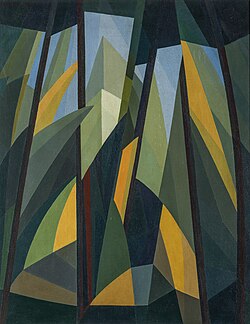
Pettoruti's work is characterized by a near-scientific precision, balancing order and harmony with spiritual lyricism. He resisted being categorized into a single movement, constantly evolving his technique across various mediums, including theater sets, stained glass, and mosaics.
Musicians and Harlequins
A recurring motif in his work is the figure of the musician, often linked to the tango culture of Buenos Aires. In works like Quinteto (1927), these figures are abstracted and their eyes are hidden. He later transitioned to depicting harlequins, using the masked figure as a generalized, anonymous form rather than an individual portrait.
Still Lifes and the Study of Light
Pettoruti's still lifes evolved from simple arrangements of bottles and glasses to the Copa series, which approached total abstraction. In his later works, such as Sol Argentino (1941), light ceased to be a mere tool for illumination and became a concrete, life-giving element of the composition.
The Path to Absolute Abstraction
In his final years, particularly after returning to Europe in 1952, Pettoruti embraced non-objective painting. He focused on the communicative power of color and hard-edged geometric shapes, giving these abstract works romantic titles like Winter in Paris (1955).
Career Milestones and Legacy
Pettoruti's influence extended beyond the canvas. In 1930, he led the Museo Provincial de Bellas Artes in La Plata. His international reach expanded in 1942 during a major exhibition in San Francisco, which led to increased demand from North American museums.
Political tensions eventually forced a change in his trajectory. Due to the conservative direction of the museum under President Juan Perón and the harassment of university staff, Pettoruti returned to Europe in 1952. He spent his final years in Paris, where he wrote his autobiography, Un Pintor Ante el Espejo (A Painter Before the Mirror), in 1968.
| Work Title | Year | Medium | Location/Collection |
|---|---|---|---|
| El Sifón | 1915 | Collage | Museo Nacional de Bellas Artes, Buenos Aires |
| Quinteto | 1927 | Oil on plywood | Private Collection, Buenos Aires |
| Arlequín | 1928 | Oil on canvas | Museo Nacional de Bellas Artes, Buenos Aires |
| Sol Argentino | 1941 | Oil on canvas | Museo Nacional de Bellas Artes, Buenos Aires |
| Invierno en París | 1955 | Oil on canvas | Museo Nacional de Bellas Artes, Buenos Aires |
Frequently Asked Questions
Why was Emilio Pettoruti's 1924 exhibition considered scandalous?
The exhibition was scandalous because it introduced European Modernism to a conservative Buenos Aires art scene that preferred traditional themes like gauchos and rural landscapes over avant-garde geometric abstraction.
Which artistic movements influenced Pettoruti?
Pettoruti was influenced by Cubism, Futurism, Constructivism, and Abstraction, as well as the geometric proportions of 14th-century Italian Renaissance art.
What is the significance of the harlequin in his paintings?
Pettoruti used the harlequin as a device to represent the human figure as an anonymous, remote, and generalized form rather than a specific individual.
Why did Pettoruti leave Argentina for Europe in 1952?
He left due to the conservative shift in museum administration under President Juan Perón and the ongoing harassment and dismissal of university staff.
Did Pettoruti identify as a Cubist or Futurist?
No. Although his work exhibited qualities of these movements, he rejected any specific categorization, preferring to constantly alter his style and maintain artistic independence.