Anselmo Piccoli: The Evolution of an Argentine Abstract Master
Anselmo Piccoli (1915–1992) was a distinguished Argentine artist whose career spanned several decades of stylistic transformation. From his early days as a student in Rosario to his later recognition as a master of abstraction and figurative art, Piccoli's journey reflects the shifting artistic currents of 20th-century Argentina.
Early Life and Artistic Foundations
Born in Rosario, Argentina, in 1915, Piccoli was a politically active Socialist during his secondary school years. His formal artistic journey began at the Gaspary Academy, where he trained as a painter. It was here in 1932 that he met Antonio Berni, a prominent Figurative artist (an artist who represents recognizable objects or figures from the real world), who became a pivotal mentor to the young Piccoli.
The collaboration between the two artists culminated in the 1935 Autumn Art Festival with the presentation of Wounded Man. This mural utilized a unique technique involving lacquer blown through a tube, a process that left a lasting impression on Piccoli regarding the importance of texture in art.
Rise to Prominence and Personal Transition
By 1941, Piccoli's talent was recognized through an award at a competition in Rosario. He further integrated himself into the local art scene by joining the Independent Artists' Group in 1942. His rising profile led to his first solo exhibition at the prestigious Juan B. Castagnino Fine Arts Museum in 1943.
In 1944, Piccoli married Lydia Langbart and moved to Burzaco, a suburb of Buenos Aires. During this period, he prioritized his family life, which led to fewer public exhibitions, though he continued to paint and refine his craft. His excellence was still recognized by the art community, notably in 1954 when a selection of his work was featured at the Emilio Caraffa Fine Arts Museum in Córdoba.
The Shift Toward Constructivism and Figurative Art
Piccoli's style underwent a significant evolution in the late 1950s. In 1959, while painting a portrait of his wife, he began incorporating geometry into his work, signaling a transition toward Constructivism (an art movement focused on geometric abstraction and industrial materials).
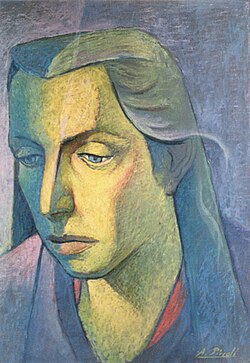
This geometric phase culminated in a 1969 exhibition, marking his first official show as a painter in the Constructivist genre. In the following years, Piccoli became more active in the gallery circuit and began exploring Figurative art once again, a trend popularized in Argentina during the 1970s by artists such as Eduardo Mac Entyre.
Final Years and Legacy
The later stage of Piccoli's career was marked by high critical acclaim. In 1983, the Wildenstein Gallery in Buenos Aires hosted a retrospective of his work. He reached a career pinnacle in 1984, winning the Grand Prize at the National Art Show.
Anselmo Piccoli passed away in 1992 at the age of 76. In 2004, his widow donated his final piece, Rhythms in Aluminum, to the Castagnino Art Museum in Rosario to commemorate the opening of their contemporary art branch.
Key Facts
- Born: September 4, 1915, in Rosario, Argentina.
- Died: July 12, 1992, at age 76.
- Key Mentor: Antonio Berni.
- Major Styles: Abstract, Constructivism, and Figurative art.
- Major Award: Grand Prize at the National Art Show (1984).
- Final Work: Rhythms in Aluminum.
| Year | Event/Achievement | Significance |
|---|---|---|
| 1935 | Exhibited Wounded Man | Collaboration with Antonio Berni; focus on texture. |
| 1943 | First solo exhibition | Held at Juan B. Castagnino Fine Arts Museum. |
| 1959 | Portrait of Lydia | Shift toward geometric Constructivism. |
| 1969 | First Constructivist show | Formal debut in the geometric genre. |
| 1983 | Wildenstein Gallery Retrospective | Comprehensive review of his career. |
| 1984 | National Art Show Grand Prize | Highest national recognition. |
Frequently Asked Questions
Who was Anselmo Piccoli's primary mentor?
Anselmo Piccoli was mentored by Antonio Berni, a well-known Figurative artist whom Piccoli met in 1932 while attending the Gaspary Academy.
What was the significance of the work "Wounded Man"?
Created in 1935 as a collaboration with Antonio Berni, this mural used lacquer blown through a tube, which established a lifelong interest in texture for Piccoli.
When did Piccoli transition to Constructivism?
His transition toward Constructivism became evident in 1959 through the use of geometry in a portrait of his wife, leading to his first exhibition in this genre in 1969.
Which museum holds his final work?
His final work, Rhythms in Aluminum, was donated by his widow to the Castagnino Art Museum in Rosario in 2004.
What major award did he win in the 1980s?
Anselmo Piccoli was awarded the Grand Prize at the National Art Show in 1984.