Cubism: The Avant-Garde Movement That Redefined Visual Art
Cubism was a revolutionary early-20th-century avant-garde art movement that originated in Paris. By breaking away from the traditional requirement of a single perspective, it fundamentally altered the trajectory of painting and visual arts, eventually sparking innovations in architecture, literature, ballet, and music. It is widely regarded as the most influential art movement of the 20th century.
At its core, Cubism involves analyzing, breaking up, and reassembling subjects in an abstract form. Rather than depicting an object from one fixed viewpoint, Cubist artists represent the subject from multiple perspectives simultaneously to provide a more comprehensive context. This approach was heavily influenced by the late works of Paul Cézanne, particularly his representation of three-dimensional forms.
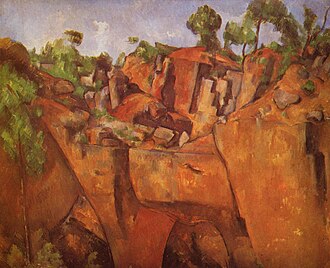
Key Facts
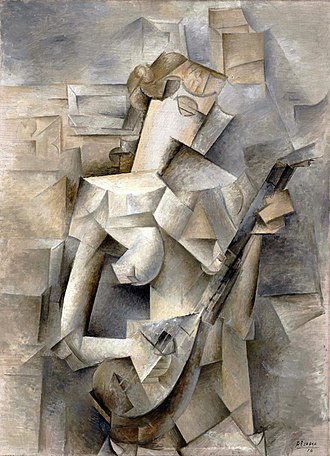
- Founders: Pioneered by Pablo Picasso and Georges Braque.
- Core Concept: Depicting subjects from multiple viewpoints simultaneously rather than a single perspective.
- Origin: Developed in Paris (specifically Montmartre, Montparnasse, and Puteaux) during the 1910s and 1920s.
- Key Figures: Including Jean Metzinger, Albert Gleizes, Robert Delaunay, Juan Gris, and Fernand Léger.
- Global Impact: Influenced architecture (notably in Prague) and design (Art Deco).
The Evolution of Cubism
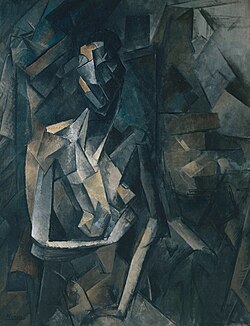
Proto-Cubism (1907–1908)
The movement began to emerge between 1907 and 1911. Pablo Picasso's 1907 work, Les Demoiselles d'Avignon, is frequently cited as a seminal proto-Cubist piece. Around the same time, Georges Braque's 1908 Houses at l'Estaque led critic Louis Vauxcelles to describe the style as bizarreries cubiques (cubic oddities), giving the movement its name.
![Pablo Picasso, Les Demoiselles d'Avignon, 1907, considered to be a major step towards the founding of the Cubist movement[14]](/images/3a/53/3a5367bca4553a38108d601e036dcc683b9b223f617691283354bc893d35de3c.jpg)
Early Cubism and the Paris Salons (1909–1914)
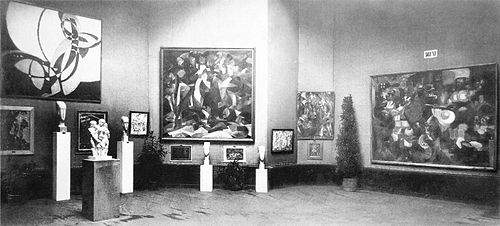
By 1911, Cubism moved from private studios to public exhibitions. The first organized group exhibition took place at the Salon des Indépendants in Paris in "Salle 41," featuring artists like Jean Metzinger and Albert Gleizes, though Picasso and Braque were notably absent from this specific show.
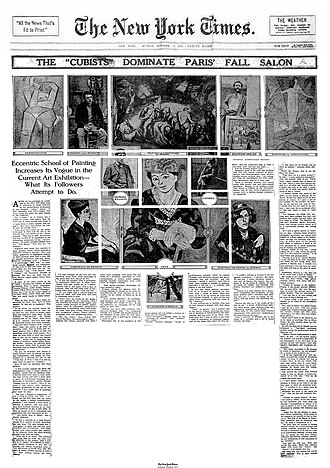
The movement gained further visibility at the Salon d'Automne and through the Section d'Or (also known as the Groupe de Puteaux). This collective of painters, sculptors, and critics held a major exhibition in October 1912 at Galerie La Boétie, which served as a retrospective of Cubist development from 1909 to 1912.
Global Expansion and the Armory Show
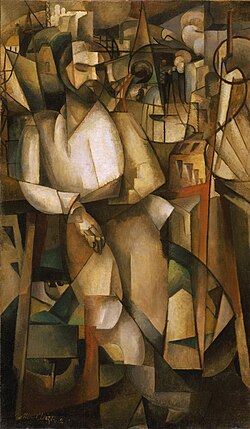
Cubism reached the United States via the legendary 1913 Armory Show in New York City, which later traveled to Boston and Chicago. This event introduced American audiences to European avant-garde styles, including Cubism, Fauvism, and Futurism. Works by Picasso, Marcel Duchamp, and Albert Gleizes were among those that shocked a public accustomed to realistic art.
Styles and Variations
Analytic and Synthetic Cubism
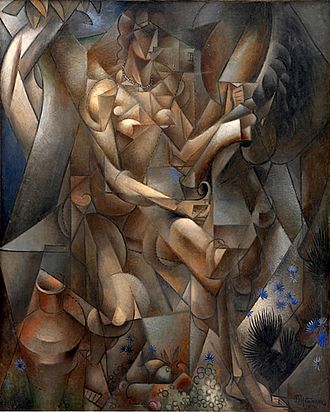
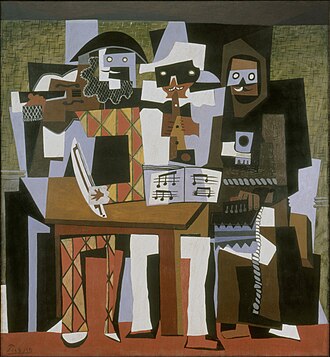
Cubism evolved through different phases. Early works focused on the fragmentation of forms, while later developments led to Synthetic Cubism, which incorporated different materials and simpler shapes. Picasso's Three Musicians (1921) stands as a classic example of this synthetic approach.
![Pablo Picasso, Three Musicians (1921), Museum of Modern Art, New York, USA (MoMA). Three Musicians is a classic example of synthetic cubism.[63]](/images/fa/e4/fae49cfd64127f17edbc2f22758ec01028b057f5121e01858e28afe2479750e5.jpg)
Abstract Cubism
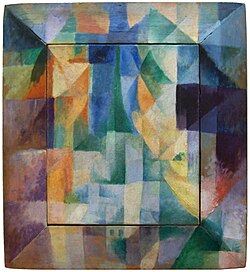
Some artists pushed the movement toward total abstraction. Robert Delaunay's work, such as Simultaneous Windows on the City, exemplifies Abstract Cubism, focusing on color and light.
Beyond the Canvas: Sculpture and Architecture
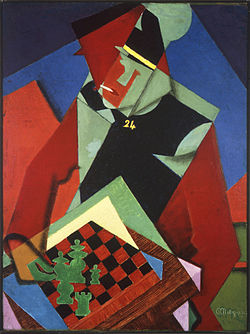
Cubist Sculpture
The principles of fragmentation and multiple perspectives were applied to three-dimensional art. Artists like Joseph Csaky and Raymond Duchamp-Villon translated the faceted language of Cubist painting into bronze and other materials.
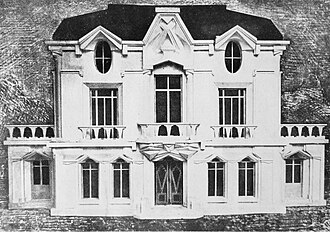
Architecture and Design
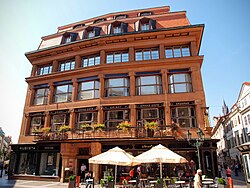
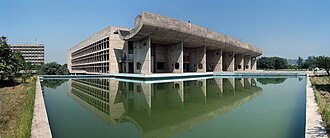
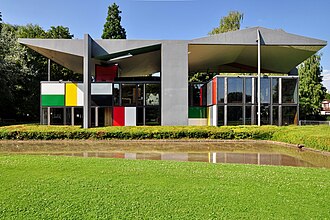
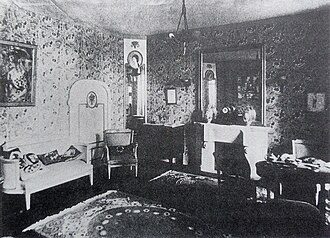
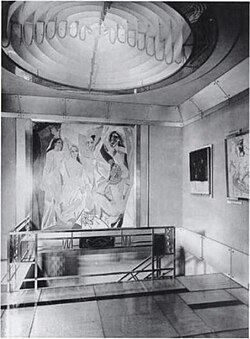
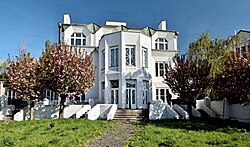
Cubism's influence extended into the built environment. In Prague, a distinct style of Czech Cubist architecture emerged, seen in works like the House of the Black Madonna. In France, the La Maison Cubiste (Cubist House) project demonstrated how the style could be applied to domestic living and decorative arts.
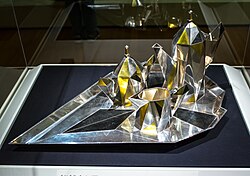
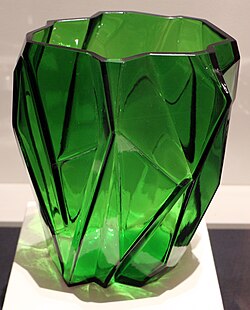
The movement also left a lasting mark on industrial design, influencing the geometric aesthetics of the Art Deco period in the 1920s.
Cubism Summary Table
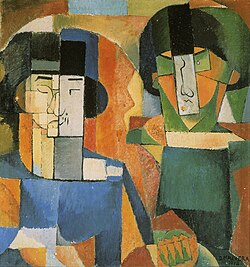
| Category | Details |
|---|---|
| Primary Pioneers | Pablo Picasso, Georges Braque |
| Key Locations | Paris (Montmartre, Montparnasse, Puteaux) |
| Major Influences | Paul Cézanne's 3D forms |
| Key Exhibitions | Salon des Indépendants, Salon d'Automne, Armory Show (1913) |
| Associated Styles | Analytic Cubism, Synthetic Cubism, Orphism, Art Deco |
Frequently Asked Questions
![Juan Gris, Portrait of Pablo Picasso, 1912, oil on canvas, Art Institute of Chicago[66]](/images/d2/26/d226e97ad27cc54d53e5bd738c4fc0cf711f54f2e3f42841049df0d3c28bad2b.jpg)
What is the main goal of a Cubist painting?
The main goal is to represent a subject from multiple perspectives simultaneously, breaking the object into abstract forms to provide a more complete context than a single-point perspective allows.
Who were the primary founders of Cubism?
The movement was pioneered in partnership by Pablo Picasso and Georges Braque, who were later joined by other key artists such as Juan Gris and Jean Metzinger.
How did the Armory Show impact Cubism?
The 1913 Armory Show introduced Cubism and other European avant-garde styles to the American public, sparking widespread astonishment and interest in experimental art in the US.
Did Cubism influence anything other than painting?
Yes, Cubism sparked innovations in sculpture, architecture (particularly in the Czech Republic), literature, ballet, music, and the decorative arts of the Art Deco period.
What is the difference between Proto-Cubism and later Cubism?
Proto-Cubism (roughly 1907–1908) refers to the early experimental works, such as Picasso's Les Demoiselles d'Avignon, that led toward the fully developed fragmented style of the 1910s.