Julio Barragán: The Argentine Master of Cubism and Concrete Art
Julio Barragán was a distinguished Argentine painter whose career spanned nearly six decades, leaving an indelible mark on the 20th-century art scene of Buenos Aires. Known for his versatility and technical precision, Barragán navigated the complex transitions between Concrete art—a form of geometric abstraction that avoids metaphorical references—and Cubism, the revolutionary style that breaks objects into geometric shapes.
Key Facts
- Born: 1928, Buenos Aires, Argentina.
- Died: January 14, 2011, Almagro, Buenos Aires.
- Primary Genres: Concrete art and Cubism.
- Key Influence: Georges Braque and Pablo Picasso.
- Major Award: The Braque Prize (1964) from the Buenos Aires Museum of Modern Art.
- Active Period: 1946–2005.
Early Life and Artistic Foundations
Barragán's journey into the arts began exceptionally early. At just 12 years old, he started studying art by creating reproductions of Renaissance masters, including the influential El Greco. This early discipline provided him with a strong technical foundation before he pursued formal education at the National School of Ceramics. He graduated in 1945 with a technical degree, a period during which he met his future wife, María de las Nieves Adeff, who would later become an accomplished potter in her own right.
His professional debut occurred in 1946 at the National Fine Arts Exhibition. While his initial works were rooted in Realism, Barragán consciously distanced himself from the contemporary genres that had defined the careers of his peers and family members, including his elder brother, Luis Barragán.
Evolution of Style: From Paris to Cubism
A pivotal shift occurred in the late 1940s when Barragán traveled to Paris, France. Immersed in the European avant-garde, he was deeply influenced by the works of Pablo Picasso and Georges Braque. Upon returning to Argentina, he joined the "Twenty Painters and Sculptors" group alongside Oscar Capristo, Bruno Venier, and his brother. This collective was active between 1952 and 1963, exploring various abstract genres.
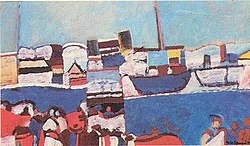
While many of his contemporaries in the group leaned toward surrealism, Barragán entered a Concrete phase. Eventually, his style evolved into a sophisticated form of Cubism characterized by a chiaroscuro tone—the use of strong contrasts between light and dark—which became his artistic trademark.
The "Assembly Line" Method
In his later decades, Barragán focused on cityscapes and landscapes that blended Cubist and Impressionist influences. To manage the increasing demand for his work, he implemented a unique "assembly line" routine at his Villa Urquiza atelier. He arranged several easels in a row, allowing him to alternate randomly between different paintings, ensuring a fluid and dynamic creative process.
Recognition and Legacy
Barragán's work was showcased in the most prestigious galleries in Argentina, including Sotheby's, Wildenstein, Witcomb, and Gutiérrez y Guad, as well as the Eduardo Sívori Museum. His technical mastery earned him numerous accolades, including First Prizes at the National Salon in 1976 and 1978, and the Grand Prize in Painting at the Belgrano Municipal Salon in 1970.
The local art critic Mauricio Neuman famously described Barragán as a "solitary aristocrat of beauty," reflecting the refined and disciplined nature of his compositions. Barragán retired from the Buenos Aires art circuit in 2005 and passed away in 2011 at the age of 82.
| Category | Details |
|---|---|
| Education | National School of Ceramics (Graduated 1945) |
| Key Movements | Realism, Concrete Art, Cubism, Impressionism |
| Notable Group | Twenty Painters and Sculptors (1952–1963) |
| Major Awards | Braque Prize (1964), Belgrano Municipal Salon Grand Prize (1970) |
| Atelier Location | Villa Urquiza, Buenos Aires |
Frequently Asked Questions
What were the primary artistic styles of Julio Barragán?
Julio Barragán is most recognized for his work in Concrete art and Cubism, though his early career began with Realism and his later landscapes incorporated Impressionist influences.
Who were the main influences on Barragán's work?
His style was significantly shaped by the Renaissance masters (such as El Greco) in his youth, and later by the modernists Pablo Picasso and Georges Braque during his time in Paris.
What was the "assembly line" routine in his atelier?
To meet high demand, Barragán set up multiple easels in a row at his Villa Urquiza studio, which allowed him to switch randomly between different artworks during his painting process.
Which awards did Julio Barragán win during his career?
He received the Braque Prize from the Buenos Aires Museum of Modern Art in 1964, the Grand Prize in Painting at the Belgrano Municipal Salon in 1970, and First Prizes at the National Salon in 1976 and 1978.
What is the significance of the "Twenty Painters and Sculptors" group?
This group, active in Argentina from 1952 to 1963, allowed Barragán to collaborate with other artists like Oscar Capristo and Bruno Venier while exploring various abstract and surrealist genres.