Modern Furniture: The Evolution of Minimalist Design and Function
Modern furniture represents a seismic shift in interior design, spanning from the late 19th century to the present day. Influenced by the broader movement of modernism, this era marked a definitive break from the ornate traditions of the past. While previous styles like Victorian, Neoclassical, and Art Nouveau celebrated decorative excess, modern design embraced a philosophy of cutting waste and prioritizing the practical application of materials.
This transition saw dark, gilded carved woods and heavy fabrics replaced by the geometric precision of polished metal and visually light forms. This evolution was driven by new technologies, shifting philosophies, and the principles of modern architecture, which favored machine-like simplicity and the avoidance of unnecessary ornament.
Key Facts
- Core Philosophy: Shifted from furniture as ornament to furniture as a functional, accessible tool.
- Design Mantra: Popularized the concept of "form follows function."
- Key Materials: Introduced industrial materials like chrome-plated tubular steel and moulded polypropylene into the home.
- Major Influences: Shaped by the De Stijl movement, the Deutscher Werkbund, and the Bauhaus school.
- Global Impact: Heavily influenced by Japanese simplicity and the efficiency of factory modules.
The Philosophical Foundations of Modernism
Before the rise of modernism, the value of a piece of furniture was often measured by the time and labor required to create its intricate decorations. The Industrial Revolution changed this trajectory by introducing mechanized production. This technological leap birthed a new philosophy: design should promote functionality, accessibility, and efficient production rather than mere decoration.
The "machine aesthetic" allowed for the use of factory modules, emphasizing efficiency in time, money, and labor. The ultimate goal was to achieve a timeless beauty through spare, mathematical precision.
Influential Movements and Schools
De Stijl
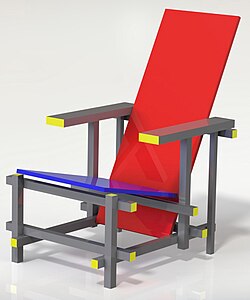
Founded in 1917 by Theo Van Doesburg in Amsterdam, De Stijl (The Style) sought to promote universality through abstraction. By reducing design to its essential forms and colors—specifically primary colors, black, and white—the movement rejected the excesses of Art Nouveau in favor of logical construction.
Deutscher Werkbund
Established in 1907 in Munich, the Deutscher Werkbund was a collective of artists and manufacturers aiming for a cultural utopia. They championed "material honesty" and sustainability, advocating that the form of an object should be dictated by its intended function.
The Bauhaus School
Founded by Walter Gropius in 1919, the Bauhaus school is perhaps the most iconic pillar of modern design. Moving from Weimar to Dessau and finally Berlin before its closure under the Nazi regime, the school sought to unify art, craft, and technology. Bauhaus designers focused on creating high-quality objects that could be mass-produced, making sophisticated design accessible to the general public.
Global Influences: The Impact of Asia and Africa
The move toward minimalism was not solely a European invention. The softening of Japan's isolationist policies during the Edo period introduced the West to Japonism. Japanese design, characterized by solid planes of color, a lack of ornament, and striking simplicity, deeply influenced designers like Frank Lloyd Wright, Eileen Gray, and Charles Rennie MacIntosh.
Iconic Examples of Modern Furniture
The Red-Blue Armchair by Gerrit Rietveld
Created around 1917, this chair exemplifies De Stijl principles. Rietveld used standard beechwood laths and pine planks to create a "skeleton" of a chair, visually separating the seat, back, and armrests to emphasize construction over comfort.
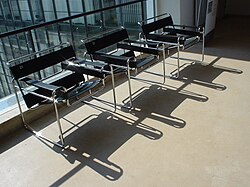
The Wassily Chair by Marcel Breuer
Designed between 1925 and 1926, the Wassily Chair (Model B3) revolutionized domestic furniture by introducing chrome-plated tubular steel. Inspired by the handlebars of his bicycle, Breuer realized that if steel could support a body in motion, it could support one at rest.
Le Corbusier's LC Series
Building on Breuer's use of tubular steel, Le Corbusier created the LC4 Chaise Longue in 1928, featuring an adjustable headrest—an early foray into ergonomic design (design optimized for human comfort and efficiency). He also developed the LC2 sofa, which utilized a steel cage to support loose cushions.
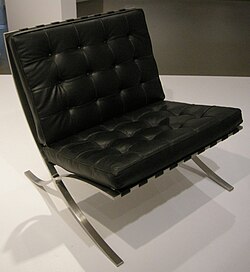
The Barcelona Chair by Mies van der Rohe
Designed for the 1929 Barcelona International Exposition, this piece is often viewed as functional art. Inspired by Roman footstools and Pharaohs' folding chairs, it uses flat steel bars to create a sleek, S-shaped curve.
Other Modern Classics
- Eileen Gray Side Table: A non-conformist, adjustable piece influenced by Japanese lacquer and functionalism.
- Noguchi Coffee Table: Created by Isamu Noguchi, this piece blends organic modern forms with sculptural simplicity.
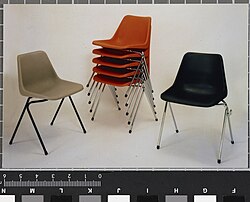
- Polyprop Chair: Designed by Robin Day in 1963, this moulded polypropylene chair became the world's best-selling chair.
Summary of Modern Design Movements
| Movement/School | Origin | Core Focus | Key Characteristics |
|---|---|---|---|
| De Stijl | Netherlands | Abstraction & Universality | Primary colors, vertical/horizontal lines |
| Deutscher Werkbund | Germany | Cultural Utopia | Material honesty, form follows function |
| Bauhaus | Germany | Art & Technology Unity | Mass production, industrial materials |
| Japonism | Japan/Europe | Simplicity | Solid color planes, lack of ornament |
Transitional Design
While modernism defined a specific era, not all contemporary furniture is strictly modern. Transitional design serves as a bridge, blending modern and traditional elements. It often incorporates classical Greek forms or non-Western patterns, such as Asian scrollwork or Tribal African motifs, to create a balanced aesthetic.
Frequently Asked Questions
What does "form follows function" mean?
This principle suggests that the shape and aesthetic of an object should be primarily based upon its intended function, rather than being dictated by decorative trends.
How did the bicycle influence modern furniture?
Marcel Breuer was inspired by the lightweight yet strong chrome-plated tubular steel used in bicycle handlebars, leading him to use the material for the Wassily Chair.
What is the difference between Modern and Mid-Century Modern?
Modern furniture refers to the broad movement starting in the late 19th century. Mid-Century Modern specifically refers to the styles produced roughly between the 1930s and 1960s, often associated with the Bauhaus and post-war ideals.
Why was the Bauhaus school significant?
The Bauhaus was pivotal because it combined intellectual design with practical mass production, aiming to make high-quality, functional art accessible to everyone through industrial technology.
What is transitional furniture?
Transitional furniture is a style that blends elements of both traditional and modern design, often mixing classical forms with minimalist lines.