Mitre Railway: The History and Evolution of an Argentine Icon
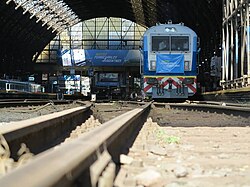
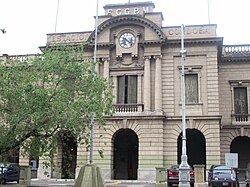
The Ferrocarril General Bartolomé Mitre (FCGBM) stands as one of the most significant railway networks in Argentina. Named after the former president Bartolomé Mitre, this expansive system was forged from the nationalization of foreign-owned lines in 1948. Spanning multiple provinces, it has served as a vital artery for both passenger travel and freight transport, connecting the bustling hub of Buenos Aires with the northern reaches of the country.
From the luxury of long-distance expresses to the daily grind of suburban commuting, the Mitre Railway reflects the broader economic and political shifts of 20th-century Argentina, moving from British and French private ownership to state control and, eventually, a complex system of privatizations and re-nationalizations.
Key Facts
- Official Name: Ferrocarril General Bartolomé Mitre.
- Established: 1948 (via nationalization).
- Primary Termini: Retiro (Buenos Aires) and Tucumán.
- Track Gauges: 1,676 mm (broad gauge) and 1,435 mm (standard gauge for Tren de la Costa).
- Current Operators: Trenes Argentinos (passenger) and Nuevo Central Argentino (freight).
- Coverage: Buenos Aires, Santa Fe, Córdoba, Santiago del Estero, and Tucumán.
The Path to Nationalization
Following World War II, many British and French railway companies in Argentina faced severe financial difficulties. This culminated on March 1, 1948, when the administration of President Juan Perón nationalized all foreign railway companies. This move created the Empresa de Ferrocarriles del Estado Argentino (EFEA), later known as Ferrocarriles Argentinos.
The Mitre Railway was formed by incorporating the broad gauge assets of the British-owned Central Argentine Railway and the northern section of the French-owned Rosario and Puerto Belgrano Railway. This consolidation created a massive network extending from the Retiro terminus in Buenos Aires toward the north.
Regional Evolution and the Rosario Hub
The reorganization of the network led to significant changes in Rosario. The original Rosario and Puerto Belgrano station was closed, and passenger services were moved to Rosario Central. Over time, the old station site was repurposed for the Ciudad Universitaria of Rosario, including the Faculty of Engineering and a school of music.
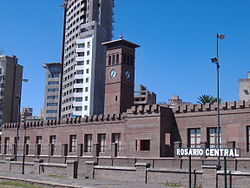
By 1977, most urban passenger services in Rosario were cancelled, and Rosario Norte became the primary terminus. Although a brief attempt was made in 1989 to introduce a "Ferrobús" (a bus chassis remodeled as a train coach) running from Rosario Central to the National Flag Memorial, the service was short-lived and ceased by the end of that year.
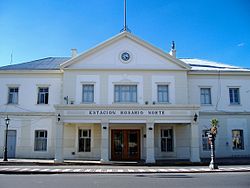
The Buenos Aires Suburban Network
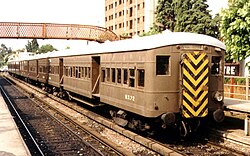
The urban section of the Mitre Railway is renowned for its electrification. In 1916, the 28.3 km branch from Retiro to Tigre was electrified using Metropolitan Vickers coaches, making it the first electric rail line in South America.
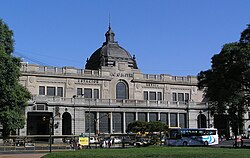
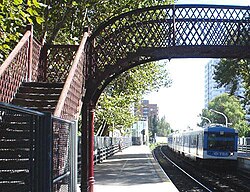
Throughout the mid-20th century, the network saw various upgrades. Under President Arturo Frondizi, the state acquired Toshiba electric coaches from Japan, which required the installation of new elevated platforms at stations to accommodate their specific structure. Meanwhile, services to Zárate and Campana were operated using diesel locomotives from the US company ALCO.
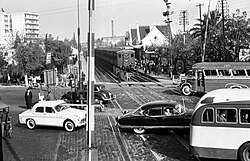
The Rise and Fall of Tren de la Costa
In 1990, a project to reopen the Mitre-Delta branch led to the creation of Tren de la Costa. This light rail system, operated by a private company, focused on tourism and commercial development. It featured stations designed as shopping malls and utilized two-car train sets from the Spanish company CAF.
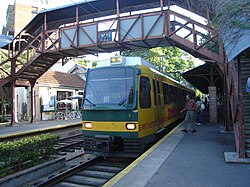
The service opened officially in April 1995 and was accompanied by the development of Parque de la Costa, a major amusement park, and the Trillenium Casino. However, economic crises in Mexico (1994) and Asia (1997) led to a decline in passengers. Because it was categorized as a tourism train, it was ineligible for government subsidies, eventually leading the state to revoke the concession and take over operations via SOFSE.
The Buenos Aires-Tucumán Express
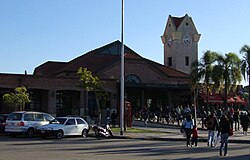
Launched in 1969, the Buenos Aires-Tucumán Express was a pinnacle of Argentine rail luxury. Covering 1,156 km in approximately 15 hours, the service featured air conditioning, a restaurant, and ambient music.
The success of the Express was supported by massive infrastructure investments, including 357 km of new tracks in Santiago del Estero and the use of 3,700 tons of rail produced by the local company Somisa. It became one of the most emblematic services of Ferrocarriles Argentinos.
Modern Management and Freight Services
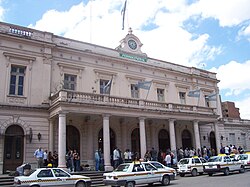
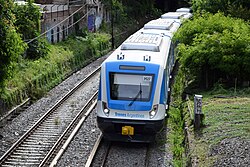
The 1990s brought a wave of privatization under President Carlos Menem. In 1992, the urban passenger services (the Mitre Line) were conceded to Trenes de Buenos Aires (TBA). While initial investments were high—including the introduction of air-conditioned "Puma" coaches—service quality declined due to budget cuts and lack of investment. Following the 2012 Once station disaster, the concession was revoked, and the line eventually transitioned to state operator UGOFE and later Corredores Ferroviarios S.A. In 2014, new rolling stock from the Chinese company CSR Corporation Limited was introduced.
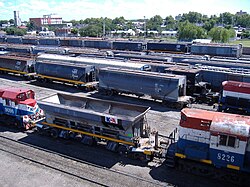
Freight services were handled differently. In 2002, the government awarded the operation and maintenance of the Mitre freight lines to Nuevo Central Argentino (NCA). NCA took over a system in significant disrepair, with only 45% of the tracks operational and a fraction of the locomotives in working order. Today, NCA continues to manage freight across 4,512 km of track.
| Feature | Details |
|---|---|
| Primary Gauge | 1,676 mm (Broad Gauge) |
| Key Termini | Retiro and Tucumán |
| Passenger Operator | Trenes Argentinos |
| Freight Operator | Nuevo Central Argentino (NCA) |
| Notable Service | Buenos Aires-Tucumán Express |
| Tourist Branch | Tren de la Costa |
Frequently Asked Questions
When was the Mitre Railway nationalized?
The railway was nationalized on March 1, 1948, under the administration of President Juan Perón, as part of the creation of Ferrocarriles Argentinos.
What was the significance of the Retiro-Tigre branch?
Electrified in 1916 with Metropolitan Vickers coaches, the Retiro-Tigre branch was the first electric rail line in South America.
What happened to the Tren de la Costa service?
Originally a private tourist venture, it suffered from declining ridership following international economic crises. Because it was not classified as public transport, it received no subsidies, leading the Argentine government to revoke the concession and take over the line.
Who currently operates the freight services on the Mitre line?
Freight services are operated by the private company Nuevo Central Argentino (NCA), which was awarded the concession in 2002.
What was the Buenos Aires-Tucumán Express?
It was a luxury long-distance service launched in 1969 that connected the two cities in 15 hours, featuring high-end amenities like air conditioning and a restaurant.