Miridae: The Diverse World of Plant Bugs
The Miridae, commonly known as plant bugs, leaf bugs, or grass bugs, represent one of the most expansive and varied families within the suborder Heteroptera (true bugs). Formerly referred to by the taxonomic synonym Capsidae, these insects are found globally and are recognized for their significant impact on both agriculture and natural ecosystems.
With over 10,000 known species distributed across more than 1,300 genera, the Miridae family is the largest among the true bugs. While many are notorious for damaging crops, others play a vital role in nature as predators, helping to manage pest populations.
Key Facts
- Species Count: Over 10,000 known species.
- Size: Generally small, terrestrial insects measuring less than 12 millimeters in length.
- Identifying Feature: The presence of a cuneus (a triangular tip on the forewing).
- Diet: Primarily sap-feeders, though some species are predatory.
- Taxonomy: Part of the order Hemiptera and superfamily Miroidea.
Physical Characteristics and Identification
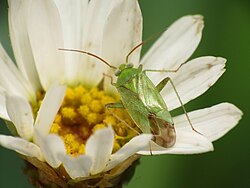
Mirids are typically oval or elongate in shape. A distinctive physical trait is the shape of the prothorax, which often gives the insect a "hunched" appearance because it causes the head to bend downward. Their coloration varies wildly; some species are brightly patterned to attract or warn, while others are drab and inconspicuous. Interestingly, some genera have evolved to mimic ants during specific life stages.
From a technical standpoint, Miridae are distinguished by the absence of ocelli (simple eyes) and a rostrum (piercing mouthpart) consisting of four segments. Their tarsi, or feet, almost always possess three segments.
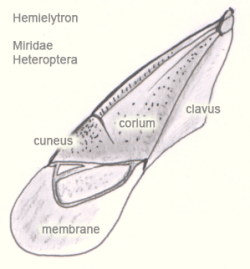
The most reliable way to identify a member of this family is the cuneus. This is the triangular tip of the corium, which is the hardened, sclerotized section of the hemelytron (the forewing). While a few other Hemiptera, such as the Anthocoridae, also possess a cuneus, it is a hallmark of the Miridae family.
Ecological Roles and Notable Species
The Miridae family is split between species that act as herbivores and those that act as predators. Many plant-feeding mirids are agricultural pests that pierce plant tissues to feed on sap, sometimes transmitting viral diseases in the process.
Agricultural Pests
- Lygus bugs: Including the western tarnished plant bug, these are major threats to alfalfa, strawberry, and cotton industries.
- Apple dimpling bug (Campylomma liebknechti): Specifically targets apple blossoms and developing fruit.
- Mosquito bugs (Helopeltis and Afropeltis spp.): Infest cacao, tea, and cotton.
- Green mirid (Creontiades dilutus): A generalist that damages various field crops.
- Potato capsid (Closterotomus norwegicus): A significant pest of clover and potato plants in New Zealand.
Beneficial Predators
Not all mirids are pests. Some species are utilized in biological pest control because they prey on other harmful insects. For example, Deraeocoris nebulosus is used to control scale insects and mites, while Dicyphus hesperus preys on red spider mites and whiteflies.
Systematics and Classification
The taxonomic structure of Miridae is complex, involving numerous subfamilies and tribes. The primary subfamilies include:
- Bryocorinae
- Cylapinae
- Deraeocorinae
- Isometopinae
- Mirinae
- Orthotylinae
- Phylinae
- Psallopinae
The subfamily Psallopinae, established by Schuh in 1976, includes genera such as Psallops and Isometopsallops, as well as extinct genera like Cylapopsallops.
| Common Name / Species | Primary Target | Role |
|---|---|---|
| Lygus bugs | Cotton, Strawberry, Alfalfa | Agricultural Pest |
| Apple dimpling bug | Apple blossoms/fruit | Agricultural Pest |
| Green mirid | Field crops | Agricultural Pest |
| Deraeocoris nebulosus | Mites, Scale insects | Biocontrol Agent |
| Dicyphus hesperus | Whitefly, Red spider mites | Biocontrol Agent |
Frequently Asked Questions
What is a cuneus and why is it important?
The cuneus is a triangular section at the tip of the corium (the hardened part of the forewing). It is a critical diagnostic feature used by entomologists to identify members of the Miridae family.
Are all plant bugs harmful to crops?
No. While many Miridae are pests that feed on sap and transmit viruses, several species are predatory and are used as biological control agents to kill other pests like mites and whiteflies.
How large do Miridae typically grow?
Most species in this family are small, terrestrial insects that generally measure less than 12 millimeters (0.5 inches) in length.
What is the difference between Miridae and Capsidae?
There is no biological difference; Capsidae is a taxonomic synonym for Miridae. The family was once known as Capsidae but is now primarily referred to as Miridae.
Do Miridae have simple eyes?
No, members of the Miridae family do not have ocelli, which are the simple eyes found in many other insect groups.