Aphids: The Ancient and Complex World of Sap-Sucking Insects
Aphids are a diverse group of small, sap-sucking insects that have played a significant role in Earth's ecosystems for millions of years. Belonging to the order Hemiptera, these insects are characterized by their specialized mouthparts designed to pierce plant tissues and extract nutrient-rich fluids. While often viewed through the lens of agriculture as troublesome pests, aphids possess a biological complexity—ranging from intricate reproductive cycles to unique symbiotic relationships—that makes them a fascinating subject of scientific study.
![Probable etymology of 'aphis' by misreading Greek κόρῐς as αφῐς[2]](/images/8c/cb/8ccb3b2fe48d04190e363755908d27cd58c6b91cd9eee74c49022e08879e5650.webp)
Key Facts
- Temporal Range: Aphids have existed from the Permian period to the present day.
- Diet: They primarily feed on plant fluids, specifically phloem sap.
- Reproduction: Many species can alternate between asexual and sexual reproduction.
- Symbiosis: They maintain vital relationships with internal bacteria and external ants.
- Economic Impact: They are significant agricultural pests due to their feeding habits and ability to transmit plant diseases.
Evolutionary History and Taxonomy
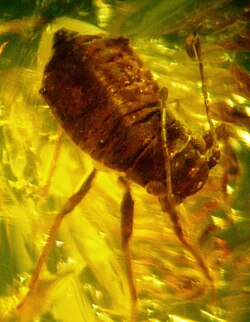
The fossil record reveals that aphids are an ancient lineage. Evidence of aphid-like insects dates back to the Middle Triassic, as seen in fossils such as Vosegus triassicus. Throughout geological history, various extinct families have existed, including the Bajsaphididae and Canadaphididae, contributing to the rich evolutionary tapestry of the superfamily Aphidoidea.
![Forewing of the early Middle Triassic (early Anisian) aphid Vosegus triassicus[8]](/images/5c/8b/5c8ba09272dd9d387eb38bcc80ba306fb5b5c3f60cf6d36025749cdcb91c01f4.jpg)
Taxonomically, aphids belong to the class Insecta and the suborder Sternorrhyncha. The most prominent family is Aphididae, which contains the vast majority of living species. Their evolutionary journey has seen rapid radiation, particularly during the Cretaceous period, as they diversified alongside their host plants.
Anatomy and Feeding Mechanisms
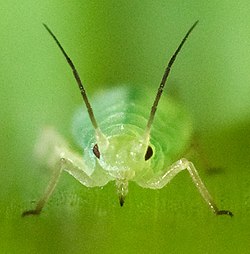
The most defining physical characteristic of an aphid is its mouthparts. They possess specialized piercing-sucking structures that allow them to penetrate plant cell walls to reach the phloem, the tissue responsible for transporting sugars throughout the plant.
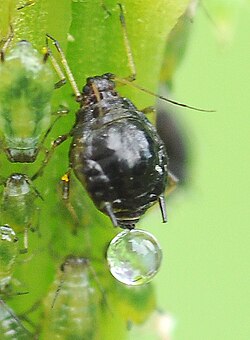
As they feed, aphids excrete a sugary substance known as honeydew. This liquid is a byproduct of their high-sugar diet and is expelled from the anus. While honeydew can coat leaves and encourage the growth of sooty mold, it also serves as a primary food source for other organisms, including ants.
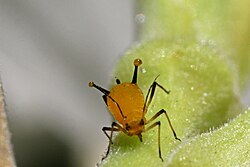
To defend themselves, many aphids possess cornicles—small tube-like structures on their abdomen. These organs can secrete defensive fluids to deter predators, though they are distinct from the digestive process of honeydew excretion.
Complex Life Cycles and Reproduction
Aphids are renowned for their remarkable reproductive strategies. Many species exhibit parthenogenesis, a form of asexual reproduction where females give birth to live young without the need for mating. This allows populations to explode rapidly when environmental conditions are favorable.
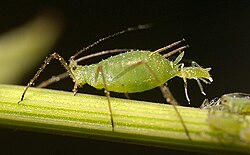
Some species, such as the soybean aphid, utilize a complex life cycle that involves alternating between different host plants and switching between asexual and sexual reproduction. This flexibility helps them exploit seasonal changes and diverse environments.
![Soybean aphid alternates between hosts and between asexual and sexual reproduction.[52]](/images/0f/9d/0f9d869e0a00917a663d3f606aefaefbd35ad680847a6ffa6f1da1bd6c4ed9c4.gif)
The various stages of development, from nymphs to adults, are critical to their survival and population dynamics. For example, the green apple aphid undergoes distinct life stages that are essential for its seasonal progression.
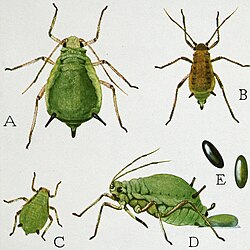
Ecological Interactions and Symbiosis
Aphids do not live in isolation; they are central players in complex ecological webs. One of the most notable interactions is ant mutualism. Ants often "tend" aphids, protecting them from predators in exchange for the energy-rich honeydew the aphids produce.
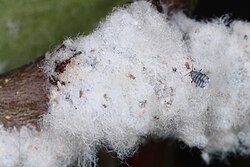
Beyond insects, aphids maintain an essential internal relationship with endosymbiotic bacteria, such as Buchnera. These bacteria live inside the aphid's cells and provide essential nutrients that the aphid cannot obtain from plant sap alone, such as certain amino acids.
However, aphids are also preyed upon. They face threats from various predators and parasitoids—insects, such as certain species of wasps, that lay their eggs inside the aphid, eventually killing the host. Fungal pathogens also play a role in regulating aphid populations in the wild.
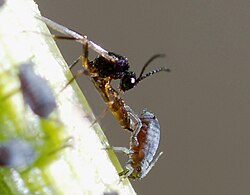
In summary, the aphid's existence is a delicate balance of feeding, defending, and reproducing within a highly interconnected biological network.
Summary of Aphid Characteristics
| Feature | Description |
|---|---|
| Order | Hemiptera |
| Primary Diet | Plant phloem sap |
| Key Byproduct | Honeydew (sugary excretion) |
| Reproduction | Asexual (parthenogenesis) and sexual |
| Defense Mechanisms | Cornicle secretions and alarm pheromones |
Frequently Asked Questions
How do aphids feed on plants?
Aphids use specialized piercing-sucking mouthparts to penetrate plant tissues and reach the phloem, where they extract nutrient-rich sap.
What is honeydew?
Honeydew is a sugary liquid excreted by aphids from their anus as a byproduct of processing large amounts of plant sap.
Why are aphids considered pests?
They are considered pests because they can damage crops by feeding on plant nutrients and can also act as vectors for various plant diseases.
Do aphids reproduce sexually?
Yes, while many species can reproduce asexually through parthenogenesis, some species also utilize sexual reproduction as part of their complex life cycles.
What are cornicles used for?
Cornicles are small tubes on the aphid's abdomen used to secrete defensive fluids to ward off potential predators.