Minor Scales: Types, Theory, and Musical Applications
In music theory, a minor scale is a sequence of notes characterized by a third scale degree that is a minor third above the tonic (the starting note). While the notes A–B–C–D–E–F–G serve as the prototypical example, the minor scale exists in several variations, each offering a distinct emotional quality and harmonic function.
Depending on the musical context—whether it be a classical symphony, a jazz improvisation, or a heavy metal solo—composers utilize different types of minor scales to resolve tension and create melody. The three most common variations are the natural, harmonic, and melodic minor scales.
Key Facts
- Defining Feature: A minor scale is defined by its minor third interval above the tonic.
- Three Primary Types: Natural, harmonic, and melodic minor scales are the standard variations.
- Relative Keys: The natural minor scale shares the same key signature as its relative major scale (e.g., A minor and C major).
- Leading Tone: The harmonic and melodic minor scales were developed to provide a stronger "leading tone" for more satisfying musical resolutions (cadences).
- Modes: The Aeolian, Phrygian, and Dorian modes are all examples of minor scales.
The Natural Minor Scale
The natural minor scale is the diatonic Aeolian mode. On a piano, this is most easily demonstrated by playing the white keys from A to A (A–B–C–D–E–F–G). Because it shares the same collection of notes as the C major scale, A natural minor is considered the relative minor of C major; the major scale always sits a third above its relative minor.
Structurally, the natural minor scale consists of two semitones and five whole tones. While these are the same intervals found in the major scale, the starting point changes the resulting harmonies. In A natural minor, the tonic (A–C–E), subdominant (D–F–A), and dominant (E–G–B) chords are all minor. This lack of a leading tone—a note that pulls strongly toward the tonic—often made it difficult for early composers to create a satisfying cadence, leading to the development of the harmonic and melodic variations.
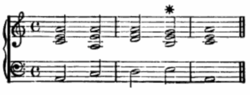
The Harmonic Minor Scale
To solve the problem of the missing leading tone, composers created the harmonic minor scale by raising the seventh scale degree. This modification creates a strong pull toward the tonic but introduces an augmented second (a wider interval) between the sixth and seventh degrees.
This scale is a staple of classical music, appearing in works such as Wolfgang Amadeus Mozart's Piano Sonata No. 16. Ludwig van Beethoven utilized the upper tetrachord (the top four notes) of the harmonic minor to increase chromaticism and tonal ambiguity in pieces like the Grosse Fuge. Nikolai Rimsky-Korsakov viewed this scale as a fundamental basis of harmony and further expanded the concept with the "harmonic major scale," which features a lowered sixth.
Beyond classical music, the harmonic minor is found in spirituals like "Go Down Moses" and "Soon I Will Be Done." In modern music, "shred" guitarists like Yngwie Malmsteen use it to move beyond the standard blues scale, while heavy metal guitarists often center the scale around the dominant to create a Phrygian flavor.
Specialized Variations
- Hungarian Minor: A harmonic minor scale with a raised 4th degree.
- Neapolitan Minor: A harmonic minor scale with a lowered 2nd degree.
The Melodic Minor Scale
Because the augmented second in the harmonic minor can sound melodically awkward, the melodic minor scale was developed to smooth out the voice leading. This scale is unique because it changes depending on the direction of the melody:
- Ascending: Both the sixth and seventh degrees are raised (matching the major scale), leaving only the third degree lowered. This version is often called the jazz minor scale.
- Descending: The sixth and seventh degrees return to their natural minor positions.
Because these alterations happen frequently, they are often treated as diatonic rather than requiring constant accidentals in the sheet music. A notable example of the melodic minor in popular music is found in Elton John's "Sorry Seems to Be the Hardest Word."
Other Minor-Type Scales
Any scale featuring a minor third or a minor tonic triad can be classified as minor. The Dorian and Phrygian modes are prominent examples. Additionally, gapped scales—such as the minor pentatonic scale—are considered incomplete versions of the minor scale.
| Scale Type | Key Characteristic | Primary Use/Context |
|---|---|---|
| Natural Minor | Diatonic Aeolian mode | Foundational tonal music, relative to major keys |
| Harmonic Minor | Raised 7th degree | Classical music, Heavy Metal, Spirituals |
| Melodic Minor | Raised 6th and 7th (ascending) | Jazz, sophisticated voice leading in classical |
Frequently Asked Questions
What is the difference between a natural minor and a harmonic minor scale?
The natural minor scale follows the diatonic Aeolian mode. The harmonic minor scale raises the seventh note of the natural minor scale to create a leading tone, which provides a stronger resolution to the tonic.
Why does the melodic minor scale change when descending?
The ascending version raises the sixth and seventh degrees to improve the melodic flow and voice leading. When descending, these notes are lowered back to the natural minor positions because the strong pull toward the tonic is no longer required.
What is a relative minor scale?
A relative minor scale is a minor scale that shares the same key signature (the same set of sharps or flats) as a specific major scale. For example, A minor is the relative minor of C major.
Which minor scale is used in jazz?
The ascending melodic minor scale is frequently used in jazz and is often referred to as the "jazz minor scale."
What are the Dorian and Phrygian modes?
The Dorian and Phrygian modes are types of minor scales because they feature a minor third, though they differ from the natural minor scale in their other interval structures.