Military Junta: Governance, History, and Global Impact
A military junta is a system of government led by a committee of military leaders. Derived from the Spanish word for "meeting" or "committee," the term originated during the Spanish resistance to Napoleon's 1808 invasion. In modern political contexts, it describes an authoritarian government where a dominant group of military officers holds primary political power.
Key Facts
- Origin: The term comes from Spanish resistance committees formed in 1808.
- Power Acquisition: Juntas typically seize power through a coup d'état (a sudden, violent, or illegal seizure of power from a government).
- Structure: Unlike a single dictator (strongman), a junta is governed by a committee of high-ranking officers.
- Governance Styles: They may rule openly by decree or through "disguised rule" using puppet civilian governments.
- Outcomes: Research suggests military regimes are more likely to end in democratization than the rule of individual military strongmen.
How Military Juntas Exercise Power
When a junta takes control, it generally adopts one of two primary governance models: open rule or disguised rule.
Open Rule
In an open rule system, the junta formally establishes itself as the nation's governing body. In this capacity, the committee possesses the authority to rule by decree, bypassing traditional legislative processes.
Disguised Rule
Disguised rule occurs when the military exercises binding, though informal, control over a nominally civilian government. This typically manifests in two ways:
- Civilianization: The junta removes obvious military markers to appear civilian. This may include ending martial law, swapping uniforms for civilian clothes, and placing former officers in key government roles.
- Indirect Rule: The junta maintains concealed, behind-the-scenes control over a civilian puppet. This control can be comprehensive or limited to specific sectors, such as national security.
Historical Patterns and Regional Trends
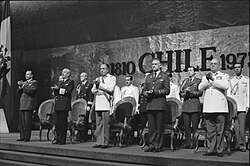
Throughout the 20th century, military juntas were prevalent in Latin America. These were often "institutionalized" or "corporate" juntas, consisting of the commanding officers from the army, navy, and air force, and occasionally the national police.
Political scientist Samuel Finer noted a distinct difference in size: while the median junta globally had 11 members, Latin American juntas were typically smaller, consisting of only three or four members.
Historians distinguish between two types of military takeovers:
- Corporate Coups: Carried out by the armed forces as a professional institution, led by senior commanders.
- Factional Coups: Carried out by a specific segment of the military, often led by mid-ranking officers.
Comparative Analysis: Regimes vs. Strongmen
A 2014 study in the Annual Review of Political Science highlighted critical differences between military regimes (led by a group) and military strongmen (single dictators). The findings revealed that:
- Both strongmen and military regimes are more prone to human rights abuses and civil wars than civilian dictatorships.
- Military strongmen are more likely to initiate international wars, potentially due to a greater fear of exile, imprisonment, or assassination following their removal.
- Military regimes and civilian dictatorships have a higher probability of transitioning toward democratization, whereas the rule of strongmen often ends via invasion, popular uprising, or insurgency.
Global Examples of Military Rule
Military juntas have appeared across various continents and eras. The following table summarizes notable historical and recent examples.
| Region | Notable Examples | Timeframes/Contexts |
|---|---|---|
| Africa | Ethiopia (Derg), Nigeria, Libya, Mali | Various (e.g., Derg 1974–1987) |
| Americas | Chile, Argentina, Brazil, Paraguay | Various (e.g., Chile 1973–1990) |
| Asia | Myanmar, Pakistan, South Korea, Thailand | Various (e.g., South Korea 1962–1979) |
| Oceania | Fiji | 2006–2014 |
Frequently Asked Questions
What is the difference between a junta and a military dictatorship?
While both involve military control, a junta specifically refers to a government led by a committee or group of officers, whereas a military dictatorship may be led by a single individual, known as a military strongman.
How does a junta typically come to power?
Most juntas seize power through a coup d'état, which is the sudden and often illegal overthrow of an existing government.
What is "civilianization" in the context of a junta?
Civilianization is a form of disguised rule where a junta removes its military appearance—such as wearing civilian clothes and ending martial law—while maintaining actual political dominance.
Are military regimes more likely to start wars than civilian dictators?
According to research, military strongmen (single dictators) are more likely to start international wars. However, both military regimes and strongmen are more likely to be involved in civil wars and human rights abuses than civilian dictatorships.
Do military juntas usually lead to democracy?
Research indicates that military regimes (group-led) are more likely to end in democratization compared to the rule of military strongmen, which more frequently ends in insurgency or popular uprising.