Military Corps: Evolution, Structure, and Global Applications
The term corps (derived from the French corps and Latin corpus, meaning "body") refers to a variety of organizational structures within military and civil service. While it can describe a specialized administrative group, in a tactical sense, it represents a powerful operational formation capable of independent action on the battlefield.
The modern concept of the field corps was a military innovation pioneered by Napoleon Bonaparte. Formally introduced on March 1, 1800, when Napoleon ordered General Jean Victor Marie Moreau to divide his command into four corps, this structure became a cornerstone of Napoleon's early imperial victories. While earlier attempts at similar divisions existed—such as Jourdan's Army of Sambre and Meuse in 1795—these were temporary and lacked the legal status and skillful organization that Napoleon later perfected by 1805.
Key Facts
- Origin: Formally introduced by Napoleon in 1800 to create flexible, permanent operational formations.
- US DoD Scale: Typically consists of two to five divisions, totaling between 40,000 and 80,000 personnel.
- Versatility: Can function as an operational field formation or as a specialized administrative body.
- Global Variations: Equivalent structures include the PLA's "group army" and the US Marine Corps' "Marine Expeditionary Force" (MEF).
Operational Formations
An operational formation, or field corps, is a large military unit consisting of two or more divisions. This structure allows a commander to manage vast numbers of troops while maintaining the ability to maneuver independently.
The United States Experience
The US Army first legalized field corps during the American Civil War via an act of Congress on July 17, 1862. In the Union Army, a corps typically averaged three divisions and approximately 36,000 soldiers. The Confederate States Army also authorized corps in November 1862, often fielding larger units than the Union; for example, all Confederate corps at the Battle of Gettysburg exceeded 20,000 men.
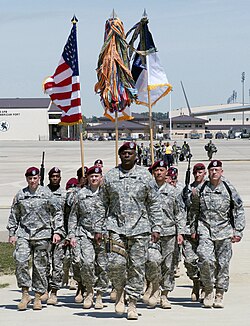
In the modern era, the US Army maintains active field corps including I Corps, III Corps, and XVIII Airborne Corps, with V Corps reactivated in 2020 to strengthen the US presence in Europe.
Global Implementations
- Australia and New Zealand: The Australian and New Zealand Army Corps (ANZAC) was raised in 1914, famously fighting at Gallipoli in 1915. Later, the Australian Corps united five infantry divisions on the Western Front under Lieutenant General Sir John Monash.
- China: The National Revolutionary Army (NRA) used corps as basic tactical units during the Second Sino-Japanese War. In the modern People's Liberation Army (PLA), the group army is the closest equivalent, typically consisting of six combined arms brigades and approximately 30,000 combat troops.
- Russia and Europe: Russia officially introduced corps in 1810 under Emperor Alexander I. Following the Battle of Ulm in 1805, most European armies adopted the formation, with Prussia introducing it formally in 1816 to increase war readiness.
Specialized Corps Structures
Beyond standard army corps, other specialized formations exist. The US Marine Corps utilizes the Marine Expeditionary Force (MEF), a self-contained air-ground task force consisting of a headquarters group, a Marine division, a Marine aircraft wing, and a Marine logistics group.
The Soviet Union also developed Air Defence Corps (later air defence corps areas), which integrated anti-aircraft artillery, searchlight regiments, and eventually fighter aviation and missile formations to protect industrial centers.
Administrative and Non-Military Corps
Not all corps are tactical combat formations. Many nations use the term for administrative corps—specialized branches that provide essential services to the wider military.
| Country | Examples of Administrative Corps |
|---|---|
| United Kingdom | Intelligence Corps, Royal Logistic Corps, Royal Corps of Signals |
| India | Army Medical Corps, Corps of Engineers, Army Ordnance Corps |
| United States | Examiner Corps (Patent Examiners - Non-military) |
| United Kingdom | Royal Observer Corps (Civil Defence, 1925–1995) |
Frequently Asked Questions
What is the typical size of a military corps?
While sizes vary by nation and era, the US Department of Defense defines a corps as consisting of two to five divisions, with a personnel count ranging from 40,000 to 80,000.
Who invented the modern military corps system?
Napoleon Bonaparte is credited with the innovation. He formally introduced the system on March 1, 1800, allowing for more flexible and permanent command structures than previous temporary divisions.
How does a Marine Expeditionary Force (MEF) differ from a standard army corps?
A MEF is a self-contained Marine air-ground task force. It integrates a Marine division, an aircraft wing, and a logistics group, allowing it to operate independently across air, land, and sea.
What is an administrative corps?
An administrative corps is a specialized branch of the military focused on a specific function—such as medicine, signals, or intelligence—rather than being a tactical combat formation like a field corps.
Did the American Civil War use the corps system?
Yes. Both the Union and Confederate armies utilized corps. The Union legalized them in July 1862, while the Confederates authorized them in November 1862.