Military Commissions: Formal Appointments Across Global Armed Forces
A military commission is a formal legal document that appoints an individual as an officer in a nation's armed forces. Unlike enlisted personnel, commissioned officers hold their authority from a head of state or a designated government authority, granting them the legal power to command subordinates and exercise discipline. While the modern era has seen a shift toward contractual employment in some nations, the tradition of the written commission remains a cornerstone of military hierarchy in many parts of the world.
Key Facts
- Canada: Commissions are signed by the Governor General and countersigned by the Minister of National Defence on behalf of the King.
- United Kingdom: Modern commissions are issued in the name of the Sovereign and notifications are published in the London Gazette.
- United States: Under Article II, Section 3 of the Constitution, the President commissions all officers of the United States.
- Sweden: Transitioned from royal commissions to a contract-based civil service employment structure in 1982.
- Historical Naval Authority: Prior to 1964, the UK Royal Navy used commissions signed by the Lords Commissioners of the Admiralty rather than the Sovereign.
Commissioning Traditions in Canada
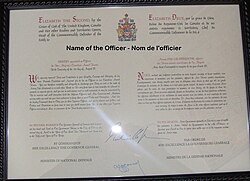
In Canada, the formal appointment of an officer is handled through what National Defence Headquarters (NDHQ) refers to as "Commissioning Scripts." These documents are issued in the name of the King of Canada, emphasizing the trust and confidence placed in the officer's loyalty, courage, and integrity.
The script mandates that the officer diligently discharge their duties and maintain good order and discipline among inferior officers and non-commissioned members. The document is signed by the Governor General of Canada at Government House in Ottawa.
Historically, the Royal Canadian Navy utilized specific wording prior to 1968. These commissions, issued in the name of the Queen, specifically required the officer to "repair on board" and take charge of a ship or establishment, warning that failure to follow regulations would be answered "at your Peril."
The British System and the Royal Navy
British commissions during the reign of Charles III are issued in the name of the King, the Head of the Commonwealth and Defender of the Faith. These documents appoint the individual to a specific rank and state that any future promotions will be officially notified via the London Gazette.
The commission is typically signed by the King (or a facsimile) and countersigned by two senior members of the Ministry of Defence. It explicitly commands subordinates to obey the officer and requires the officer to follow the Rules and Discipline of War.
The Role of the Board of Admiralty
Before 1964, the process for naval officers differed from army officers. Instead of the Sovereign, commissions were signed by the Lords Commissioners of the Admiralty, who executed the office of Lord High Admiral. This authority was granted via Letters Patent under the Great Seal.
For example, a Lieutenant's commission from 1800 served as a "Warrant," commanding the officer to take charge of a specific ship and requiring all company on board to show respect and obedience to the Lieutenant.
The United States Presidential Appointment
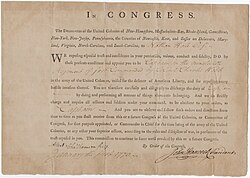
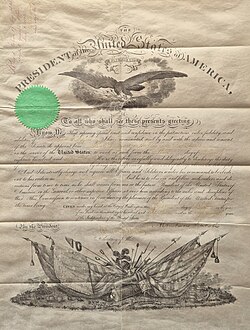
In the United States, the authority to commission officers is rooted in the U.S. Constitution. The President commissions both uniformed service officers and civilian officers. While the commission is issued in the President's name, the actual signature is usually provided by the secretary of the respective department.
The U.S. system distinguishes between different types of officers:
- Commissioned Officers: Appointed by the President.
- Commissioned Warrant Officers: Pay grades W-2 through W-5, also appointed by the President.
- Warrant Officers (W-1): Appointed by warrant by the service secretary (except in the Coast Guard, where they receive a secretarial commission).
For high-ranking positions—such as Major or Lieutenant Commander and above in Regular components, or Colonel or Captain and above in Reserve components—the commission reflects that the appointment was made with the "Advice and Consent of the Senate."
The Swedish Transition to Contracts
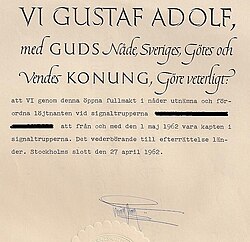
Sweden provides a unique example of the evolution of military appointments. Until 1982, all Swedish officers received written certificates of commission signed by the King of Sweden. These documents formally announced the officer's rank and regiment for the "observance of all."
However, in 1982, Sweden instituted a new employment structure by law. Officers are no longer commissioned in the traditional sense; instead, they are hired on contracts, aligning the military officer role with other civil service positions.
Summary of Commissioning Authorities
| Country | Primary Issuing Authority | Key Document/Process | Current Status |
|---|---|---|---|
| Canada | Governor General (for the King) | Commissioning Scripts | Active |
| United Kingdom | The Sovereign | Royal Commission / London Gazette | Active |
| United States | The President | Presidential Commission | Active |
| Sweden | The King (Pre-1982) | Royal Certificate | Replaced by Contracts |
Frequently Asked Questions
What is the difference between a commissioned officer and a warrant officer in the US?
Commissioned officers and commissioned warrant officers (W-2 to W-5) are appointed by the President. However, W-1 warrant officers are generally appointed by a warrant from their service secretary, though the Coast Guard uses a secretarial commission.
How did the UK Royal Navy commissions change in 1964?
Before 1964, naval commissions were signed by the Lords Commissioners of the Admiralty. After the Board of Admiralty merged into the Ministry of Defence in 1964, the title of Lord High Admiral reverted to the Crown, and commissions shifted to the Sovereign's authority.
Do Swedish officers still receive royal commissions?
No. Since 1982, Swedish officers have been hired on contracts as part of a civil service employment structure, replacing the previous system of written commissions signed by the King.
Who signs a Canadian military commission?
Canadian commissions are signed by the Governor General of Canada and countersigned by the Minister of National Defence on behalf of the King of Canada.
Why does the US Senate need to be involved in some commissions?
For higher grade levels (such as Colonel or Captain in the Reserves, or Major and above in Regular components), the U.S. Constitution requires the "Advice and Consent of the Senate" for the appointment to be valid.