Military Brigades: Structure, History, and Global Variations
In the hierarchy of military organization, the brigade serves as a critical tactical formation. Positioned between a regiment and a division, a brigade is designed to be a versatile unit capable of independent operations or acting as a building block for larger forces. While the specific composition varies by nation, the core purpose of the brigade is to provide a manageable level of command that can coordinate multiple battalions and supporting elements effectively on the battlefield.
Key Facts
- Typical Size: Generally consists of three to six battalions, with NATO standards averaging around 5,000 troops.
- Command: Usually led by a brigadier, brigadier general, or colonel.
- Versatility: Can be specialized (e.g., armored, engineer, or aviation) or combined-arms (mixing different branches).
- Hierarchy: Two or more brigades typically constitute a division.
- Independence: Some "separate" or "independent" brigades operate outside the traditional division structure.
The Evolution of the Brigade
The term originates from the Italian brigata (derived from brigare, meaning to contend or fight) and entered the English language in the 17th century. Historically, armies consisted of independent regiments and batteries that reported directly to a field army commander. As armies grew, this structure became unmanageable for a single general.
The modern tactical brigade was refined by King Gustavus Adolphus of Sweden in 1631 during the Thirty Years' War. He introduced the "battle group" to solve the lack of coordination between infantry, cavalry, and artillery. This concept was later adopted in France by Marshal Turenne, who established the brigade as a permanent standing unit in 1667.
Global Organizational Models
Different nations adapt the brigade structure to meet their specific strategic needs and historical doctrines.
United States
In the U.S. Army, the brigade is the primary operational organization, while regiments are largely administrative. The modern Brigade Combat Team (BCT) is a self-sufficient unit containing both combat elements and support units. Personnel strength varies by type: Infantry BCTs average 4,400, Stryker BCTs 4,500, and Armored BCTs 4,700.
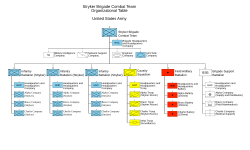
A U.S. brigade is led by a colonel (or occasionally a lieutenant colonel) and supported by a comprehensive staff of majors overseeing intelligence (S2), operations (S3), logistics (S4), and other specialized functions.
Canada
The Canadian Army utilizes Canadian Mechanized Brigade Groups (CMBG). Each Regular Force CMBG consists of approximately 5,000 personnel and includes a mix of mechanized infantry, light infantry, armored, artillery, and engineer regiments, supported by a combat service support battalion.
United Kingdom
British brigades are typically commanded by a brigadier. Historically, they used a "square brigade" concept (a 2x2 configuration of armor and infantry) starting in 1970 for forces in the British Army of the Rhine (BAOR). Unlike some other models, combat support units in the UK often remain under divisional command but may be affiliated with a specific brigade group.
Asia-Pacific Variations
- Japan: The Japan Ground Self-Defense Force (JGSDF) employs combined-arms brigades of 3,000–4,000 soldiers, led by a major general.
- China: The People's Liberation Army Ground Force (PLAGF) underwent "brigade-ization," shifting from division-centric warfare to combined arms brigades (CA-BDE) to increase flexibility.
- Australia: The brigade is the smallest tactical formation, typically comprising around 5,500 personnel.
- Myanmar: A rough equivalent is the Tactical Operation Command, which typically commands three infantry battalions.
Comparative Summary of Brigade Structures
| Country | Typical Strength | Primary Command Rank | Key Characteristic |
|---|---|---|---|
| USA (BCT) | 4,400 – 4,700 | Colonel | Self-sufficient combined arms teams |
| Canada (CMBG) | ~5,000 | Brigadier | Integrated mechanized and light infantry |
| Japan (JGSDF) | 3,000 – 4,000 | Major General | Combined arms, similar to divisions |
| Australia | ~5,500 | Brigadier | Smallest tactical formation |
| NATO Standard | ~5,000 | Various | 3 to 6 battalions plus support |
Frequently Asked Questions
What is the difference between a brigade and a division?
A brigade is a smaller tactical unit that typically consists of several battalions. A division is a larger formation that usually comprises two or more brigades, along with additional divisional support assets.
What does "combined arms" mean in the context of a brigade?
Combined arms refers to the integration of different combat branches—such as infantry, armor, and artillery—into a single unit to maximize their mutual strengths and cover each other's weaknesses.
Who typically commands a military brigade?
Depending on the country and the specific type of brigade, the commander is usually a brigadier, brigadier general, or colonel.
Why did the military move toward "brigade-ization"?
Many modern armies shifted toward brigade-centric structures to increase operational flexibility and responsiveness, allowing smaller, self-sufficient units to deploy and operate more effectively than large, cumbersome divisions.
How does a U.S. Brigade Combat Team (BCT) differ from a traditional brigade?
A BCT is designed to be more autonomous, incorporating its own organic support units (logistics, intelligence, and engineers) directly into the brigade structure rather than relying on higher-level divisional assets.