British Army: History, Structure, and Modern Operations
The British Army is the land warfare component of the British Armed Forces, serving as the primary force for territorial defense and international security operations. Founded on April 1, 1707, the Army has evolved over three centuries from a colonial force into a modern, professional military organization capable of rapid deployment across the globe.
Under the ultimate command of King Charles III, the Army is managed by the Chief of the General Staff, General Sir Roland Walker. Headquartered in Whitehall, London, it maintains a diverse force consisting of regular personnel, the Army Reserve, and the specialized Gurkhas.

Key Facts
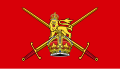
- Founded: April 1, 1707.
- Total Personnel (April 2026): Approximately 105,000 (including regular forces, Gurkhas, and reserves).
- Primary Role: Land warfare and security.
- Headquarters: Whitehall, London.
- Training Hub: Royal Military Academy Sandhurst.
Historical Evolution
The British Empire (1707–1914)
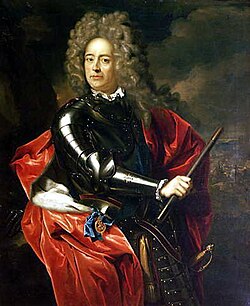
Following its formal establishment, the British Army became the primary tool for expanding and maintaining the British Empire. This era was marked by significant conflicts and the rise of legendary military leaders. For instance, John Churchill, 1st Duke of Marlborough, was a pivotal figure in the War of the Spanish Succession.
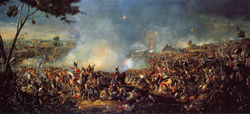
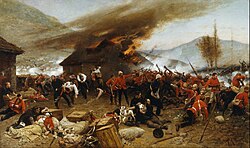
The Army's capabilities grew through the Napoleonic Wars, culminating in the victory at the Battle of Waterloo, and later through colonial engagements such as the Battle of Rorke's Drift in 1879, where a small force repelled a massive Zulu attack.
The World Wars (1914–1945)
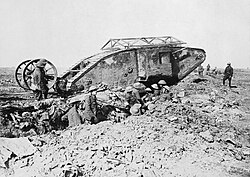
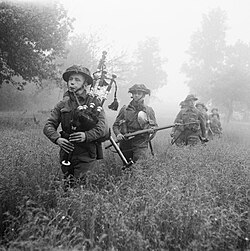
The 20th century saw the Army expand to unprecedented sizes. During World War I, the force introduced revolutionary technology, such as the Mark I tank, to break the stalemate of trench warfare. World War II further expanded the Army's reach, involving massive mobilizations across Europe, Africa, and Asia.
Postcolonial Era and Modern Conflicts (1945–Present)
After 1945, the Army transitioned from an imperial force to one focused on Cold War deterrence and regional stability. This included operations during "The Troubles" in Northern Ireland, the Persian Gulf War, and conflicts in the Balkans.
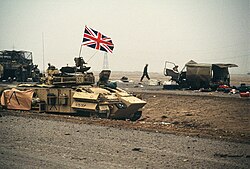
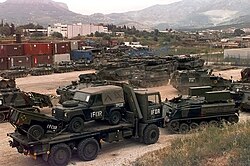
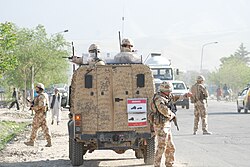
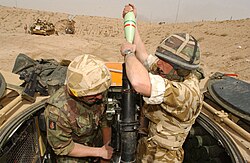
In the 21st century, the British Army has been heavily engaged in the War in Afghanistan and the Iraq War, while continuing to provide military aid and security in the Baltic states and Ukraine.
Personnel and Strength
The size of the British Army has fluctuated wildly based on global geopolitical needs. While it reached a peak of over 3 million personnel during World War II, it has shifted toward a leaner, more specialized force in the modern era.
| Year | Regular Army | Army Reserve | Total |
|---|---|---|---|
| 1710 | 68,000 | — | 68,000 |
| 1820 | 93,000 | — | 93,000 |
| 1918 | 3,838,000 | Included | 3,838,000 |
| 1945 | 2,930,000 | Included | 3,120,000 |
| 2000 | 110,000 | 45,000 | 155,000 |
| 2025 | 74,000 | 26,000 | 108,000 |
Organizational Structure
Command Hierarchy
The Army is organized into a strict hierarchy to ensure efficient command and control. The largest unit is the Division, which is broken down into smaller, more agile components.
- Division: ~10,000 personnel, commanded by a Major-General.
- Brigade: ~5,000 personnel, commanded by a Brigadier.
- Battalion/Regiment: ~720 personnel, commanded by a Lieutenant Colonel.
- Company/Squadron: ~120 personnel, commanded by a Major.
- Platoon/Troop: ~30 personnel, commanded by a Lieutenant.
- Section: 8–10 personnel, commanded by a Corporal.
Specialized Units and Colonial Forces
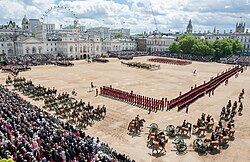
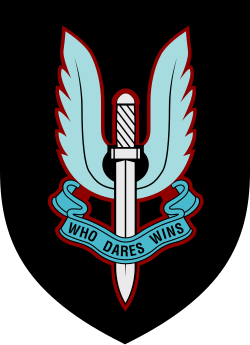
Beyond the Field Army and Home Command, the UK maintains Special Forces (such as the SAS) and several colonial units, including the Royal Bermuda Regiment and the Royal Gibraltar Regiment.
Equipment and Training
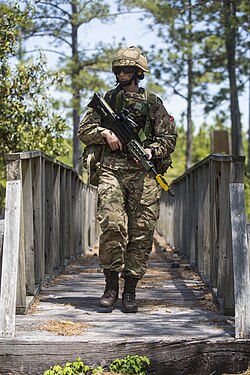
The modern British Army utilizes a wide array of advanced weaponry and vehicles. This includes the L85A3 (SA80A3) assault rifle for infantry, Challenger 2 main battle tanks for armor, and various unmanned air systems for reconnaissance.
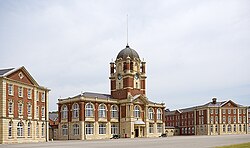
Recruits undergo rigorous training, with officers attending the Royal Military Academy Sandhurst to learn leadership and tactical skills.
Frequently Asked Questions
Who is the current head of the British Army?
The Head of the Armed Forces is King Charles III, while the professional lead is the Chief of the General Staff, General Sir Roland Walker.
What is the role of the Gurkhas in the British Army?
The Gurkhas are specialized soldiers recruited from Nepal who serve as a distinct and highly respected part of the British Army's regular forces.
How is the Army Reserve different from the Regular Army?
The Regular Army consists of full-time professional soldiers, whereas the Army Reserve consists of volunteer personnel who serve part-time and can be mobilized for full-time duty during emergencies or conflicts.
What do the different beret colors signify?
Beret colors indicate the wearer's regiment. For example, maroon is worn by the Parachute Regiment, beige by the Special Air Service (SAS), and scarlet by the Royal Military Police.
Where does the British Army maintain permanent overseas postings?
The Army maintains permanent postings in several locations, including Belize, Bermuda, Brunei, Canada, Cyprus, the Falkland Islands, Gibraltar, Kenya, and Oman.