Middlebury College: A Legacy of Knowledge and Virtue in Vermont
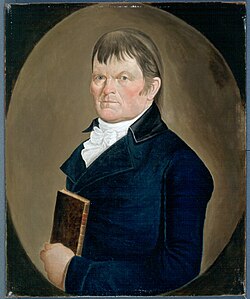
Nestled in the scenic landscape of Middlebury, Vermont, Middlebury College stands as a premier private liberal arts institution dedicated to the pursuit of Scientia et Virtus—Knowledge and Virtue. Established on November 1, 1800, the college has spent over two centuries cultivating an environment of academic rigor and intellectual curiosity, evolving from a regional pioneer into a globally recognized center for higher learning.
As the first operating college in Vermont, Middlebury holds a distinguished place in American educational history, having issued the state's first degree in 1802. Today, it serves a diverse student body from all 50 U.S. states and 70 countries, blending a rural campus atmosphere with a cosmopolitan academic outlook.
Key Facts
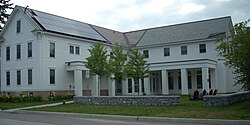
- Founded: November 1, 1800
- Location: Middlebury, Vermont, USA
- Endowment: $1.73 billion (2025)
- Accreditation: New England Commission of Higher Education (NECHE)
- Student Body: Approximately 2,773 undergraduates (2022)
- Mascot: Panther
- Notable First: First U.S. institution to offer an environmental studies major (1965)
Academic Excellence and Innovation
Middlebury College is renowned for its commitment to the liberal arts, offering 40 undergraduate departments and programs. The institution is particularly noted for its leadership in sustainability; in 1965, it became the first college in the United States to establish a major in environmental studies.
The college's academic reach extends beyond its Vermont campus. In 2010, the Monterey Institute of International Studies, a graduate school in California, officially became a graduate school of Middlebury College. Additionally, the college is famous for its specialized language schools and the prestigious Bread Loaf School of English in Ripton.
Popular Fields of Study
Based on 2021 graduation data, the most sought-after majors reflect a blend of quantitative analysis and social science:
- Econometrics & Qualitative Economics
- Computer Science
- Political Science & Government
- Environmental Studies
- Neuroscience
Campus Life and Infrastructure
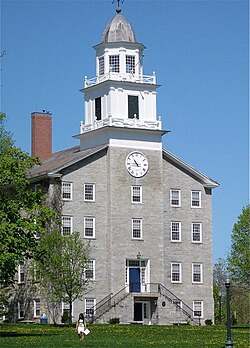
The 350-acre rural campus is a blend of historic architecture and cutting-edge sustainable design. From the iconic Old Chapel, which served as the primary academic hub for a century, to the platinum LEED-certified Hillcrest Environmental Center, the campus reflects the college's growth and values.
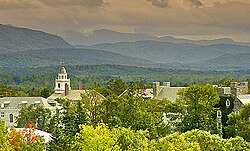
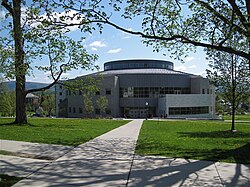
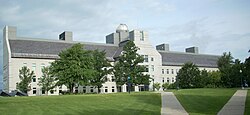
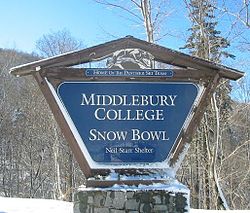
Students have access to world-class facilities, including the Davis Family Library, opened in 2004, and the John M. McCardell, Jr. Bicentennial Hall, a multidisciplinary science facility. For recreation and tradition, the college owns the Middlebury College Snow Bowl, a ski mountain that hosts the annual Winter Carnival and the unique "Feb" graduation ceremonies.
Campus Landmarks
- Old Chapel: Completed in 1836, a symbol of the college's early academic life.
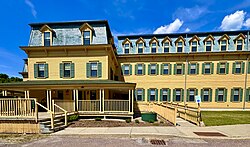
- Le Chateau: Built in 1925, housing the French department and student residences.
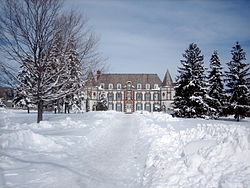
Le Chateau, constructed in 1925, is the home to the college's French department, and serves as a student residential hall - Starr Library: The original library facility, circa 1900.
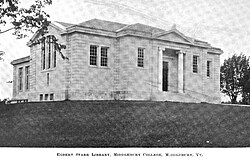
Starr Library, Middlebury's original library, circa 1900 - Emma Willard House: A National Historic Landmark currently serving as the Admission Office.
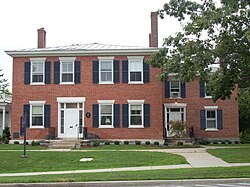
The Emma Willard House, a National Historic Landmark, is Middlebury's Admission Office - Youngman Field: Part of Alumni Stadium, adjacent to the Ralph Myhre golf course.
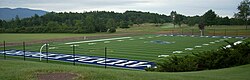
Youngman Field at Alumni Stadium, with the Ralph Myhre 18-hole golf course in the background
Admissions and Student Demographics
Middlebury is classified as a "more selective" institution by the Carnegie Foundation. For the class of 2026, the college maintained a competitive acceptance rate of 15%, admitting 1,955 students from a pool of 13,028 applicants.
The college employs a need-blind admission policy for incoming domestic students, ensuring that financial status does not impact the decision to admit. While the tuition, room, and board for the 2022–23 year was $79,800, the average financial aid grant for that entering class was $57,078.
| Race/Ethnicity | Number of Students |
|---|---|
| White, non-Hispanic | 1,547 |
| Hispanic/Latino | 331 |
| Nonresidents | 331 |
| Asian | 200 |
| Two or more races | 194 |
| Black | 149 |
| American Indian or Alaska Native | 3 |
| Unknown | 18 |
| Total | 2,773 |
Reputation and Notable Alumni
Middlebury consistently ranks among the top liberal arts colleges in the United States. In 2026, U.S. News & World Report ranked it tied for 13th out of 211 liberal arts colleges. It is also highly regarded for undergraduate teaching and overall value.
The college's influence is evident in its alumni, who have excelled in arts, science, and governance. Notable figures include Roger Easton, a principal inventor of GPS, and Eve Ensler, the Tony Award-winning creator of The Vagina Monologues.
Frequently Asked Questions
What is Middlebury College's acceptance rate?
For the class of 2026, Middlebury College had an overall acceptance rate of 15%, admitting 1,955 students out of 13,028 applicants.
Is Middlebury College need-blind?
Yes, Middlebury College is need-blind for incoming domestic students, meaning financial need is not considered during the admissions process.
What was the first environmental studies major in the U.S.?
Middlebury College was the first institution of higher education in the United States to offer a major in environmental studies, establishing the program in 1965.
What are the college's athletic affiliations?
Middlebury competes in NCAA Division III and is a member of the NESCAC, NEISA, and EISA.
Who is the current president of Middlebury College?
As of 2025, the president of Middlebury College is Ian Baucom.