University of Wisconsin–Madison: A Legacy of Research and Academic Excellence
Located in the heart of Madison, Wisconsin, the University of Wisconsin–Madison stands as a premier public land-grant research university. Since its establishment on July 26, 1848, the institution has grown from its early roots into a global powerhouse of knowledge, driven by its motto, Numen Lumen: "The divine within the universe, however manifested, is my light."
With a sprawling 938-acre campus, the university serves as a vital hub for both academic inquiry and community engagement. It is a cornerstone of the University of Wisconsin System and is recognized by prestigious affiliations such as the Association of American Universities (AAU) and the Association of Research Libraries (ARL).
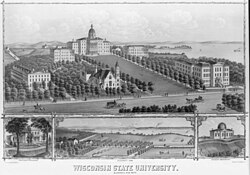
Key Facts

- Established: July 26, 1848
- Type: Public land-grant research university
- Student Population: 48,557 (2024 data)
- Endowment: $4.92 billion (2025)
- Mascot: Bucky Badger
- Colors: Cardinal and white
A Rich Historical Foundation

The history of UW–Madison is deeply intertwined with the evolution of the state of Wisconsin. Originally known simply as the University of Wisconsin until 1971, the institution has navigated significant eras of change, from the late 19th-century expansions to the transformative social movements of the late 20th century.
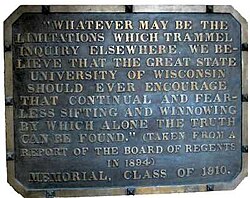
One of the most enduring philosophies of the university is the Wisconsin Idea, the principle that the university's influence should reach every home in the state to improve lives. This commitment to public service is reflected in the campus architecture and its various research initiatives.
Campus Landmarks and Architecture
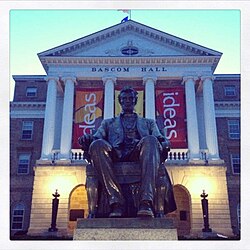
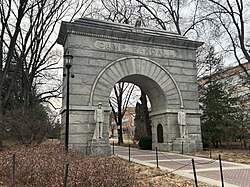
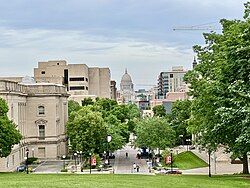
The campus is anchored by Bascom Hill, a central landscape that houses many of the university's most iconic buildings. Bascom Hall, situated at the top of the hill, serves as a symbolic heart of the campus. The building has weathered significant challenges, including a major fire in 1916 that destroyed its dome.
![Bascom Hall fire that destroyed the dome in 1916[24]](/images/f5/3a/f53af720e5c14de8cde667084f09039cdafa68af68a2e20d9c02944faff3ca55.jpg)
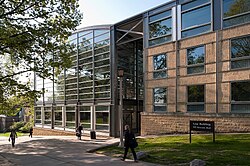
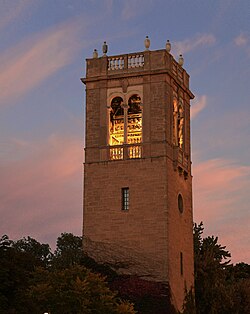
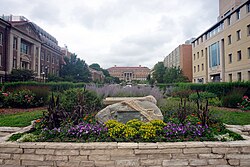
Other notable structures include the Carillon Tower, which offers a striking evening view, and the Memorial Union, famous for its terrace overlooking Lake Mendota. The campus also features diverse spaces like Henry Mall, surrounded by the College of Agricultural and Life Sciences, and the Allen Centennial Gardens.


Academic Excellence and Research Power
UW–Madison is a leader in global research. The university is organized into numerous specialized colleges and schools, ranging from the College of Letters & Science to the School of Medicine and Public Health. The latter is a significant driver of innovation, with the School of Medicine and Public Health accounting for 40% of the university's research grants.
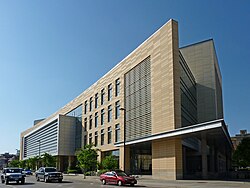
![A view of UW Health University Hospital, the Health Sciences Learning Center (HSLC), and the Wisconsin Institutes for Medical Research rising above Lake Mendota, on the western edge of the UW–Madison campus. The University of Wisconsin School of Medicine and Public Health, housed in the HSLC, accounts for 40% of UW–Madison's research grants.[150]](/images/7b/90/7b90eb9d6e3fbd0772ca6fe0c881eba70a4076957156d34e790c721fc5e53598.jpg)
Top-Ranked Programs
The university consistently earns high marks in national and global rankings. Notable program strengths include:
- Education: Ranked #1
- Rehabilitation Counseling: Ranked #1
- Social Work: Ranked #20
- Speech-Language Pathology: Ranked #3
- Veterinary Medicine: Ranked #5
- Occupational Therapy: Ranked #9
- Pharmacy: Ranked #9
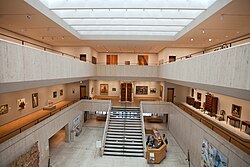
Beyond the classroom, the university provides extensive resources through its libraries and museums, such as the Chazen Museum of Art and the Wisconsin Historical Society, which offers specialized reading rooms for researchers.

Student Life and Athletics
Being a Badger means participating in a vibrant campus culture. With over 48,000 students, the community is diverse, including a significant population of international students and a range of economic backgrounds. Student life is enriched by various organizations, media outlets like The Daily Cardinal and The Badger Herald, and a spirited athletic tradition.
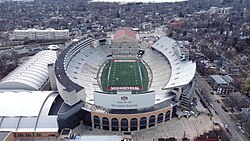
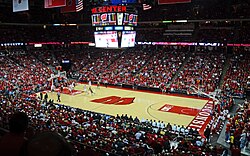
The university competes in NCAA Division I as part of the Big Ten Conference. Athletics are a major point of pride, with iconic venues like Camp Randall Stadium and the Kohl Center hosting high-stakes games. Traditions, such as the rivalry battles involving Paul Bunyan's Axe, bring the student body together in celebration.


Summary of University Profile
| Category | Details |
|---|---|
| Total Students | 48,557 (2024) |
| Faculty Count | 2,220 |
| Campus Size | 938 acres |
| Primary Colors | Cardinal and White |
| Athletic Conference | Big Ten |
Frequently Asked Questions
What is the motto of UW–Madison?
The university's motto is Numen Lumen, which translates to "The divine within the universe, however manifested, is my light."
How competitive is admission to the university?
For the 2023 entering class, the admit rate was 43.3%, with a middle 50% SAT score range of 1370–1490.
What is the "Wisconsin Idea"?
The Wisconsin Idea is the principle that the university's research and expertise should be applied to benefit the entire state of Wisconsin and its citizens.
What are the university's colors and mascot?
The official colors are cardinal and white, and the mascot is Bucky Badger.
Where is the campus located?
The campus is located in Madison, Wisconsin, United States.