Metropolitan Hotel: A Gilded Era Landmark of Manhattan
In the mid-19th century, New York City experienced a dramatic "hotel boom," a period of rapid expansion in luxury accommodations driven by the city's growing status as a global commercial hub. At the center of this growth was the Metropolitan Hotel, a lavish establishment that defined opulence in Manhattan for over four decades.
Opening its doors on September 1, 1852, the hotel was strategically timed to capitalize on the influx of visitors expected for the New York Crystal Palace exhibition of 1853. Located on the site formerly occupied by Niblo's Garden and owned by Stephen Van Rensselaer, the hotel became a symbol of the grand commercialized style of the era.
Architectural Grandeur and Design
Designed by architects Joseph Trench and John Butler Snook, the Metropolitan Hotel was modeled after Roman palazzos. The structure featured a brownstone-faced frontage extending 300 feet along Broadway, with an additional 200 feet facing Prince Street. The building consisted of four floors situated above a series of fashionable shopfronts.
The interior was equally impressive, boasting furnishings imported from Europe and the largest plate-glass mirrors in the United States at the time. By 1866, the cost of the interior decorations and furnishings was estimated at $200,000. To ensure guest comfort, the hotel utilized steam heating and offered a variety of accommodations, ranging from standard rooms to "family apartments" equipped with private drawing rooms.
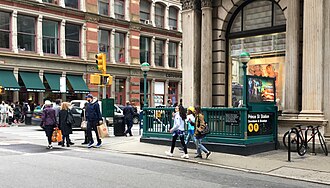
Operations and Notable Guests
The hotel was managed by the Leland brothers, who are recognized as the organizers of the first American hotel chain. They operated the establishment on the American plan, a hospitality model where the cost of the room included three meals per day. The hotel had the capacity to shelter up to six hundred guests.
The Metropolitan was known for its inclusive policies regarding the staff of its patrons. Unlike many other New York hotels of the period, it permitted the enslaved servants of Southern guests to stay on the premises. This was notably the case for Mary Todd Lincoln and her Black seamstress, Elizabeth Keckley, who visited the hotel on several occasions.
The hotel also served as a diplomatic sanctuary. In 1860, the Leland brothers hosted a Japanese delegation visiting New York to study technological advancements. The management worked to provide privacy for the guests, who were frequently pursued by a curious public and the press due to their traditional attire.
Economic Decline and Demolition
The fortunes of the Metropolitan Hotel mirrored the volatility of the American economy. The Civil War triggered an economic downturn in New York City, leading to significant financial losses for the hotel's lavish proprietors. Following 1871, the hotel entered a new chapter under the management and eventual proprietorship of Richard Tweed, the son of the notorious political figure William M. Tweed, known as "Boss Tweed."
Despite its storied past, the era of the great brownstone hotels eventually faded. The Metropolitan Hotel closed its doors and was demolished in 1895.
Key Facts
- Opened: September 1, 1852.
- Closed/Demolished: 1895.
- Architects: Joseph Trench and John Butler Snook.
- Capacity: 600 guests.
- Design Style: Roman palazzo-inspired commercial style.
- Notable Management: The Leland brothers and later Richard Tweed.
- Key Feature: Included the largest plate-glass mirrors in the U.S. at the time of installation.
| Attribute | Details |
|---|---|
| Location | Broadway and Prince Street, Manhattan, NYC |
| Frontage | 300 ft (Broadway) / 200 ft (Prince St) |
| Operating Plan | American Plan (Meals included) |
| Interior Cost (1866) | $200,000 |
| Former Site Use | Niblo's Garden |
Frequently Asked Questions
What was the "American plan" used by the Metropolitan Hotel?
The American plan was a hotel pricing model where the room rate included three meals a day for the guest.
Who were the architects of the Metropolitan Hotel?
The hotel was designed by Joseph Trench and John Butler Snook in a style reminiscent of Roman palazzos.
Which famous figures stayed at the hotel?
Mary Todd Lincoln and her seamstress Elizabeth Keckley were frequent guests, and the hotel also hosted a Japanese technological delegation in 1860.
How did the hotel handle the enslaved servants of Southern guests?
Unlike many of its contemporaries in New York, the Metropolitan Hotel allowed the enslaved servants of its Southern patrons to stay on the premises.
What led to the hotel's eventual decline?
The economic downturn caused by the Civil War resulted in heavy losses for the proprietors, and the hotel eventually closed and was demolished in 1895.