A Streetcar Named Desire: The Legacy of Tennessee Williams' Southern Gothic Masterpiece
Written by the legendary Tennessee Williams, A Streetcar Named Desire stands as a cornerstone of American theater. A definitive example of the Southern Gothic genre—a style characterized by decayed settings and grotesque characters to explore social issues—the play delves into the volatile collision between fading aristocratic delusions and the gritty reality of the working class.
Set against the humid, atmospheric backdrop of the French Quarter and Downtown New Orleans, the story centers on the strained relationship between Blanche DuBois, her sister Stella Kowalski, and Stella's husband, Stanley Kowalski. The narrative is further complicated by Harold "Mitch" Mitchell, a coworker and friend of Stanley who becomes a romantic interest for Blanche.

Key Facts
- Premiere: December 3, 1947, at the Ethel Barrymore Theatre in New York City.
- Major Awards: Won the 1948 Pulitzer Prize for Drama and the New York Drama Critics' Circle award for Best Play.
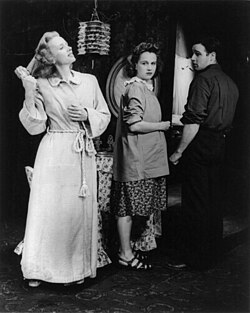
- Original Cast: Featured Jessica Tandy as Blanche and Marlon Brando as Stanley.
- Setting: New Orleans, Louisiana, specifically the French Quarter.
- Genre: Southern Gothic.
The Original Broadway Production
The play's journey to Broadway began in early November 1947 with tryouts in New Haven, Connecticut, and Philadelphia. Produced by Irene Mayer Selznick and directed by Elia Kazan, the production officially opened at the Ethel Barrymore Theatre on December 3, 1947.
While Selznick initially considered Margaret Sullavan and John Garfield for the leads, the production ultimately cast Jessica Tandy and a then-unknown Marlon Brando. Williams specifically chose Brando because his youth shifted the character of Stanley from a vicious older man to someone whose cruelty stemmed from youthful ignorance. The production was a massive success, running for 855 performances and earning Jessica Tandy a Tony Award for Best Actress in a Play in 1948.
Notable Revivals and Global Productions
Since its debut, A Streetcar Named Desire has been reimagined by generations of actors and directors worldwide. A 1949 London production directed by Laurence Olivier starred Vivien Leigh as Blanche and Bonar Colleano as Stanley.

Modern revivals have continued to bring fresh perspectives to the text. In 2005, the Roundabout Theater Company staged a Broadway revival starring Natasha Richardson, John C. Reilly, and Amy Ryan. More recently, a 2022 production at London's Almeida Theatre, directed by Rebecca Frecknall, received widespread acclaim. This version, starring Paul Mescal and Patsy Ferran, won three Laurence Olivier Awards, including Best Revival.
Summary of Major Stage Productions
| Year | Production/Venue | Blanche | Stanley | Stella |
|---|---|---|---|---|
| 1947 | Broadway (Original) | Jessica Tandy | Marlon Brando | Kim Hunter |
| 1949 | London (Aldwych) | Vivien Leigh | Bonar Colleano | Renée Asherson |
| 2005 | Broadway (Roundabout) | Natasha Richardson | John C. Reilly | Amy Ryan |
| 2009 | Sydney Theatre Co. | Cate Blanchett | Joel Edgerton | Robin McLeavy |
| 2022 | Almeida Theatre | Patsy Ferran | Paul Mescal | Anjana Vasan |
Adaptations Across Media
The play's intensity translated powerfully to the screen in the 1951 Warner Bros. film directed by Elia Kazan. Most of the original Broadway cast returned, with Vivien Leigh joining as Blanche. The film was a critical triumph, winning four Academy Awards, including three for acting (Leigh, Karl Malden, and Kim Hunter).
Beyond film, the work has inspired various artistic interpretations:
- Opera: A 1995 opera composed by André Previn premiered at the San Francisco Opera in the 1998–1999 season.
- Ballet: A 1952 ballet choreographed by Valerie Bettis debuted in Montreal, featuring music by Alex North.
- Cinema: Pedro Almodóvar's 1999 film All About My Mother features a Spanish-language version of the play.
The Allegory of the New Orleans Setting
The play's title is not merely descriptive but allegorical. In New Orleans, the Desire Line was a real streetcar route that operated from 1920 to 1948. Blanche's journey—taking a streetcar named Desire, transferring to one called Cemeteries, and arriving at Elysian Fields—serves as a poetic map of her own psychological descent and the inevitable fate of her character.
Frequently Asked Questions
Who wrote A Streetcar Named Desire?
The play was written by the American playwright Tennessee Williams.
What is the significance of the Southern Gothic genre in this play?
The Southern Gothic genre allows Williams to explore themes of social decay, mental instability, and the clash between the old aristocratic South and the new industrial reality through atmospheric and often grotesque storytelling.
How did Marlon Brando's casting change the character of Stanley?
Tennessee Williams believed that casting the younger Brando evolved Stanley from a vicious older man into a character whose cruelty could be attributed to youthful ignorance.
Did the 1951 film follow the play's ending exactly?
No, the ending was slightly altered; in the film, Stella does not remain with Stanley as she does in the original stage play.
Which actors won awards for the 2022 Almeida Theatre production?
The production won the Laurence Olivier Award for Best Revival, while Paul Mescal won Best Actor and Anjana Vasan won Best Supporting Actress.