Megachilidae: The Diverse World of Mason and Leafcutter Bees
The Megachilidae are a cosmopolitan family of bees known primarily for their solitary nature and unique nesting behaviors. Unlike many other bee families, these insects are distinguished by their specialized anatomy and the diverse materials they use to construct their homes, ranging from mud and leaves to plant resins and fibers. With over 4,000 identified species globally, they represent approximately 15% to 20% of all named bee species.
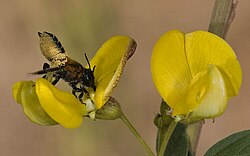
One of the most defining physical characteristics of the Megachilidae is the scopa—a pollen-carrying structure. While most bees carry pollen on their hind legs, megachilids possess a scopa located on the ventral surface (underside) of their abdomen. Additionally, they typically feature elongated labra (upper lips) and strong jaws, which are essential tools for harvesting the materials they need for nest construction.
Key Facts
- Global Presence: Over 4,000 species worldwide, including roughly 630 in North America.
- Pollen Transport: Unique for carrying pollen on the underside of the abdomen rather than the legs.
- Nesting Materials: Depending on the group, they use soil (mason bees), leaves (leafcutter bees), plant hairs (carder bees), or resins (resin bees).
- Pollination Style: Their energetic, "swimming-like" movement within flowers releases large amounts of pollen.
- Social Structure: Almost all species are solitary bees.
Types of Megachilid Bees
The family is broadly categorized by the materials they collect to build their nest cells:
- Leafcutter Bees: Use cut pieces of leaves to line their nests.
- Mason Bees: Utilize soil or mud for construction.
- Carder Bees: Collect plant or animal hairs and fibers.
- Resin Bees: Use plant resins to create hard, glue-like cell walls.
The European Wool Carder Bee
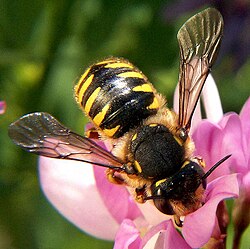
A notable example is Anthidium manicatum, the European wool carder bee. Accidentally introduced to the Americas in the late 1960s, it is now one of the most widely distributed unmanaged bee species. Unlike most of its relatives, the male is larger than the female and aggressively defends a "harem" of females, attacking other pollinators like honeybees and bumblebees.
Lifecycle and Nesting Habits
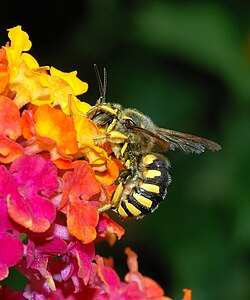
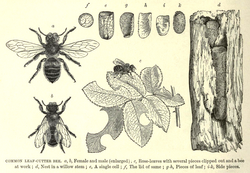
For non-parasitic species, the lifecycle begins when a female finds a suitable cavity—often a hollow plant stem, a snail shell, or an artificial tube. She constructs a linear series of cells, stocking each with a mixture of pollen and nectar before laying a single egg and sealing the cell with a wall.
The larva hatches and consumes the provided food, eventually spinning a cocoon to pupate. Once the adult emerges, the cycle repeats. While males die shortly after mating, females survive for several more weeks to establish new nests.
Brood Parasites (Cuckoo Bees)
Not all Megachilidae are industrious builders. Some genera, such as Coelioxys and Stelis, are kleptoparasites, informally known as "cuckoo bees." These species do not possess a scopa because they do not collect pollen. Instead, they enter the nests of other megachilids and lay their eggs. The parasite larva then kills the host larva and consumes its food stores.
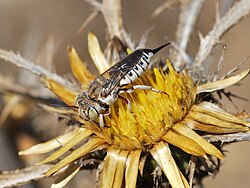
Agricultural Importance and Diversity
Because they nest in above-ground cavities, megachilids are more easily cultivated than ground-nesting bees. This has made them invaluable for commercial pollination. In North America, the introduced Megachile rotundata (alfalfa leafcutter bee) is used for alfalfa, while the native Osmia lignaria (blue orchard bee) is widely used in orchards.
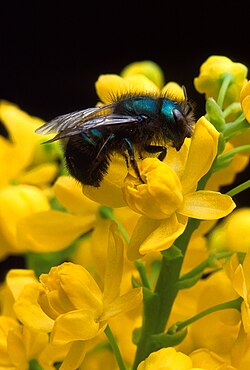
While ground-nesting bees are more numerous in nature (comprising about 70% of all bee species), megachilids are often the most frequently encountered in trap-nesting surveys due to their preference for hollow stems and tubes.
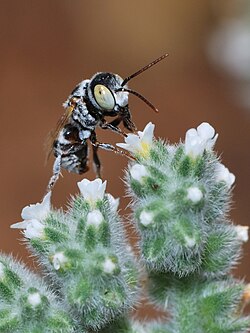
Summary of Megachilidae Characteristics
| Common Name | Primary Nest Material | Example Genus | Key Feature |
|---|---|---|---|
| Leafcutter Bee | Leaves/Petals | Megachile | Semicircular leaf cutouts |
| Mason Bee | Soil/Mud | Osmia | Commonly used in orchards |
| Carder Bee | Plant fibers/hairs | Anthidium | Territorial males |
| Resin Bee | Plant resins | Various | Hard, glue-like cells |
| Cuckoo Bee | None (Parasitic) | Coelioxys | No abdominal scopa |
Evolution and Taxonomy
The fossil record for this family is sparse, but evidence of their behavior dates back to the Middle Eocene (approximately 45 million years ago). Fossilized dicotyledonous leaves from this era show the characteristic semicircular cutouts associated with leaf-cutting bees, suggesting that this behavior evolved early in the group's history.
Frequently Asked Questions
How do Megachilidae differ from other bees in how they carry pollen?
Unlike most bees that use hind legs, Megachilidae have a scopa, a specialized pollen-carrying structure located on the ventral surface of their abdomen.
What is a "cuckoo bee" in the Megachilidae family?
A cuckoo bee is a kleptoparasite, such as those in the genera Coelioxys or Stelis, which lay eggs in the nests of other bees and rely on the host's collected pollen to feed their larvae.
Why are these bees useful for farmers?
Because they are solitary and nest in above-ground cavities, they can be easily managed in "nest blocks" or tubes, making them efficient pollinators for crops like alfalfa and orchard fruits.
What is the difference between a mason bee and a leafcutter bee?
The primary difference is the nesting material: mason bees use mud or soil to build their cells, while leafcutter bees use precisely cut pieces of leaves.
Are all Megachilidae bees solitary?
Yes, the members of the Megachilidae family are solitary bees, meaning they do not live in colonies with a queen and workers.