Mecklenburg-Schwerin: The History and Legacy of the Grand Duchy
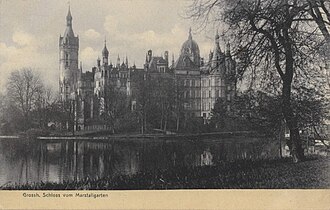
The Grand Duchy of Mecklenburg-Schwerin (German: Großherzogtum Mecklenburg-Schwerin) was a sovereign territory in Northern Germany ruled by the House of Mecklenburg. Centered in the city of Schwerin, this state navigated a complex political landscape, evolving from a member of the German Confederation into a federal state of the German Empire by 1871.
The region's identity was deeply rooted in its lineage, with the ruling dynasty tracing its origins back to the Obotrite (West Slavic) Prince Niklot. For nearly eight centuries, the Grand Dukes held the title "Prince of the Wends," maintaining a continuous rule that only saw a brief interruption between 1628 and 1630 under Albrecht von Wallenstein.
Key Facts
- Duration: 1815 to 1918.
- Capital: Schwerin.
- Total Area: 13,161 km².
- Government: Primarily a feudal monarchy, with a brief period as a constitutional monarchy (1849–1851).
- Key Cities: Schwerin, Rostock, Wismar, Parchim, and Güstrow.
- Final Ruler: Grand Duke Frederick Francis IV.
Geography and Territorial Bounds
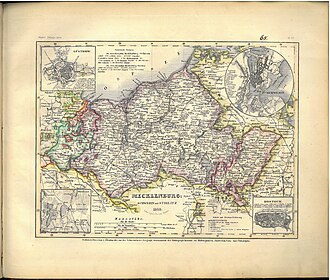
Mecklenburg-Schwerin occupied the central and western portions of the historic Mecklenburg region. This territory expanded in 1701 following the incorporation of the extinct Duchy of Mecklenburg-Güstrow. To the southeast lay the smaller Duchy of Mecklenburg-Strelitz, which also controlled the Prince-Bishopric of Ratzeburg in the far northwest.
The Grand Duchy was bordered by the Baltic coast to the north and the Prussian province of Pomerania to the northeast. Its southern border met the Prussian Province of Brandenburg, while the southwest bordered the Amt Neuhaus district. Over time, as neighboring territories like the Duchy of Holstein and the Kingdom of Hanover were incorporated into Prussia, Mecklenburg-Schwerin became almost entirely surrounded by Prussian land.
Political Evolution and History
The Napoleonic Era and the Congress of Vienna
During the French Revolutionary Wars, Duke Frederick Francis I initially maintained neutrality. However, following Napoleon's victory at Austerlitz and the collapse of the Holy Roman Empire in 1806, the duchy joined the Confederation of the Rhine in 1808. This alliance was short-lived; Frederick Francis I abandoned Napoleon during the War of the Sixth Coalition, aligning instead with Prussia and Russia.
The 1815 Congress of Vienna marked a turning point, as Frederick Francis was elevated to the title of Grand Duke and the state joined the newly formed German Confederation. A significant social milestone occurred in 1819 with the final abolition of serfdom within the dominion.
Internal Struggle and the Path to Empire
For much of its existence, the state was governed by the 1755 inheritance agreement (Landesgrundgesetzlicher Erbvergleich), which preserved a medieval hierarchy of estates. This feudal structure hindered social and economic modernization. While the revolutions of 1848 led Grand Duke Frederick Francis II to grant a liberal Basic Law in 1849, these democratic concessions were largely revoked by 1852 due to pressure from the nobility.
By the mid-19th century, the Grand Duchy fell increasingly under Prussian influence. Frederick Francis II supported Prussia in the 1866 Austro-Prussian War and later in the Franco-Prussian War (1870–1871). Consequently, Mecklenburg-Schwerin became a state of the North German Confederation in 1867 and a federal state of the German Empire in 1871.
The End of the Monarchy
The final Grand Duke, Frederick Francis IV, ascended the throne in 1897. Although he promised a constitution in 1907, the government remained largely feudal, with executive power held by the Grand Duke and representation limited to the Ritterschaft (estate proprietors) and the Landschaft (town burgomasters). The monarchy ended abruptly on November 14, 1918, during the German Revolution, when Frederick Francis IV was forced to renounce the throne. The territory then became the Free State of Mecklenburg-Schwerin within the Weimar Republic.
State Overview Summary
| Category | Details |
|---|---|
| Capital | Schwerin |
| Area | 13,161 km² |
| Languages | German, Low German |
| Religion | Evangelical Lutheran State Church of Mecklenburg-Schwerin |
| Currency | Mecklenburg thaler → Vereinsthaler → German gold mark |
| Political Status | German Confederation → North German Confederation → German Empire |
Frequently Asked Questions
Who were the rulers of Mecklenburg-Schwerin?
The state was ruled by the House of Mecklenburg, specifically the line of Grand Dukes including Frederick Francis I, Paul Frederick, Frederick Francis II, Frederick Francis III, and finally Frederick Francis IV.
What was the government structure of the Grand Duchy?
It was primarily a feudal monarchy where the Grand Duke held executive power. While it had a diet (Landtag), representation was dominated by the Ritterschaft (knights' estate owners) and the Landschaft (burgomasters).
When did the Grand Duchy become part of the German Empire?
Mecklenburg-Schwerin became a federal state of the German Empire in 1871, following its previous membership in the North German Confederation starting in 1867.
What happened to the state after 1918?
Following the German Revolution on November 14, 1918, the monarchy was abolished, and the territory was transformed into the Free State of Mecklenburg-Schwerin, a part of the Weimar Republic.
Which major cities were located within the Grand Duchy?
In addition to the capital of Schwerin, the state included the coastal cities of Rostock and Wismar, as well as the inland towns of Parchim and Güstrow.