Maya Archaeological Collection of the Southeastern Petén
The museum serves as a vital repository for the artifacts recovered by the Atlas Arqueológico de Guatemala. Specifically focusing on the southeastern Petén region, the collection provides a tangible timeline of the Maya civilization, showcasing the artistic and cultural evolution of the region through carefully excavated objects.
The collection comprises approximately 125 ceramic pieces and eight stone sculptures. These artifacts span a vast chronological range, from the Late Preclassic period starting around 900 BC through to the Postclassic period ending in 1524 AD.
Regional Scope and Provenance
While the museum is centrally located, its reach extends across several municipalities within the Petén region. The artifacts originate from La Libertad, Melchor de Mencos, Poptún, San Luis, Santa Ana, and San Francisco, as well as the municipality of Dolores.
In total, 22 distinct archaeological sites are represented in the collection, including:
- Calzada Mopan, Copoja, and Curucuitz
- El Chal, El Ocote, and El Reinado
- Itzimte, Ix Ak, Ixcoxol, Ix Ek', Ixkun, Ixtonton, and Ixtutz
- La Gloria-Sacul, Limones, Machaquila, Maringa, and Pueblito
- Sacul, Suk Che', Ucanal, and Yaltutu
Beyond these urban centers, the museum also houses pieces recovered from natural subterranean sites, specifically the caves of Aktun Ak'ab, Balam Na, and El Chapayal.
Featured Artifacts of the Late Classic Period
The Late Classic period is heavily represented through high-quality ceramics, often found in association with burials, which provides insight into Maya funerary customs and social hierarchy.
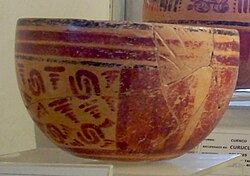
The Suk Che' Bowl
Catalogue number PSPA-507 is a flat-based ceramic bowl excavated from Group 9 at Suk Che'. This piece belongs to the Palmar-Danta ceramic group and is specifically of the Saxche variety of the Saxche Naranja Polychrome type.
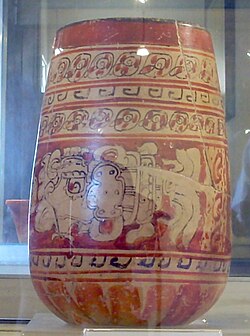
The Curucuitz Vase
Recovered from the North Structure of Group 24 at Curucuitz, this ceramic vase (PSPA-625) was found within a burial context. It is identified as the Paixban variety of the Paixban Ante Polychrome type, part of the Zacatal-Joyac ceramic group.
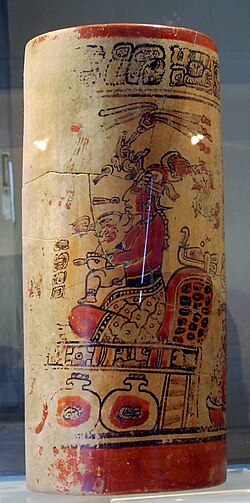
The Sacul Chocolate Vessel
One of the most significant pieces is the ceramic vase from Sacul (PSPA-708). Found as a funerary offering for Burial 193 in front of Structure 1, Group 26, this vessel is of the Palmar variety of the Palmar-Naranja Polychrome type (Palmar-Danta group).
This vessel served as a drinking cup for chocolate and features complex iconography. It depicts the tonsured maize god—who functions here as a lunar deity—seated on a throne decorated with a celestial band while holding a rabbit. The scene includes three jars of pulque (a traditional fermented beverage) and various supernatural visitors, including a man-bird hybrid and two versions of God N. A dedicatory text around the rim identifies the vessel as belonging to a lord of the city of Naranjo.
Key Facts
- Total Artifacts: Approximately 125 ceramics and 8 stone sculptures.
- Time Span: 900 BC (Late Preclassic) to 1524 AD (Postclassic).
- Geographic Reach: 22 archaeological sites and 3 caves across multiple Petén municipalities.
- Key Sites: Includes major centers like Suk Che', Sacul, and Curucuitz.
- Notable Find: A chocolate vessel from Sacul belonging to a lord of Naranjo.
Collection Summary
| Artifact | Catalogue No. | Site / Location | Ceramic Group/Type |
|---|---|---|---|
| Flat-based Bowl | PSPA-507 | Suk Che' (Group 9) | Palmar-Danta / Saxche Naranja Polychrome |
| Ceramic Vase | PSPA-625 | Curucuitz (Group 24) | Zacatal-Joyac / Paixban Ante Polychrome |
| Chocolate Vase | PSPA-708 | Sacul (Group 26) | Palmar-Danta / Palmar-Naranja Polychrome |
Frequently Asked Questions
Which organization excavated the objects in the museum?
The objects were excavated by the Atlas Arqueológico de Guatemala.
What is the chronological range of the collection?
The collection covers the period from 900 BC (Late Preclassic) to 1524 AD (Postclassic).
What does the Sacul vase depict?
The vase depicts the tonsured maize god acting as a lunar deity, holding a rabbit and seated on a celestial throne, surrounded by supernatural beings and jars of pulque.
How many archaeological sites are represented in the museum?
There are 22 archaeological sites represented, along with artifacts from three different caves.
What was the purpose of the Sacul vase (PSPA-708)?
It was a drinking vessel for chocolate and served as a funerary offering for a burial.