Max Talmey: The Polymath Who Mentored Albert Einstein
Max Talmey (born Max Talmud, 1869–1941) was a Lithuanian-born American ophthalmologist and educator whose intellectual curiosity spanned the realms of medicine, linguistics, and philosophy. While he achieved professional acclaim for his surgical success in treating cataracts, he is perhaps most remembered as the early mentor to one of history's greatest minds: Albert Einstein.
Born into a poor Jewish family in Tauroggen (now Taurage, Lithuania), Talmey demonstrated an early aptitude for languages, becoming fluent in six by the age of 18. He pursued medical studies in Germany at the Munich Medical School, a journey that would eventually lead to a lifelong connection with a young, inquisitive boy from a neighboring family.
Key Facts
- Mentorship: Tutored Albert Einstein from 1889 to 1894, introducing him to advanced science and philosophy.
- Medical Expertise: Renowned ophthalmologist at Mount Sinai Hospital, specializing in cataract removal.
- Linguistic Innovation: Founded the Esperanto Society of New York and later created his own language, Gloro.
- Medical Observation: Identified a correlation between tonsillectomies and polio cases in the early 20th century.
- Academic Reach: Published extensively on the Theory of Relativity and psychiatric elements for law and medical students.
The Mentorship of Albert Einstein
When Max Talmey was 21 and attending medical school in Munich, he became a weekly lunch guest of the Einstein family. For five years, from 1889 to 1894, Talmey served as an intellectual guide for the ten-year-old Albert. Rather than following rigid school curricula, the two engaged in deep discussions about natural science and philosophy.
Talmey provided Einstein with a curated library of influential texts. These included Aaron Bernstein's Popular Book on Natural Science, Ludwig Buchner's Force and Matter, and Immanuel Kant's The Critique of Pure Reason. He also gave Einstein a geometry textbook by Theodore Spieker, which Einstein affectionately referred to as his "holy little geometry book."
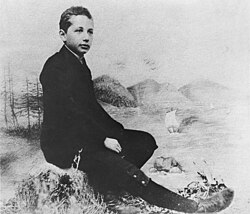
Talmey later recalled that Einstein's appetite for knowledge was extraordinary, often mastering difficult mathematical texts in months that would take adult students years to comprehend. This self-education eventually led Einstein to disregard the traditional methods of his gymnasium, as he soon surpassed Talmey himself in the fields of physics and mathematics.
Medical Career and Contributions
After graduating in 1895, Talmey moved to the United States, where he established a diverse medical practice in New York. While he eventually specialized in ophthalmology, his early interests included psychiatry and otorhinolaryngology (the study of the ear, nose, and throat). He even authored a textbook on psychology and psychiatry designed for both medical and law students.
Talmey was known for his willingness to challenge the medical establishment. He published critiques of other ophthalmologists and was a vocal opponent of Freudian psychoanalysis. One of his most significant clinical observations occurred around 1917, when he noticed a link between tonsillectomies and the subsequent development of polio. By 1929, after observing a cluster of polio cases in a single family following tonsil removals, the medical community shifted its standards to avoid performing tonsillectomies during the summer months when polio was most prevalent.
The Quest for a Universal Language
Driven by a desire for precise global communication, Talmey became a champion of auxiliary languages—artificial languages designed to facilitate communication between people of different native tongues.
In 1905, he founded the Esperanto Society of New York and served as its first president. However, he eventually grew dissatisfied with Esperanto, citing its "repugnant" sound and the use of five unique symbols that were difficult to print globally.
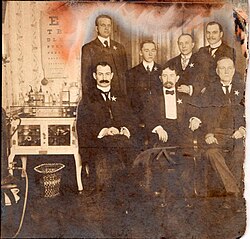
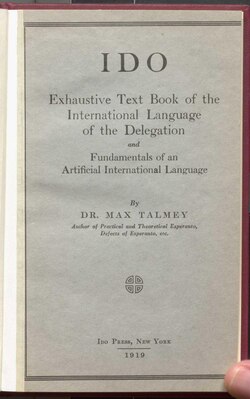
After a brief interest in Ido, Talmey created his own language in 1924, originally called Arulo and later renamed Gloro (meaning "rational language"). Unlike general-purpose languages, Gloro was intended as a "model language" for the precise exchange of complex ideas. To eliminate ambiguity, Talmey ensured that every word in Gloro had a single, unique meaning.
In 1937, Talmey publicly demonstrated Gloro at the Jewish Club in New York, reading a translation of a speech by President Roosevelt. Albert Einstein was notably present in the audience for this presentation.
Summary of Max Talmey's Legacy
| Field | Key Contribution/Achievement | Notable Work/Entity |
|---|---|---|
| Education | Mentored Albert Einstein in science and philosophy | Personal Recollections of Einstein's Boyhood |
| Medicine | Advanced cataract surgery and polio observations | Mount Sinai Hospital |
| Linguistics | Promoted Esperanto; created Gloro language | Esperanto Society of New York |
| Psychiatry | Authored interdisciplinary psychiatric texts | Psyche (1910) |
Frequently Asked Questions
How did Max Talmey influence Albert Einstein?
Talmey acted as a tutor and mentor to a young Einstein, providing him with advanced books on geometry, physics, and philosophy that encouraged Einstein's transition toward self-education and independent scientific inquiry.
What was Gloro and why did Talmey create it?
Gloro was a constructed "rational language" designed for the precise exchange of ideas. Talmey created it to avoid the ambiguities of natural languages, ensuring each word had one unique meaning.
What was Talmey's contribution to the understanding of polio?
Talmey observed a correlation between tonsillectomies and polio infections. His observations contributed to a change in medical practice in 1929, leading doctors to stop performing tonsillectomies during the summer polio season.
Why did Max Talmey leave the Esperanto movement?
Talmey found Esperanto flawed because it used non-standard symbols that were difficult to print and because he found the phonetic sound of the language to be unpleasant.
Where did Max Talmey practice medicine?
After studying in Munich, Germany, Talmey moved to the United States and practiced in New York City, where he was associated with Mount Sinai Hospital.