Matthias Sindelar: The Mozart of Football and the Legend of the Wunderteam
In the annals of football history, few figures loom as large or as enigmatically as Matthias Sindelar. Known as "The Mozart of football" and Der Papierene ("The Paper Man") due to his slight build, Sindelar was a master of creativity and dribbling. He didn't rely on brute strength; instead, he used agility and technical brilliance to dismantle defenses, earning him a place as one of the greatest pre-war footballers in the world.
Voted the best Austrian footballer of the 20th Century by the IFFHS in 1999, Sindelar's legacy extends beyond his statistics. He was the heartbeat of the legendary Wunderteam (Wonder Team) of the early 1930s, a side that redefined the tactical approach to the game and brought Austria to the brink of global dominance.
Key Facts
- Full Name: Matthias Sindelar (born Matěj Šindelář).
- Position: Centre-forward.
- Primary Club: FK Austria Vienna (1924–1939).
- International Record: 43 caps and 26 goals for Austria.
- Major Achievement: Captained Austria to the 1934 World Cup semi-finals.
- Nickname: "The Paper Man" (Der Papierene) for his slight physique.
Early Life and the Rise of a Talent
Born on February 10, 1903, in Kozlov, Moravia, within the Austro-Hungarian Empire, Sindelar moved to Vienna in 1905. He grew up in Favoriten, a working-class district with a vibrant Czech-speaking community. It was here, playing in the streets with other immigrant children—including his future teammate Josef Bican—that he honed the skills that would later mesmerize Europe.
His formal career began in 1918 with Hertha Vienna. Spotted by a scout at age fifteen, he quickly rose through the youth ranks to the first team. Despite being a prolific finisher and dribbler, his early progress was halted in May 1923 by a severe knee injury. This coincided with a financial crisis at Hertha Vienna, leading to his redundancy from the club.
The Golden Era at Austria Vienna
Facing a potential career-ending injury, Sindelar underwent a risky meniscus surgery—a procedure considered dangerous at the time. The surgery was a success, and in 1924, he signed with SV Amateure, who later became FK Austria Vienna in 1926 upon turning professional.
At Austria Vienna, Sindelar became a sporting icon. He utilized his "ankle-breaking" agility to overcome physically larger defenders, a style often compared to modern greats like Ferenc Puskás. During his tenure, he helped the club secure five Austrian Cups, one league title, and two Mitropa Cups (a prestigious competition for Central European clubs).
Over his club career, Sindelar's impact was staggering, scoring 228 goals in 385 official appearances across league, cup, and Mitropa competitions. His fame even extended to the silver screen, appearing as himself in the 1938 film Roxy and the Wonderteam.
Leading the Wunderteam
Sindelar's international career spanned from 1926 to 1937. While he initially struggled with the strict discipline of coach Hugo Meisl, his return to the squad in 1931 provided the "vital spark of unpredictability" that the Austrian national side needed.
Under Meisl, the Wunderteam became a global powerhouse. Sindelar led them to victory in the 1931–32 Central European International Cup and a runners-up finish in the 1933–35 edition, becoming Austria's all-time top scorer in that competition.
The pinnacle of his international career came during the 1934 World Cup. As captain, Sindelar guided Austria to the semi-finals, including a legendary quarter-final victory over Hungary. Although Austria eventually fell to the host nation, Italy, Sindelar's individual brilliance was recognized with the Silver Ball.
The Anschlussspiel and Political Defiance
The trajectory of Sindelar's life changed abruptly in 1938 when Nazi Germany annexed Austria in the Anschluss. The Austrian national team was absorbed into the German side, effectively ending Austria's independent footballing existence and their qualification for the 1938 World Cup.
On April 3, 1938, Austria played Germany in the Anschlussspiel (the Anschluss game) at Prater Stadium. In a subtle act of defiance, Sindelar insisted the team wear red-white-red strips to mirror the Austrian flag. During the match, the Austrians appeared to deliberately miss easy goals, though Sindelar and Karl Sesta eventually scored to secure a 2–0 win. Reports suggest Sindelar celebrated his goal extravagantly in front of high-ranking Nazi officials.
Following the match, Sindelar refused to play for the German national team, citing age and injury as his reasons for retirement.
Death and Enduring Mystery
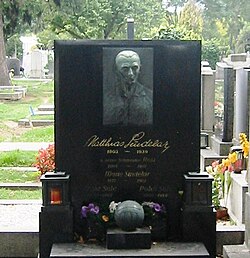
On January 23, 1939, Matthias Sindelar and his girlfriend, Camilla Castagnola, were found dead in their Vienna apartment. The official cause was listed as carbon monoxide poisoning.
His death remains a subject of historical debate. Some believe it was a tragic accident caused by a defective chimney. Others, including writer Friedrich Torberg, suggested it was a suicide driven by the despair of the Nazi occupation. More provocative theories suggest he may have been murdered by the Gestapo, who had kept his café under surveillance. A lifelong friend, Egon Ulbrich, later claimed that officials were bribed to record the death as an accident to ensure Sindelar could receive a state funeral, which was forbidden for suicides or murder victims under Nazi law.
Career Summary
| Category | Appearances | Goals | Major Honours |
|---|---|---|---|
| Club (Total) | 335 | 244 | 1x 1. Liga, 5x Austrian Cup, 2x Mitropa Cup |
| International (Austria) | 43 | 26 | Central European International Cup (1931–32) |
| World Cup (1934) | - | - | Semi-finalist, Silver Ball |
Frequently Asked Questions
Why was Matthias Sindelar called "The Paper Man"?
He was nicknamed Der Papierene (The Paper Man) because of his slight, frail build, which contrasted sharply with his immense skill and agility on the pitch.
What was the "Wunderteam"?
The Wunderteam was the Austrian national football team of the early 1930s. Known for their technical proficiency and organized play, they were one of the most dominant teams of the pre-war era.
What happened during the Anschlussspiel?
The Anschlussspiel was a match between Austria and Germany in 1938 following the Nazi annexation of Austria. It is remembered as a symbolic clash where Sindelar and his teammates used the game to express silent resistance against the Nazi regime.
How did Matthias Sindelar die?
The official cause of death was carbon monoxide poisoning in January 1939. However, theories persist that his death was either a suicide due to political oppression or a murder carried out by the Gestapo.
Was Matthias Sindelar Jewish?
Despite playing for Austria Vienna (a club associated with the Jewish bourgeoisie) and coming from Moravia, historical records indicate that Sindelar's family was Catholic.