Total Football: The Evolution of a Fluid Tactical System
Total Football (Dutch: totaalvoetbal) is one of the most influential tactical systems in the history of association football. Unlike traditional formations where players are locked into specific roles, Total Football is a fluid system where any outfield player can take over the role of any other teammate. When a player moves out of their designated position, another teammate immediately steps in to fill the gap, ensuring the team's organizational structure remains intact.
In this dynamic approach, no player is fixed; a defender may suddenly find themselves attacking, while a forward drops back to organize the defense. This versatility requires highly intelligent players with a diverse skill set and the ability to adapt instantly to the shifting conditions of the match.
Key Facts
- Core Concept: Positional fluidity where players interchangeably swap roles to maintain team structure.
- Primary Requirement: High levels of spatial awareness and tactical intelligence from every player.
- Key Figures: Rinus Michels (manager) and Johan Cruyff (player/exponent).
- Defining Teams: AFC Ajax and the Netherlands national team of the 1970s.
- Modern Legacy: Directly influenced the development of Tiki-taka and Juego de Posición.
The Foundations: Pre-1970s Pioneers
While often associated with the 1970s, the roots of Total Football stretch back decades. Much of the early theory is credited to Jimmy Hogan, an Englishman influenced by the combination game. Hogan's ideas helped shape the Austrian "Wunderteam" of the 1930s under Hugo Meisl, which is considered one of the first sides to employ such a fluid style.
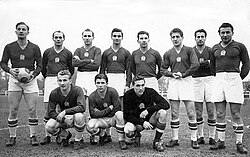
Hogan's influence extended to Hungary, where coach Gusztáv Sebes led the "Golden Team" in the 1950s. The Hungarian Football Association's president, Sandor Barcs, explicitly credited Hogan for their footballing knowledge.
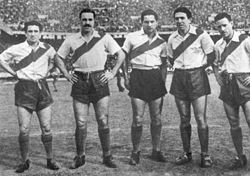
Other teams experimented with similar concepts during this era. In the 1940s, the Italian side "Grande Torino" played a comparable style. Simultaneously, the Argentine club River Plate developed a legendary squad known as "La Máquina" (The Machine). Between 1941 and 1947, this team perfected the false nine—a striker who drops deep into midfield—and constantly rotated attacking positions to confuse defenders.
In England, manager Harry Potts led Burnley to the 1959–60 First Division title using a system where every player could occupy every position. Additionally, Vic Buckingham's work at Ajax and Barcelona provided the educational foundation for the future success of Rinus Michels and Johan Cruyff.
The Golden Era of Totaalvoetbal
Rinus Michels is widely credited with formalizing Total Football during his tenure at AFC Ajax starting in 1965 and later with the Netherlands national team. The system reached its zenith with the emergence of Johan Cruyff. Although listed as a center forward, Cruyff was encouraged to roam freely, using his intelligence to exploit gaps in the opposition's defense.
The success of the system relied on two primary pillars: spatial awareness and pressing. Players focused on constantly creating space and using aggressive pressing to win back the ball or force opponent errors. This proactive approach contributed to the decline of Catenaccio, the heavily defensive Italian system championed by Helenio Herrera.
The effectiveness of this era is reflected in the trophy cabinet, with Michels and Cruyff securing eight Eredivisie titles, three European Cups, and one Intercontinental Cup. However, the system had vulnerabilities. In the 1974 FIFA World Cup final, West Germany managed to stifle the Dutch playmaking through effective marking by Berti Vogts, ultimately winning 2–1.
Summary of Tactical Influence
| Era/Team | Key Figure(s) | Contribution |
|---|---|---|
| 1930s Austria (Wunderteam) | Jimmy Hogan, Hugo Meisl | Early improvisational and fluid play. |
| 1940s River Plate (La Máquina) | Pedernera, Labruna, et al. | Perfected the "false nine" and attacking rotation. |
| 1950s Hungary (Golden Team) | Gusztáv Sebes, Jimmy Hogan | Integration of combination play and fluidity. |
| 1970s Ajax & Netherlands | Rinus Michels, Johan Cruyff | Formalized Total Football; emphasis on space and pressing. |
| 2000s Spain & Barcelona | Pep Guardiola | Developed Tiki-taka and Juego de Posición. |
The Modern Era
The legacy of Total Football did not end with the 1970s. It evolved into the modern tactical systems seen in the late 2000s and early 2010s, most notably with FC Barcelona under Pep Guardiola and the Spanish national team. This evolution resulted in Tiki-taka (a style characterized by short passing and movement) and Juego de Posición (Position Play), both of which maintain the core Total Football principle of intelligent spatial management.
Frequently Asked Questions
What is the main goal of Total Football?
The main goal is to maintain the team's organizational structure while allowing players to move fluidly between positions, thereby creating space and exploiting weaknesses in the opponent's defense.
Who is considered the father of Total Football?
Rinus Michels is generally credited with introducing and formalizing the system in the 1970s, though he was influenced by earlier pioneers like Jimmy Hogan and Jack Reynolds.
What is a "false nine" in this context?
A false nine is a center forward who drops deep into the midfield instead of staying high up the pitch, drawing defenders out of position and creating space for teammates to attack.
How does Total Football differ from Catenaccio?
Total Football is proactive, attacking, and fluid, focusing on the creation of space. Catenaccio is a reactive, defensive-heavy system that prioritizes preventing goals over creating them.
Why is spatial awareness important in this system?
Spatial awareness allows players to know exactly where to stand or run when a teammate leaves their position, ensuring that no area of the pitch is left undefended or unoccupied.