Mathematicians: History, Specializations, and Professional Paths
A mathematician is a professional who utilizes extensive mathematical knowledge to solve complex problems. Their work centers on the study of numbers, data, quantity, structure, space, models, and change. From the ancient philosophers of Greece to modern research scientists, mathematicians have shaped our understanding of the physical and abstract universe.
Key Facts
- Core Competencies: Advanced mathematics, analytical skills, and critical thinking.
- Education: Typically requires a doctoral degree, though a master's degree is occasionally sufficient.
- Employment Sectors: Universities, government agencies, private corporations, and the financial industry.
- Primary Branches: Pure mathematics (abstract concepts) and applied mathematics (real-world problem solving).
- STEM Status: Mathematics is a core pillar of STEM (science, technology, engineering, and mathematics) careers.
The Evolution of Mathematics
The history of mathematics is a global journey of discovery, beginning with early thinkers who transitioned from simple observation to deductive reasoning.
Ancient Foundations
Thales of Miletus (c. 624 – c. 546 BC) is often hailed as the first true mathematician for applying deductive reasoning to geometry. This was followed by Pythagoras of Samos, who founded a school based on the belief that "All is number." Later, Archimedes made monumental contributions to the study of spheres, circles, and the method of exhaustion—an early precursor to integral calculus.
Other pivotal figures include Euclid, whose work Elements established the axiomatic method (a system where a set of basic truths are used to prove further theorems), and Apollonius, who advanced the study of conic sections such as ellipses and parabolas.
Global Contributions and the Middle Ages
Hypatia of Alexandria (c. AD 350 – 415) stands as the first recorded woman mathematician, serving as a librarian and writing on applied mathematics before her death during a political conflict in Alexandria.
During the Middle Ages, the Islamic world became a hub of mathematical advancement through state patronage and the translation of scientific texts. Polymaths like Al-Khawarizmi and Ibn al-Haytham integrated mathematics with optics and astronomy. Simultaneously, Indian mathematicians made critical breakthroughs: Aryabhata applied trigonometry to astronomy, while Brahmagupta provided the first systematic explanation of zero and negative numbers. Later, Mādhava of Sangamagrāma founded the Kerala school, pioneering work in infinite series and algebra.
The Renaissance and the Rise of the Research University
The European Renaissance saw mathematics move toward secular applications. Many early mathematicians held diverse roles; for example, Luca Pacioli founded accounting, and Gerolamo Cardano pioneered probability. By the 17th century, figures like Isaac Newton at Cambridge shifted the focus toward university-based research.
In 1810, the University of Berlin, influenced by Alexander von Humboldt, redefined the university's mission from the mere "regurgitation of knowledge" to the active discovery of it. This shift led to the creation of seminars and laboratories, establishing the modern research university model characterized by freedom of study and professional regulation.
Specializations in Mathematics
Modern mathematics is generally divided into two overlapping philosophies: pure and applied.
Pure Mathematics
Pure mathematics focuses on abstract concepts and the intrinsic nature of mathematical entities. It is often described as speculative mathematics, as it is pursued for its own sake rather than for immediate practical application.
Applied Mathematics
Applied mathematicians use professional methodology to solve concrete problems in science, engineering, business, and industry. Their primary tool is the mathematical model—a mathematical representation of a real-world system used to predict behavior or optimize outcomes.
Teaching and Consulting
Many mathematicians balance research with education. Their duties often include teaching university courses, supervising graduate research, and serving on academic committees.
Professional Landscape
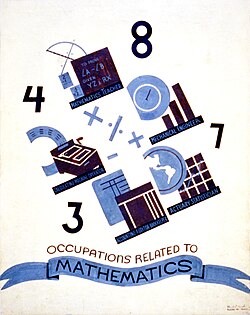
The career paths for mathematicians are diverse, ranging from theoretical research to high-stakes financial analysis.
| Job Title | Primary Focus |
|---|---|
| Actuary | Risk assessment and financial statistics |
| Operations-Research Analyst | Optimization of complex processes |
| Mathematical Statistician | Development of statistical theory and methods |
| Applied Statistician | Application of statistics to real-world data |
| Mathematical Technician | Technical support for mathematical research |
Recognition and Literature
While there is no Nobel Prize for mathematics, the field has prestigious alternatives. The Fields Medal and the Abel Prize are among the most renowned. Additionally, societies like the Association for Women in Mathematics offer prizes to increase representation for women and minorities.
The human side of the profession is often captured in autobiographies. Works such as G.H. Hardy's A Mathematician's Apology and Norbert Wiener's I Am a Mathematician provide insight into the dedication and mindset required for a life of mathematical study.
Frequently Asked Questions
What is the difference between pure and applied mathematics?
Pure mathematics studies abstract concepts for their own sake, while applied mathematics uses mathematical methods to solve practical problems in fields like engineering, business, and science.
What education is required to become a professional mathematician?
Most professional mathematicians hold a doctoral degree (PhD), which typically involves a period of broad undergraduate study followed by specialized graduate research and a dissertation.
Is there a Nobel Prize in Mathematics?
No, there is no Nobel Prize specifically for mathematics. However, mathematicians sometimes win Nobel Prizes in related fields like Physics or Economics, and they compete for other prestigious awards like the Fields Medal.
Where do mathematicians typically work?
They are commonly employed in universities, government agencies, private corporations, and the financial industry, often working as statisticians, actuaries, or research scientists.
Who is considered the Father of Geometry?
Euclid is known as the "Father of Geometry" due to his work Elements, which established the foundations of geometry through axioms and logical proofs.