Marvin Griffin: The Life and Political Career of Georgia's 72nd Governor
Samuel Marvin Griffin, Sr. was a prominent and controversial figure in mid-20th century Georgia politics. A lifelong Democrat and newspaper publisher, Griffin rose through the ranks of state government to serve as both the Lieutenant Governor and the 72nd Governor of Georgia. His tenure was defined by a staunch commitment to racial segregation and a series of high-profile clashes with educational and athletic institutions.
Key Facts
- Office: 72nd Governor of Georgia (1955–1959).
- Military Rank: Brigadier General in the Georgia National Guard.
- Education: Graduate of The Citadel (1929).
- Profession: Publisher of the Bainbridge Post-Searchlight.
- Legacy: Co-founder of Bainbridge College.
Early Life and Professional Beginnings
Born on September 4, 1907, in Bainbridge, Georgia, Marvin Griffin developed a foundation in leadership early on. He attended The Citadel, where he served as a battalion commander and played baseball, graduating in 1929. After a brief period teaching in Virginia, he returned to his hometown of Bainbridge to pursue business and politics.
Griffin entered the political arena in 1934 when he was elected to the Georgia General Assembly. Although an attempt to enter the U.S. House of Representatives failed two years later, he transitioned into executive administration, serving as the executive secretary for Governor Eurith D. Rivers. Beyond politics, Griffin was an entrepreneur, owning the Bainbridge Post-Searchlight and establishing the radio station WMGR (named for Marvin Griffin Radio) in the late 1940s.
Military Service and Rise to Power
During World War II, Griffin served in the United States Army, commanding a Georgia National Guard anti-aircraft battery in New Guinea. He held the rank of major for most of the war and was honorably discharged as a lieutenant colonel in 1944. Immediately following his discharge, Governor Ellis Arnall appointed him as the adjutant general of the Georgia National Guard, a role in which he attained the rank of brigadier general before leaving the post in 1947.
Griffin's ascent in state government continued in 1948 when he became the first Lieutenant Governor of Georgia to win the office via a special election. He was subsequently elected to a full term in 1950, positioning himself as a key figure in the state's Democratic leadership.
The Gubernatorial Years (1955–1959)
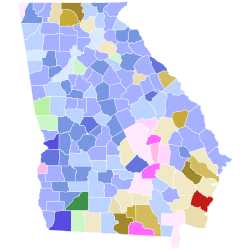
In 1954, Griffin won the Democratic primary for governor with 36.3% of the vote, defeating candidates including Melvin E. Thompson and future Atlanta Mayor Ivan Allen, Jr. His administration was characterized by a fierce opposition to the integration of public schools following the Brown v. Board of Education decision, famously pledging to maintain segregation "come hell or high water."
The 1956 Sugar Bowl Controversy
One of the most contentious episodes of Griffin's term involved the 1956 Sugar Bowl between the Georgia Tech Yellow Jackets and the Pitt Panthers. The controversy centered on Bobby Grier, an African-American player for Pitt. Griffin pressured Georgia Tech's president, Blake R. Van Leer, to pull the team out of the game to avoid a racially integrated event.
President Van Leer steadfastly refused, famously telling the Board of Regents that they could find another president if the team did not play. Despite Griffin's attempts to cut state funding and request investigations into the players and administration, the game proceeded. Van Leer died of a heart attack on January 24, 1956, shortly after the event.
The Springhill Mining Disaster Incident
In 1958, Griffin attempted to use the international media attention surrounding the Springhill mining disaster in Nova Scotia, Canada, to promote Georgia tourism. He offered free vacations to Jekyll Island for the survivors. However, the gesture became a public relations failure when it was revealed that one of the rescued miners was Black, contradicting Griffin's segregationist platform.
Later Political Career and Retirement
Griffin's term was clouded by corruption charges against members of his administration. While a 1960 grand jury investigation into Griffin himself returned no true bills (meaning no indictments were issued), his political standing shifted. In 1962, he ran for governor again but lost the primary to moderate Carl Sanders. Griffin attributed his loss to the voters being "sick and tired" of him.
In later years, Griffin remained active in Democratic politics, supporting segregationist Lester Maddox in 1966. In 1968, he briefly served as a stand-in Vice Presidential candidate for George C. Wallace's American Independent Party, though he was eventually replaced by General Curtis LeMay.
Personal Life and Legacy
Griffin's personal life was marked by tragedy; his 14-year-old daughter, Patricia Ann, perished in the Winecoff Hotel fire in 1946. After leaving office, he returned to Bainbridge to enter the real estate business. In 1970, he helped found Bainbridge College (later Bainbridge State College), serving on its board of directors.
Marvin Griffin died of lung cancer on June 13, 1982, at the age of 74, passing away less than a week after his second wife, Laura Jane Gibson, who had also succumbed to the disease.
| Role | Period | Key Detail |
|---|---|---|
| Georgia General Assembly | 1934–1936 | Early entry into state politics |
| Adjutant General of GA | 1944–1947 | Rank of Brigadier General |
| Lieutenant Governor | 1948–1955 | First to win via special election |
| Governor of Georgia | 1955–1959 | 72nd Governor; staunch segregationist |
| Bainbridge College | Founded 1970 | Served on Board of Directors |
Frequently Asked Questions
What was Marvin Griffin's stance on school integration?
Marvin Griffin was a staunch segregationist who strongly opposed the Brown v. Board of Education ruling and vowed to keep Georgia's schools segregated.
How did Griffin influence the 1956 Sugar Bowl?
Griffin attempted to pressure Georgia Tech to withdraw from the game because the opposing team, the Pitt Panthers, had an African-American player, Bobby Grier.
What was the outcome of the corruption investigations into Griffin?
While several members of his administration were found guilty of crimes, a 1960 grand jury investigation into Griffin himself returned no true bills.
What role did Griffin play in higher education in Georgia?
After his political career, Griffin helped found Bainbridge College in 1970 and served as a member of its board of directors.
Why did Marvin Griffin lose the 1962 gubernatorial primary?
Griffin lost to moderate candidate Carl Sanders. Factors included a shift in voter sentiment and the abolishment of the county unit system, though studies suggest Sanders likely would have won regardless.