1956 Sugar Bowl: Bobby Grier and the Breaking of the Color Barrier
The 1956 Sugar Bowl was more than just a clash between two powerhouse college football teams; it was a pivotal moment in the American struggle for civil rights. Played on January 2, 1956, at Tulane Stadium in New Orleans, the game pitted the 7th-ranked Georgia Tech Yellow Jackets against the 11th-ranked Pittsburgh Panthers. While the final score reflected a defensive struggle, the events surrounding the game signaled a seismic shift in the integration of athletics in the Deep South.
Key Facts
- Historic Milestone: The 1956 Sugar Bowl was the first integrated bowl game in the Deep South.
- The Trailblazer: Bobby Grier, a fullback and linebacker for Pittsburgh, became the first Black player to compete in the Sugar Bowl.
- The Result: Georgia Tech defeated Pittsburgh 7–0.
- Key Figure: Georgia Tech President Blake R. Van Leer resisted political pressure to bench Grier, ensuring the game proceeded.
- Attendance: Between 76,535 and 80,175 spectators attended the event.
A Climate of Segregation
The game took place during a period of intense racial conflict in the United States, coinciding with the aftermath of Brown v. Board of Education (1954) and the murder of Emmett Till (1955). Since its inception in 1935, the Sugar Bowl had been strictly segregated, with separate stadium sections for Black and white attendees and no Black players ever having taken the field.
At the time, many Southern colleges adhered to an unofficial "gentleman's agreement" with Northern schools. This agreement dictated that integrated teams could only play if their African American players were benched. While some Northern schools began refusing these terms in the 1950s, most Southern bowl games remained segregated, with the exception of the Cotton Bowl (1948) and Sun Bowl (1950).
The Battle for Bobby Grier's Participation
When the University of Pittsburgh was invited to the Sugar Bowl, the presence of Bobby Grier sparked immediate controversy. Segregationists in New Orleans and Georgia Governor Marvin Griffin attempted to use their political influence to bar Grier from playing. Pittsburgh took a firm stance: "No Grier, no game," insisting that he travel and play with the team.
Inside Georgia Tech, the response was unexpectedly progressive. Head coach Bobby Dodd polled his players, and every single member voted in favor of playing against an integrated team. However, the most critical support came from Georgia Tech President Blake R. Van Leer. Despite receiving violent threats and facing pressure from the state government, Van Leer insisted that the Institute honor its commitment to the game.
Political Turmoil and Student Protests
Governor Marvin Griffin publicly implored the state's Board of Regents to prevent Georgia teams from participating in integrated events. This sparked a massive backlash from the student body. Approximately 2,000 Georgia Tech students rioted, marching to the governor's mansion and hanging Griffin in effigy. Even students at the rival University of Georgia protested in support of Georgia Tech.
The conflict reached a boiling point when Van Leer was summoned before the Board of Regents. In a legendary display of defiance, he told the board, "Either we're going to the Sugar Bowl or you can find yourself another damn president of Georgia Tech." On December 5, 1955, the board voted 13-1 to allow the game to proceed.
Game Summary: A Defensive Struggle
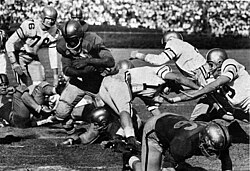
The game itself was a high-caliber defensive battle. Despite Pittsburgh dominating in total yardage (311 yards compared to Georgia Tech's 142), they were plagued by 72 penalty yards and two lost fumbles.
The game's only score occurred after Georgia Tech recovered a Pitt fumble on the 32-yard line. A disputed 31-yard pass interference penalty against Bobby Grier placed the ball at the 1-yard line, where quarterback Wade Mitchell scored the winning touchdown. Pittsburgh nearly tied the game in the second quarter, driving to the 1-yard line, but were stopped on 4th and goal. Bobby Grier finished the game as the leading rusher with 51 yards.
| Category | Georgia Tech | Pittsburgh |
|---|---|---|
| Final Score | 7 | 0 |
| AP Rank | 7 | 11 |
| Total Yardage | 142 | 311 |
| Head Coach | Bobby Dodd | John Michelosen |
| MVP | Franklin Brooks | N/A |
Legacy and Aftermath
The 1956 Sugar Bowl served as a catalyst for integration at Georgia Tech and in Atlanta. Although it did not immediately end segregation in Southern bowl games—Louisiana later passed the "Athletic Events Bill" (Act 579) to prohibit interracial sports competitions—it established a precedent of courage and institutional integrity.
The legal battle against Act 579 eventually reached the U.S. Supreme Court, which upheld a lower court ruling that segregation of public facilities was no longer justifiable. By 1965, the Sugar Bowl was fully integrated, featuring players like Floyd Little and Jim Nance from Syracuse University.
Bobby Grier's legacy as a trailblazer was formally recognized in 2019 when he was elected to the Sugar Bowl Hall of Fame. In 2022, he was enshrined in the Pittsburgh Hall of Fame during a game between Georgia Tech and Pitt, where the families of Grier and Van Leer reunited to honor their shared history.
Frequently Asked Questions
Who was the first Black player to play in the Sugar Bowl?
Bobby Grier, a fullback and linebacker for the University of Pittsburgh, was the first Black player to compete in the Sugar Bowl in 1956.
Why was there controversy surrounding the 1956 Sugar Bowl?
The controversy stemmed from racial segregation in the Deep South. Georgia Governor Marvin Griffin and other segregationists attempted to block Bobby Grier from playing because of his race, challenging the integration of the game.
What role did Blake R. Van Leer play in the game?
As President of Georgia Tech, Blake R. Van Leer resisted intense political pressure and threats from Governor Griffin, insisting that the university honor its contract to play the integrated Pittsburgh team.
How did the Georgia Tech students react to the governor's opposition?
Approximately 2,000 students protested and rioted, marching to the governor's mansion to express their support for playing the game regardless of race.
What was the final score of the 1956 Sugar Bowl?
Georgia Tech won the game with a final score of 7–0.