Mario Vargas Llosa: The Life and Legacy of a Literary Giant
Jorge Mario Pedro Vargas Llosa was more than a novelist; he was a towering figure of 20th and 21st-century letters whose work bridged the gap between rigorous intellectualism and gripping narrative. A central figure of the Latin American Boom—a period of extraordinary literary productivity and international recognition for Latin American writers—Vargas Llosa explored the complexities of power, corruption, and the human condition with surgical precision.
Born in Arequipa, Peru, his journey took him from the halls of the National University of San Marcos to the pinnacle of global literary achievement, culminating in the Nobel Prize in Literature in 2010. His life was marked by a constant evolution, not only in his writing style but in his political convictions, moving from early activism to a staunch defense of liberalism.
Key Facts
- Full Name: Jorge Mario Pedro Vargas Llosa
- Born: Arequipa, Peru
- Died: April 13, 2025, in Lima, Peru (aged 89)
- Major Award: Nobel Prize in Literature (2010)
- Citizenships: Peru, Spain (1993), and Dominican Republic (2023)
- Notable Title: Hereditary Marquess of Vargas Llosa (bestowed by King Juan Carlos I of Spain in 2011)
- Key Literary Movement: Latin American Boom
Literary Career and Evolution
Early Works and the Latin American Boom
Vargas Llosa emerged as a powerhouse of Spanish-language fiction in the 1960s. His early novels, such as The Time of the Hero (1963) and The Green House (1966), established his reputation for creating intricate structures and exploring the social hierarchies of Peru. His work during this era was characterized by a commitment to realism and a deep investigation into the mechanisms of authority.
The Discovery of Humor and Later Mastery
By the 1970s, Vargas Llosa's writing evolved to incorporate a new sense of humor and irony, as seen in Pantaleón and the Special Service (1973) and Aunt Julia and the Scriptwriter (1977). This shift allowed him to critique society through satire without losing the intellectual depth of his earlier work. His later career produced masterpieces like The War of the End of the World (1981) and the critically acclaimed The Feast of the Goat (2000), which examined the brutal dictatorship of Rafael Trujillo.
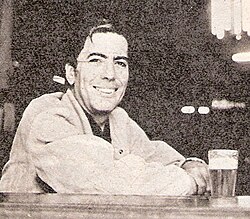
Writing Style and Themes
Vargas Llosa is renowned for his use of interlacing dialogues—a technique where multiple conversations and timelines occur simultaneously, requiring the reader to piece together the narrative. His work often navigates the tension between modernism and postmodernism, focusing on themes of political oppression, the struggle for individual freedom, and the intersection of personal desire and public duty.
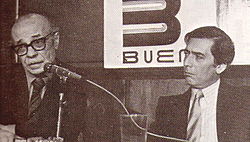
Political Engagement and Public Life
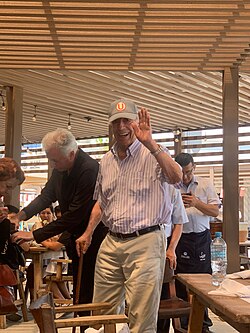
Beyond the page, Vargas Llosa was a deeply political figure. His trajectory saw a significant turn to liberalism, moving away from the leftist ideologies of his youth. He became a vocal critic of authoritarianism across the globe, from the regimes in Latin America to political structures in Spain and Mexico.
His political ambitions peaked with a presidential candidacy in Peru, though he remained primarily an intellectual force. In his later years, he was associated with the People's Liberty party (2023–2025) and the Liberty Movement. His public life was not without controversy, including mentions in the Pandora Papers regarding his financial dealings in Panama.
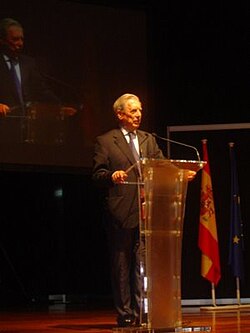
Honors and Global Recognition
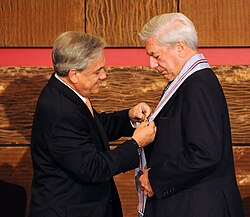
Vargas Llosa's contributions to culture earned him the highest honors from multiple nations. In addition to the Nobel Prize, he received the Miguel de Cervantes Prize (1994) and the Prince of Asturias Award for Literature (1986). He was a member of the Royal Spanish Academy and the Peruvian Academy of Language.
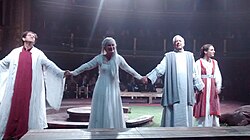
His influence extended into the performing arts, where he wrote numerous plays and even acted in his own production, Los cuentos de la peste, at the Teatro Español in 2015.
Summary of Major Works and Awards
| Category | Notable Examples / Awards |
|---|---|
| Essential Fiction | The Time of the Hero, Conversation in The Cathedral, The Feast of the Goat, The War of the End of the World |
| Key Non-Fiction | A Fish in the Water (Memoirs), Letters to a Young Novelist, Notes on the Death of Culture |
| Major Literary Prizes | Nobel Prize in Literature (2010), Miguel de Cervantes Prize (1994), Rómulo Gallegos Prize (1967) |
| State Honors | Marquessate of Vargas Llosa (Spain), Order of the Sun of Peru, Legion of Honour (France) |
Frequently Asked Questions
What was the "Latin American Boom"?
The Latin American Boom was a literary movement in the 1960s and 70s when authors from Latin America, including Mario Vargas Llosa and Gabriel García Márquez, gained unprecedented international fame for their innovative narrative styles and exploration of regional identity.
Which of his novels is considered the most famous?
While he wrote many influential books, The Feast of the Goat (2000) is widely regarded as one of his most powerful works due to its vivid portrayal of the Trujillo dictatorship in the Dominican Republic.
Did Mario Vargas Llosa hold any political office?
While he ran for the presidency of Peru and was active in several political parties, such as the Liberty Movement and People's Liberty, he is primarily remembered as an intellectual and writer rather than a career politician.
What is the significance of his title as a Marquess?
In 2011, King Juan Carlos I of Spain bestowed upon him the hereditary Marquessate of Vargas Llosa, a rare honor for a writer and a testament to his influence on the Spanish language and culture.
How did his political views change over time?
Vargas Llosa underwent a well-documented ideological shift, moving from early support of revolutionary movements to becoming a champion of classical liberalism and a critic of state-controlled economies and authoritarian regimes.