The Manticore: A History of the Legendary Man-Eater
Deep within the annals of ancient mythology lies one of the most fearsome creatures ever conceived: the manticore. A hybrid of human and beast, this legendary predator has haunted the imaginations of scholars, artists, and storytellers for millennia. From the courts of ancient Persia to the illuminated pages of medieval bestiaries, the manticore has evolved from a terrifying myth into a staple of heraldry and modern fantasy.
What is a Manticore?
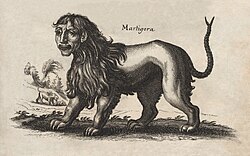
The manticore is a legendary creature characterized by its unsettling combination of features. While descriptions vary slightly across different historical eras, the standard depiction includes:
- The face of a human.
- The body of a lion.
- A tail of a scorpion or a tail covered in venomous, porcupine-like spines.
Some accounts suggest these spines are not merely defensive but can be launched at prey like arrows. Perhaps most terrifying is its method of consumption: the manticore is said to possess three rows of teeth and eats its victims whole, leaving no bones behind.
Etymology: The Meaning Behind the Name
The name "manticore" provides a direct clue to the creature's nature. The English term is derived from the Latin mantichorās, which stems from the Ancient Greek μαρτιχόρας (martikhórās). This, in turn, is a transliteration of an Old Persian compound word.
In Old Persian, the components are martīya (man) and the xar- stem (to eat). In Modern Persian, this is expressed as mardḫ(w)ār (مردخوار), which literally translates to "man-eater."
Ancient Origins and Classical Skepticism
The manticore's history begins in the East. The Greek historian Ctesias purportedly recorded seeing a martichora being presented to a Persian king by travelers from India. However, not all ancient thinkers were convinced of its existence.
The Romanized Greek writer Pausanias expressed skepticism, dismissing the creature as an exaggerated account of a tiger. Similarly, Apollonius of Tyana dismissed the manticore as a mere tall tale. Despite this skepticism, the Roman naturalist Pliny the Elder accepted the creature as fact. Because Pliny's writings were considered authoritative for 1,500 years, his descriptions became the standard for natural history, blending myth with perceived reality.
The Manticore in the Middle Ages
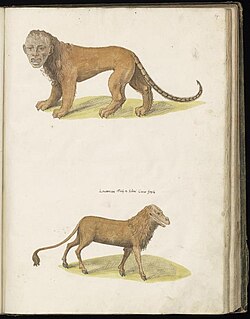
As Christianity spread, the manticore found a new home in bestiaries—medieval books that described various animals, often imbuing them with moral or religious significance. These texts were part of a tradition that combined Plinian natural history with Holy Scripture.
Medieval Bestiaries and Manuscripts
During the Middle Ages, the manticore appeared in numerous manuscripts. It was often depicted with a man's face topped by a Phrygian cap and a long beard. These illustrations helped cement the creature's visual identity in the Western consciousness.
![Woodcut from Edward Topsell's The Historie of Foure-footed Beastes (1607)[61][63]](/images/a8/c2/a8c2dbdab8d1e32f7ed1e23198b3df353959bade282f6105871ebb329aaadff6.png)
The French "Centicore" Confusion
The manticore's journey through history was not without errors. In some French bestiaries, such as those by Pierre de Beauvais, the manticore is largely absent. Instead, a "centicore" (or santicora) appears. Historians believe this was a scribal error—a misspelling of the leucrocotta (a different hybrid beast) that eventually morphed into a misnomer for the yale, a mythical antelope.
Evolution in Heraldry and Natural History
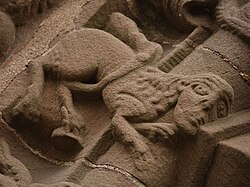
By the late Middle Ages and the Renaissance, the manticore moved from the pages of religious texts into the world of heraldry (the design of coats of arms). It first appeared in English heraldry around 1470 as a badge for William Hastings, 1st Baron Hastings.
Over time, the terminology shifted. In the 17th and 18th centuries, the term mantyger began to replace "manticore" in heraldic discourse. By the 19th century, it was often spelled mantiger. Interestingly, a separate term, mantegar, emerged in 1704 to describe a type of baboon, further complicating the linguistic history of the creature.
Summary of Manticore Characteristics
| Feature/Era | Description |
|---|---|
| Etymology | Old Persian for "man-eater" |
| Physical Traits | Human face, lion body, scorpion/spine tail |
| Primary Diet | Humans (eaten whole) |
| Classical View | Accepted by Pliny; doubted by Pausanias |
| Heraldic Names | Manticore, Mantyger, Mantiger |
Key Facts
- The manticore's name literally means "man-eater" in Old Persian.
- It is characterized by a human face and a lion's body.
- It possesses a scorpion-like tail that may launch venomous spines.
- Pliny the Elder's accounts made the creature a standard part of natural history for over a millennium.
- In English heraldry, the creature is sometimes referred to as a "mantyger."
Frequently Asked Questions
What does the word manticore mean?
The word is derived from the Old Persian compound martīya (man) and xar- (to eat), meaning "man-eater."
How did the manticore differ from a sphinx?
While both are legendary hybrids, the manticore is specifically noted for its lion body, human face, and a venomous scorpion or spine-covered tail, whereas the sphinx is traditionally associated with different anatomical combinations.
Was the manticore considered a real animal in history?
Yes. While some ancient scholars like Pausanias were skeptical, the influential naturalist Pliny the Elder included it in his works, leading many for 1,500 years to treat it as a real creature of natural history.
Why is the manticore sometimes called a "mantyger"?
This is a variation used primarily in heraldry during the 17th and 18th centuries. The spelling evolved from "manticore" to "mantyger" and later "mantiger."
What are the manticore's primary weapons?
The manticore uses its three rows of teeth to eat prey whole, and it is said to have a tail capable of launching venomous spines like arrows.