Great Seal of the State of Colorado: History and Symbolism
The Great Seal of the State of Colorado serves as the official emblem of the state's authority. Adopted on March 15, 1877, the seal is a direct adaptation of the territorial seal created in 1861. While the design remained largely unchanged, the transition to statehood saw the addition of the words "State of Colorado" and the year "1876" to mark the state's formal entry into the Union.
Today, the Colorado Secretary of State holds the exclusive authority to affix this seal to official documents, ensuring the authenticity and legality of state records.
Key Facts
- Adopted: March 15, 1877 (based on the 1861 territorial seal).
- Motto: Nil sine numine ("Nothing without providence").
- Diameter: Two and one-half inches by statute.
- Primary Designers: Lewis Ledyard Weld and William Gilpin.
- Statehood Year: 1876.
Symbolism and Design Elements
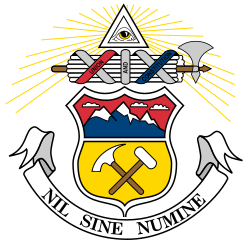
The seal is rich with heraldic imagery, blending classical symbols of power with the natural and industrial identity of the American West. The design is structured vertically, moving from divine oversight to earthly labor.
Divine and Political Authority
At the pinnacle of the seal is the Eye of Providence (also known as the "All Seeing Eye"), enclosed within a triangle with golden rays radiating from its sides. Below this sits a Roman fasces—a bundle of birch or elm rods bound together with a red, white, and blue ribbon inscribed with the words "Union and Constitution." In heraldry, the bundle of rods represents a strength that a single rod lacks, while the accompanying battle axe symbolizes leadership and authority.
Regional Identity and Industry
The center of the seal features a heraldic shield. The upper portion depicts a red sky over three snow-capped mountains and clouds, representing the state's iconic landscape. The lower half of the shield focuses on the state's mining heritage, displaying a crossed pick and sledge hammer set against a golden background.
The State Motto
At the base of the seal, a scroll bears the Latin motto Nil Sine Numine. While commonly translated as "Nothing without providence," the Colorado Department of Personnel and Administration notes that the designers specifically intended it to mean "Nothing without the Deity," distinguishing the term numine from Deo (God).
Origins and Influence
The design is primarily credited to Lewis Ledyard Weld, the territorial secretary appointed by President Abraham Lincoln in 1861, with significant contributions from Territorial Governor William Gilpin. Both men were well-versed in heraldry, and the seal incorporates elements from both the Weld and Gilpin family coats of arms.
The motto Nil sine numine has deep roots, appearing in the Weld family history of Lulworth Castle in Dorset, England. It is also believed to be an adaptation of a line from Virgil's Aeneid. Beyond the state seal, this motto is utilized by the Colorado School of Mines, High Point University, and Virginia Intermont College.
Summary of Seal Components
| Element | Visual Representation | Symbolic Meaning |
|---|---|---|
| Eye of Providence | Eye within a triangle | Divine oversight/Providence |
| Roman Fasces | Bundle of rods and axe | Strength, Union, and Authority |
| Shield (Top) | Mountains and red sky | Colorado's geography |
| Shield (Bottom) | Crossed pick and sledge hammer | Mining industry |
| Motto | Nil Sine Numine | Nothing without the Deity |
Frequently Asked Questions
What does the Colorado state motto mean?
The Latin phrase Nil sine numine is most commonly translated as "Nothing without providence," though official state records specify the intended meaning as "Nothing without the Deity."
Who designed the Great Seal of Colorado?
The design is primarily attributed to Lewis Ledyard Weld, the territorial secretary, with contributions from Territorial Governor William Gilpin.
What is the significance of the fasces on the seal?
The fasces, consisting of a bundle of rods and an axe, symbolizes the strength found in unity (the rods) and the power of leadership and authority (the axe).
When was the seal officially adopted?
The state seal was officially approved by the first General Assembly of the State of Colorado on March 15, 1877, though it was based on a territorial seal from 1861.
Is the Coat of Arms different from the Great Seal?
The Coat of Arms was implicitly defined by the same legislation that created the seal. While it is rarely used today, it is maintained for historical interest.