The Great Seal of the State of Colorado: A Legacy of Symbolism
The Great Seal of the State of Colorado is more than just an official emblem; it is a visual narrative of the state's transition from a territory to a sovereign member of the Union. Adopted by the first General Assembly on March 15, 1877, the seal serves as a formal mark of authority, with the Colorado Secretary of State being the only official authorized to affix it to documents.
The design of the state seal is an adaptation of the original territorial seal, which was first adopted by the First Territorial Assembly on November 6, 1861. While the core imagery remains consistent with its territorial predecessor, the state version updated the inscriptions to reflect the new status of the region, replacing territorial text with "State of Colorado" and the year "1876," marking the year Colorado achieved statehood.
Key Facts
- Adopted: March 15, 1877 (State Seal).
- Motto: Nil Sine Numine ("Nothing without providence").
- Statehood Year: 1876.
- Primary Designers: Lewis Ledyard Weld and William Gilpin.
- Official Diameter: Two and one-half inches.
Symbolism and Design Elements
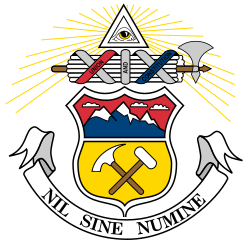
By statute, the seal is two and one-half inches in diameter and contains several deeply symbolic devices. Each element was chosen to represent the values, authority, and natural beauty of the region.
The Eye of Providence and the Fasces
At the top of the seal sits the Eye of Providence, also known as the "All Seeing Eye," positioned within a triangle with golden rays radiating from two sides. Below this, the seal features a Roman fasces—a bundle of birch or elm rods bound together with a red, white, and blue ribbon. The fasces is a classical symbol where the bundle of rods represents strength through unity, while the attached battle axe symbolizes authority and leadership. The ribbon is inscribed with the words "Union and Constitution."
The Heraldic Shield and Mining Heritage
The center of the seal features a heraldic shield. The upper portion of the shield depicts a red sky set behind three snow-capped mountains and clouds. The lower half of the shield rests on a golden ground and displays two essential tools of the region's early economy: a pick and sledge hammer, crossed in a traditional heraldic fashion.
| Element | Symbolic Meaning |
|---|---|
| Eye of Providence | Divine watchfulness/Providence |
| Fasces | Strength in unity and authority |
| Mountains and Sky | Colorado's natural landscape |
| Pick and Sledge Hammer | Mining industry and labor |
| Nil Sine Numine | "Nothing without providence" |
The History of the Motto: Nil Sine Numine
The state motto, Nil Sine Numine, is a Latin phrase that has sparked various interpretations over the years. While commonly translated as "Nothing without providence," other interpretations include "Nothing without God" or, according to Merriam-Webster, "Nothing without the divine will." During the early mining era, some jokingly suggested it meant "nothing without a new mine."
The term numen refers to any divinity, god, goddess, or divine spirit. To ensure clarity, the committee report from the seal's adoption specifically distinguished numine from Deo (God), settling on the interpretative translation: "Nothing without the Deity."
The motto's origins are tied to the state's founding figures. It is believed that Territorial Governor William Gilpin suggested the phrase to Territorial Secretary Lewis Ledyard Weld. Interestingly, the motto is also the family motto of the Weld family of Lulworth Castle in England, a notable recusant family. The phrase also appears in Virgil's Aeneid.
Origins and Designers
The design of the territorial seal, which served as the blueprint for the state seal, is attributed to two men knowledgeable in heraldry—the art of designing coats of arms. Lewis Ledyard Weld, the territorial secretary appointed by President Abraham Lincoln, is primarily credited with the design, though evidence suggests Governor William Gilpin also played a significant role. Elements of the design likely incorporate heraldic symbols from both the Weld and Gilpin family coats of arms.
Frequently Asked Questions
What does the Colorado state motto mean?
The motto "Nil Sine Numine" is most accurately translated as "Nothing without providence" or "Nothing without the Deity." It signifies the importance of divine will or providence.
Who is authorized to use the Great Seal of Colorado?
The Colorado Secretary of State is the only official authorized to affix the Great Seal of Colorado to any document.
What do the tools on the seal represent?
The crossed pick and sledge hammer on the heraldic shield represent the mining industry, which was central to the state's early development.
When did Colorado become a state?
Colorado achieved statehood in 1876, a year which is inscribed at the bottom of the state seal.
What is a fasces?
A fasces is a Roman symbol consisting of a bundle of rods bound together with an axe. In the context of the seal, the rods symbolize strength through unity, and the axe symbolizes authority.