Man-at-Arms: The Heavy Cavalry of the Medieval and Renaissance Eras
The man-at-arms was the quintessential heavy cavalryman of the High Medieval and Renaissance periods. Defined by their extensive armor and mastery of various weapons, these soldiers formed the armored core of European armies for centuries. While the term is often used interchangeably with "knight," the two roles were distinct: knighthood was a social rank, whereas being a man-at-arms was a military function. A man-at-arms could be a nobleman, a knight, a professional mercenary, or a member of a lord's retinue, serving either for pay or through feudal obligation.
Over time, the role evolved from the early medieval miles (horseman) to a specialized military class. By 1300, a clear distinction existed between the social status of a knight and the tactical role of the man-at-arms. This distinction allowed men of lesser social standing—such as esquires or wealthy mercenaries—to serve in the same heavy cavalry capacity as the nobility.
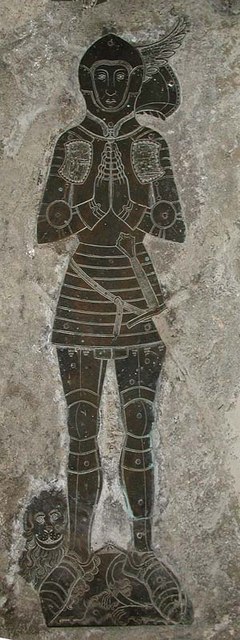
Key Facts
- Military Role: Primarily served as fully armored heavy cavalry, though they frequently fought on foot during the 14th and 15th centuries.
- Social Status: Not all men-at-arms were knights; the role included nobility, esquires, and professional mercenaries.
- Primary Weaponry: The heavy lance was the primary mounted weapon, while the two-handed poleaxe became the standard for foot combat.
- Equipment Cost: Horses were a massive investment, with some costing the equivalent of six months' wages.
- Evolution: Gradually replaced in the 16th century by lighter cavalry like the demi-lancer and the cuirassier.
Arms and Armour
From the 14th to the 16th century, the lance was the primary weapon for mounted combat. Early lances were simple ash spears roughly 12 feet (3.7 m) long. As armor improved, lances became heavier—reaching up to 18 kg (40 lb)—and were used with an arrêt (a lance rest fixed to the breastplate) to increase impact force.
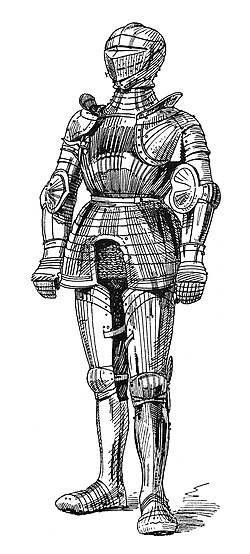
Not all soldiers carried these heavy weapons. A lighter version, the demi-lance, led to the emergence of the demi-lancer, a more lightly equipped class of cavalry toward the end of the 15th century.
Combat on Foot
Despite their cavalry training, men-at-arms often fought on foot. In the 1360s, English soldiers in Italy were known to advance in close order, sometimes sharing lances. At the Battle of Agincourt, lances were cut down to 5 feet (1.5 m) for better maneuverability. By the 15th century, the prevalence of plate armor necessitated the poleaxe, a specialized two-handed weapon designed to penetrate heavy steel.
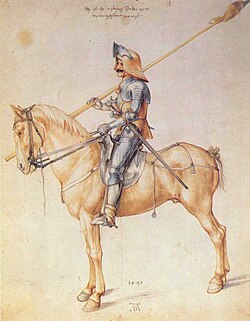
The Essential Warhorse
The horse was as critical as the armor. Depending on wealth, three main types were used: the destrier (a rare, expensive warhorse), the courser, and the general equus (horse). Destriers were elite animals, making up only about 5% of the horses used by men-at-arms.
Because horses were expensive—averaging between £7.6 and £16.4 in 13th and 14th-century England—soldiers often sought to protect their investment. A system called restauro equorum emerged in England (with similar systems in France and Italy) to compensate soldiers for horses lost in action. To qualify for this insurance, the horse's value and appearance were officially recorded.
Horse Armour (Barding)
To protect the animal, horses were barded (armored). Early barding consisted of leather or quilted fabric. Later, metal armor was introduced, utilizing mail or brigandine, with plate armor reserved for the head (the chamfron). By the 15th century, full plate armor for horses became common among the French gendarmes.
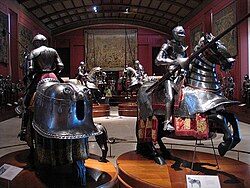
Regional Variations and Evolution
England: From Cavalry to Infantry
In England, the social composition of men-at-arms shifted. While nobility always served, the bulk of the force increasingly came from the gentry, specifically esquires and gentlemen. The percentage of knights among men-at-arms plummeted from 20-30% in the early 14th century to just 1.3% by 1443.
Tactically, the English innovated by combining dismounted men-at-arms with longbowmen, a strategy first seen at the Battle of Dupplin Moor (1332) and later used extensively in the Hundred Years' War. In this role, the man-at-arms served as heavy close-combat infantry, using horses primarily for skirmishing or pursuing broken enemies.
France: The Gendarmes
French men-at-arms, or gens d'armes, were organized into royal companies through various ordonnances. By 1445, these were structured into "lances," where one lance consisted of a man-at-arms, a coustillier (armed servant), three mounted archers, and a page.
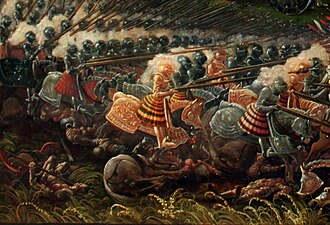
The era of the heavy lancer ended abruptly at the Battle of Coutras (1587), where 2,000 heavy gendarmes were routed by 1,300 armored pistoleers. This signaled the shift toward lighter cavalry armed with firearms and swords.
Italy and Spain
In Italy, men-at-arms were the core of condottiere (mercenary) companies. They operated under contracts (condotte) and were organized into lanze, poste, and bandiere. In Spain, the tradition was heavily influenced by the formation of prominent knightly orders, such as the Order of Calatrava, which blended military and monastic life.
Summary of Man-at-Arms Equipment and Roles
| Feature | Mounted Combat | Foot Combat |
|---|---|---|
| Primary Weapon | Heavy Lance (with arrêt) | Poleaxe or shortened lance |
| Armor | Full plate / Mail / Brigandine | Full plate / Mail / Brigandine |
| Key Asset | Destrier or Courser | N/A (Horse held in reserve) |
| Tactical Goal | Shock charge / Pursuit | Heavy close-combat line |
Frequently Asked Questions
What is the difference between a knight and a man-at-arms?
Knighthood was a social rank and title, whereas "man-at-arms" described a military function. While all knights equipped for war were men-at-arms, many men-at-arms (such as esquires or mercenaries) were not knights.
Why did men-at-arms fight on foot?
Tactical necessity often required them to fight on foot, particularly in English strategies during the Hundred Years' War, where they provided a heavy, armored anchor for longbowmen.
What was a "lance" in the context of French army organization?
In the French ordonnance system, a "lance" was not just a weapon but a small tactical unit consisting of a man-at-arms, a coustillier, three mounted archers, and a page.
How did the role of the man-at-arms end?
The rise of firearms and more mobile cavalry (like pistoleers) made heavy lances and full plate armor obsolete. By the late 16th century, they were replaced by lighter cavalry such as cuirassiers.
What happened to the French Gendarmes after their military decline?
The military corps evolved into a paramilitary police force. The Maréchaussée, created to protect roads from highwaymen, eventually became the modern Gendarmerie after the French Revolution.