Mainz Workers' and Soldiers' Council: The 1918 German Revolution in Mainz
During the tumultuous period of the German Revolution of 1918, the city of Mainz experienced a brief but pivotal shift in governance. For exactly one month, from November 9 to December 9, 1918, the city was administered by the Mainz Workers' and Soldiers' Council (Mainzer Arbeiter- und Soldatenrat), a body that emerged amidst the collapse of the imperial order and the arrival of revolutionary fervor from the north.
The Spark of Revolution in Mainz
The unrest began with news of the Kiel Mutiny—a naval uprising that served as a catalyst for the wider German Revolution—which was reported in the Mainzer Zeitung on Thursday, November 7. The situation escalated rapidly the following day when 50 armed revolutionary sailors arrived from Kiel. These sailors immediately seized control of the railway station and subsequently moved to the local prison to release inmates.
As the traditional authority crumbled, the local population began seizing food supplies, targeting military depots in particular to address shortages.
The Formation of the Council
The local chapter of the Majority Social Democratic Party of Germany (MSPD) viewed the escalating chaos with concern. They feared a precarious position, caught between the threat of a conservative counter-revolution and the prospect of a radical, soviet-style revolution.
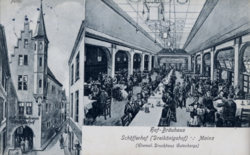
To stabilize the city, local MSPD politician Bernhard Adelung organized a meeting at the Schöffenhof restaurant. This gathering included representatives from the MSPD, various trade unions, and the military. The result was the official formation of the Mainz Workers' and Soldiers' Council, consisting of seven workers and seven soldiers, with Adelung serving as the chairman.
Expanding the Influence
The Council did not limit its efforts to the city center. On November 12, they dispatched a delegation to Ingelheim am Rhein, urging the residents there to establish their own workers' and soldiers' council to mirror the structure in Mainz.
Stabilization and the Transition to French Rule
Once established, the Council acted swiftly to temper the radical elements of the revolution. Under Adelung's leadership, the revolutionary sailors from Kiel were required to return to Frankfurt to prevent further instability. On November 10, standing on the steps of the town hall in Halleplatz, Adelung formally declared the establishment of a democratic republic.
The political landscape shifted again with the agreement of the Armistice terms, which mandated the occupation of the Rhineland. This meant that French troops were scheduled to enter Mainz. Adelung's reformist administration maintained public order and managed the city's affairs until the French troops officially arrived on December 9, 1918.
Key Facts
- Duration: The Council governed Mainz from November 9 to December 9, 1918.
- Leadership: Bernhard Adelung (MSPD) served as the chairman.
- Composition: The council consisted of 14 members (7 workers and 7 soldiers).
- Catalyst: The arrival of 50 armed sailors from the Kiel Mutiny.
- Outcome: The administration ensured public order until the French military occupation.
| Date | Event |
|---|---|
| November 7 | Reports of the Kiel Mutiny published in Mainzer Zeitung. |
| November 8 | Kiel sailors seize the railway station and release prisoners. |
| November 9 | Mainz Workers' and Soldiers' Council formed at Schöffenhof restaurant. |
| November 10 | Bernhard Adelung declares a democratic republic at Halleplatz. |
| November 12 | Delegation sent to Ingelheim am Rhein to encourage council formation. |
| December 9 | French troops arrive in Mainz, ending the Council's governance. |
Frequently Asked Questions
Who led the Mainz Workers' and Soldiers' Council?
The Council was led by Bernhard Adelung, a politician from the Majority Social Democratic Party of Germany (MSPD).
What triggered the revolutionary events in Mainz?
The unrest was triggered by reports of the Kiel Mutiny and the subsequent arrival of 50 armed revolutionary sailors from Kiel who seized the railway station.
How was the Council structured?
The Council was composed of an equal split of representatives: seven workers and seven soldiers.
What was the primary goal of the MSPD during this period?
The MSPD sought to prevent both a conservative counter-revolution and a radical soviet-style revolution, aiming instead for a stable, democratic republic.
When did the Council's authority end?
The Council's effective government ended on December 9, 1918, upon the arrival of French troops as part of the Rhineland occupation.