Magnetization in Classical Electrodynamics
In the realm of classical electromagnetism, magnetization is a vector field that describes the density of magnetic dipole moments—either permanent or induced—within a magnetic material. Essentially, it represents the total magnetic moment per unit volume of a substance. This concept is the magnetic analogue to electric polarization, which measures how a material responds to an electric field.
Magnetization is critical for understanding how materials react to applied magnetic fields and how they, in turn, modify those fields. This interaction is what allows engineers and physicists to calculate the resulting forces and design everything from simple magnets to complex data storage devices.
Key Facts
- Definition: The quantity of magnetic moment per unit volume, represented by the pseudovector M.
- SI Unit: Measured in amperes per meter (A/m).
- Origins: Arises from microscopic electric currents (electron motion in atoms) or the intrinsic spin of electrons and nuclei.
- Material Types: Includes diamagnets (weakly opposed), paramagnets (weakly attracted), and ferromagnets (strongly attracted and capable of becoming permanent magnets).
- Reversibility: Ferromagnetic materials exhibit hysteresis, meaning their magnetization depends on their history and is not a simple one-to-one function of the applied field.
The Physics of Magnetization
Defining the M-Field
The magnetization field, or M-field, is defined as the distribution of magnetic moments across a specific region or manifold. Mathematically, it is the integral of the elementary magnetic moments over a given volume. This makes the M-field completely analogous to the electric polarization field (P-field), which determines the electric dipole moment generated by a similar region.
Material Responses
Different materials respond to magnetic fields in distinct ways:
- Paramagnetic materials: Exhibit a weak induced magnetization that vanishes once the external field is removed.
- Diamagnetic materials: Exhibit a weak response that typically opposes the applied field.
- Ferromagnetic and Ferrimagnetic materials: Exhibit strong magnetization and can maintain this state even without an external field, creating permanent magnets.
Magnetization in Maxwell's Equations
Magnetization plays a pivotal role in the equations that describe the behavior of electric and magnetic fields. It helps define the auxiliary magnetic field (H), which simplifies many electromagnetic calculations. In the SI system, the relationship is defined by the vacuum permeability (approximately 4π × 10-7 V·s/(A·m)).
Linear Relations and Susceptibility
For diamagnets and paramagnets, the relationship between magnetization (M) and the auxiliary field (H) is typically linear. This is expressed using volume magnetic susceptibility (χ) and magnetic permeability (μ). The magnetic energy density of these materials is determined by these factors, and the negative gradient of this energy defines the magnetic force density acting on the material.
Magnetic Polarization
An alternative definition is magnetic polarization (I). While magnetization is measured in amperes per meter, magnetic polarization is measured in teslas. In the SI system, the two differ by a factor of the vacuum permeability (μ₀).
Magnetization Currents
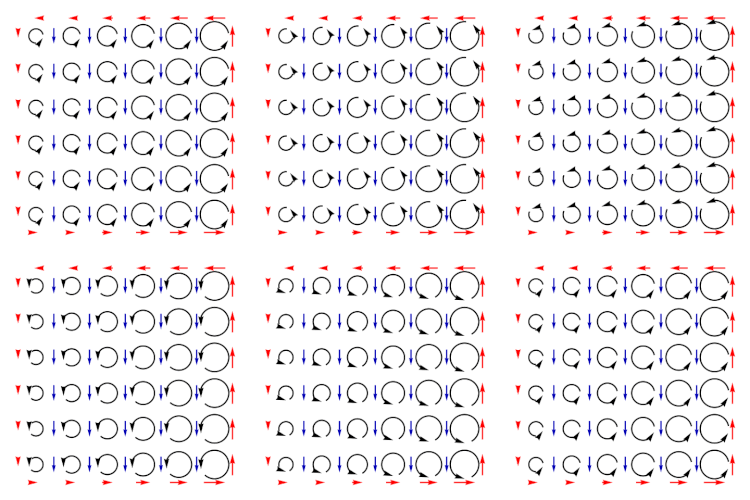
Magnetization contributes to the overall current density (J) through what are known as magnetization currents. These are divided into bound volume currents and bound surface currents.
The total current density entering Maxwell's equations is the sum of the free electric current density (free charges), the contribution from magnetization, and the contribution from electric polarization.
Magnetostatics and Dynamics
In magnetostatics—where there are no free electric currents or time-dependent effects—the divergence of magnetization (∇⋅M) acts as a fictitious "magnetic charge density," similar to how electric charge density functions in electrostatics.
On a nanoscale and nanosecond timescale, the dynamics change. Individual magnetic moments do not simply align with a field; they precess around it and eventually align through relaxation as energy is transferred into the material's lattice.
Reversal and Demagnetization
Magnetization Reversal
Also known as switching, this is the 180° re-orientation of the magnetization vector. This process is the foundation of modern hard disk drives. Reversal can be achieved via:
- An applied magnetic field.
- Spin injection using a beam of particles with spin.
- Circularly polarized light (electromagnetic radiation).
Methods of Demagnetization
Demagnetization is the process of reducing or eliminating magnetization. Common methods include:
- Thermal: Heating a material above its Curie temperature, where thermal fluctuations destroy ferromagnetic order.
- AC Coil: Using an alternating current coil to create opposing fields.
- Ultrafast Demagnetization: Using femtosecond laser pulses to deposit energy directly into electrons. This non-equilibrium process collapses magnetic order in less than a picosecond, long before the lattice heats up.
| Material Type | Magnetization Strength | Persistence | Response to Field |
|---|---|---|---|
| Diamagnetic | Very Weak | Temporary | Opposes field |
| Paramagnetic | Weak | Temporary | Aligns with field |
| Ferromagnetic | Strong | Permanent | Strongly aligns |
Frequently Asked Questions
What is the difference between magnetization and magnetic polarization?
Magnetization (M) is the magnetic moment per unit volume and is measured in amperes per meter (A/m). Magnetic polarization (I) is measured in teslas (T) and differs from magnetization by a factor of the vacuum permeability (μ₀) in the SI system.
What is the Curie temperature?
The Curie temperature is the critical temperature above which a ferromagnetic material loses its permanent magnetic properties due to thermal fluctuations overcoming the exchange interactions that maintain magnetic order.
How does magnetization reversal work in data storage?
Magnetization reversal, or switching, involves flipping the magnetization vector 180 degrees. By switching the orientation of small magnetic regions, devices like hard disk drives can store binary data (0s and 1s).
What are bound currents?
Bound currents are microscopic currents induced by magnetization. When these currents do not balance out, they manifest as bound volume currents within the material and bound surface currents on its boundary.
What is ultrafast demagnetization?
Ultrafast demagnetization is a non-equilibrium process where intense, femtosecond laser pulses deposit energy into electrons, causing the magnetic order to collapse in less than a picosecond, significantly faster than traditional thermal heating.