Magistrale for Europe: Connecting Paris to Bratislava and Budapest
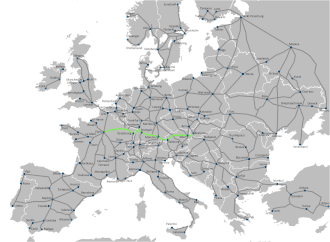
The Magistrale for Europe (also known as the Main Line for Europe) is an ambitious Trans-European Transport Networks (TEN-T) project designed to revolutionize rail travel across the heart of the continent. By creating a high-speed railway corridor between Paris and Bratislava, with a strategic branch extending to Budapest, the project aims to seamlessly link 34 million people across five European nations.
First listed as TEN project No. 17 by the European Commission in 1995, the initiative envisions a total route length of 1,562 km (971 mi) from Paris to Budapest. While the original goal was completion by 2020, the project is being delivered in stages, with various sections already operational and others currently under construction.
Key Facts
- Total Distance: 1,562 km from Paris to Budapest.
- Scope: Connects five countries and serves approximately 34 million residents.
- Top Speeds: Reaches up to 320 km/h on specific French sections.
- Major Hubs: Paris, Strasbourg, Stuttgart, Munich, Salzburg, Linz, Vienna, Bratislava, and Budapest.
- Status: Partially operational with ongoing upgrades in Germany and Austria.
Regional Development and Infrastructure
France: The LGV Est européenne
The French segment is powered by the LGV Est européenne, a dedicated high-speed line. The first phase, reaching Baudrecourt east of Metz, opened in 2007, followed by the second section to Vendenheim near Strasbourg in July 2016. This infrastructure allows trains to reach maximum speeds of 320 km/h (199 mph), slashing the travel time from Paris Gare de l'Est to Strasbourg to just 1 hour and 45 minutes.

Germany: Modernization and the Stuttgart 21 Project
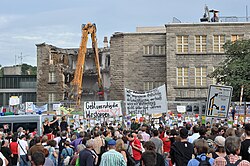
In Germany, the route utilizes a mix of existing and new lines. It follows the Europabahn (max 200 km/h) and the Rheintalbahn (up to 250 km/h) toward Bruchsal, eventually joining the Mannheim–Stuttgart high-speed railway. A central point of the German segment is the Stuttgart 21 project, a controversial but upheld effort to rebuild Stuttgart Hauptbahnhof as a through station, with completion scheduled for December 2026.
Further east, the Wendlingen–Ulm high-speed railway was completed at the end of 2022, providing speeds of 250 km/h. While the Munich–Augsburg line was upgraded in 2011 to separate high-speed traffic from freight, plans for a dedicated high-speed line between Ulm and Augsburg are currently in the planning stages.
Austria: The Western Railway and Neue Westbahn
Austria has focused on reducing travel times between Munich, Salzburg, Linz, and Vienna to roughly one hour per leg. This was achieved through the upgrade of the Attnang-Puchheim to Wels section (230 km/h) and the completion of the Neue Westbahn (New Western Railway) in 2015, which includes the Wienerwald Tunnel and supports speeds of 250 km/h.
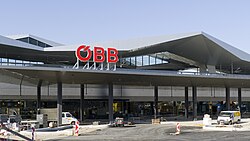
The transit hub in Vienna was further modernized with the demolition of the Südbahnhof and the creation of the new Wien Hauptbahnhof. From here, the line extends to Bratislava-Petržalka and branches off toward Budapest via Győr.
Route Summary and Performance
The transition from traditional rail to high-speed infrastructure has significantly reduced travel durations. For example, the Paris–Strasbourg leg saw travel times drop from 237 minutes to 105 minutes.
| Section | Distance | Key Milestone/Status | Planned/Recent Duration |
|---|---|---|---|
| Paris–Strasbourg | 440.2 km | Operational (2007/2016) | 105 min |
| Strasbourg–Karlsruhe | 81.6 km | Partially in use | 25 min |
| Karlsruhe–Stuttgart | 90 km | Operational | 35 min |
| Stuttgart–Ulm | 85.2 km | Wendlingen-Ulm open 2022 | 28 min (Stut-Wend) |
| Augsburg–Munich | 61 km | Upgraded 2011 | 18 min |
| Salzburg–Linz | 127 km | Upgraded 2011/2013 | 60 min |
| Linz–Vienna | 174 km | Neue Westbahn 2015 | 44-25 min (segments) |
| Vienna–Budapest | 263 km | Ongoing upgrades | Variable |
Frequently Asked Questions
What is the primary goal of the Magistrale for Europe?
The primary goal is to create a high-speed railway corridor connecting Paris, Bratislava, and Budapest, improving connectivity for 34 million people across five European countries.
Is the entire line currently operational?
No, the project is not yet fully completed. While many sections in France and Austria are operational, other parts—particularly in Germany (such as the Stuttgart 21 project)—are still under construction or in the planning phases.
What is the maximum speed achievable on this route?
The highest operational speeds are found on the French LGV Est européenne section, where trains can reach up to 320 km/h (199 mph).
How has the project affected travel time between Paris and Strasbourg?
The introduction of the LGV Est européenne reduced the travel time from 237 minutes to approximately 105 minutes.
What is the significance of the Stuttgart 21 project?
Stuttgart 21 is the conversion of the Stuttgart Hauptbahnhof from a terminal station to a through station, which is essential for the efficient flow of the Magistrale for Europe's high-speed traffic through Germany.