Rail Transit Systems: From Streetcars to Ultra High-Speed Maglev
The world of rail transport is a complex web of terminology, varying significantly by geography and technology. From the local streetcar that navigates city blocks to the ultra high-speed maglev trains that defy conventional physics, each system is designed for specific capacities, speeds, and environments. Understanding these distinctions requires looking at how they move, how they are powered, and how they interact with the surrounding urban landscape.
Key Facts
- Rapid transit is characterized by high speeds (~80 km/h) and fully grade-separated rights-of-way.
- High-speed rail generally operates at speeds between 200 km/h and 400 km/h.
- Standard gauge (1,435 mm) is used by approximately 60% of the world's railway lines.
- Tram-trains combine the flexibility of street-running trams with the speed of heavy rail.
- Ultra light rail features low passenger capacity and often operates without overhead lines.
Rapid Transit and Urban Metro Systems
A rapid transit system is an electric railway defined by high speeds—typically around 80 km/h (50 mph)—and rapid acceleration. These systems use passenger railcars operating in multiple unit trains on fixed rails. A defining feature is that they are grade-separated, meaning they operate on separate rights-of-way where all vehicular and foot traffic is excluded.
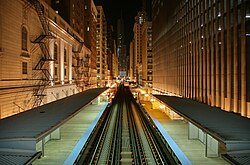
Within this category, various regional terms are used. While "metro" and "subway" are common, different cities have unique identities. For example, the Chicago "L" is a primarily elevated rapid transit system, while the New York City Subway combines various historical rapid transit systems, including some of the oldest elevated lines in the United States dating back to 1869.

Elevated and Overground Rail
Elevated railways provide a way to move large numbers of people above street level. Notable examples include the Manila LRT Line 1, which was the Philippines' first urban rail transit since 1944, and the BTS Skytrain in Bangkok. Historically, the Liverpool Overhead Railway served as the United Kingdom's only true elevated railway.
Light Rail and Street-Level Transit
Light rail systems offer a middle ground between heavy metro systems and street-level trams. A specialized subset known as ultra light rail (or very light rail) involves vehicles with modest requirements, such as the Parry People Mover, which is powered by LPG and carries a maximum of 35 standing passengers.

Trams, Streetcars, and Interurbans
In the United States, the term streetcar is commonly used. These systems evolved from 1830s horse-drawn cars to cable-pulled versions in the 1870s, and finally to electric streetcars in the 1880s.
The interurban was a unique American phenomenon between 1900 and 1930. These were high-speed streetcar lines that functioned as light rail, running through city streets as trams and between towns on their own rights-of-way. Some advanced interurbans reached speeds of 145–150 km/h (90–93 mph).

The Modern Tram-Train
The tram-train represents a modern rebirth of the interurban concept. These vehicles are designed to run on city streets like a tram and then transition to heavy rail tracks to reach the suburbs. This requires dual power systems—such as 750 V DC for trams and 15 kV AC for heavy rail—and specialized signaling. The first such system opened in Karlsruhe in 1992.
Speed Classifications in Rail Transport
As technology has advanced, the industry has developed several tiers of speed classification, though definitions can vary by country and agency.
| Characteristics | Ultra Light Rail | Tram/Streetcar | Light Rail | Metro/Heavy Rail | Commuter Rail |
|---|---|---|---|---|---|
| Rail Tracks | At grade | Private/Street | Grade-separated | Mostly grade-separated | Mostly grade-separated |
| Power Supply | Battery | Overhead lines | Overhead lines | Third/Fourth rail | Overhead/Third rail |
| Avg Speed (km/h) | 10–20 | 30–40 | 45–65 | N/A | N/A |
| Max Passengers/hr | 7,500 | 18,000 | 40,000 | 48,000 | N/A |
High-Speed and Beyond
Rail speed is generally categorized into several tiers:
- Conventional Rail: Speeds up to 200 km/h (124 mph) in some regions.
- Higher-speed Rail: Typically between 130 km/h and 250 km/h.
- High-speed Rail: Generally defined by a top speed of over 200 km/h (124 mph), often utilizing continuous welded rail to reduce vibration.
- Very High-speed Rail: Speeds between 310 km/h and 500 km/h.
- Ultra High-speed Rail: Speeds between 500 km/h and 1,000 km/h, likely dominated by maglev (magnetic levitation) technology.
Track Gauge and Infrastructure
The distance between the inner edges of the rails is known as the track gauge. While standard gauge (1,435 mm) is the global norm, other types exist:
- Narrow-gauge: Between 600 mm and 1,435 mm; cheaper to build but lower capacity.
- Minimum-gauge: Less than 600 mm; primarily used for industrial or miniature railways.
- Broad-gauge: Greater than 1,435 mm, such as the 1,520 mm Russian gauge.
Frequently Asked Questions
What is the main difference between a metro and a light rail?
A metro (or heavy rail) is typically fully grade-separated, meaning it does not cross paths with cars or pedestrians, and is designed for much higher passenger capacities. Light rail often has more interaction with street traffic and lower passenger volumes.
How do tram-trains work on different tracks?
Tram-trains use specialized vehicles capable of handling two different electrical systems (such as low-voltage DC for streets and high-voltage AC for mainlines) and are equipped to follow both tram and heavy rail signaling protocols.
Why is continuous welded rail important for high-speed trains?
Continuous welded rail reduces the vibrations and discrepancies found between individual rail segments, which is essential for maintaining stability and passenger comfort at speeds exceeding 200 km/h.
What is maglev technology?
Maglev, or magnetic levitation, is a type of rail transit that uses magnetic forces to lift and propel the train. Because it does not rely on traditional wheel-on-rail contact, it is a primary candidate for reaching ultra high-speed ranges above 500 km/h.
What are low-level vs. high-level platforms?
Low-level platforms are typically 30 to 45 cm above the track and are used by trams and some light rail. High-level platforms are 45 to 95 cm above the track and are used by heavy rail and automated guideways to allow level boarding for high-floor vehicles.