Lyrebirds: Australia's Master Mimics of the Rainforest
Deep within the wet forests of Australia lives one of the world's most extraordinary avian performers: the lyrebird. Known for their uncanny ability to replicate almost any sound they hear—from the songs of other birds to the mechanical noise of chainsaws—these birds are more than just mimics. They are ancient survivors with a complex social structure and a fascinating taxonomic history.
Belonging to the family Menuridae, lyrebirds are among the largest members of the order Passeriformes (perching birds). While they may look like pheasants or peacocks, they are biologically distinct, possessing a unique evolutionary lineage that dates back millions of years.
Key Facts
- Ancient Lineage: Fossils of the prehistoric Menura tyawanoides date back approximately 15 million years to the Early Miocene.
- Master Mimics: Capable of imitating local wildlife and human-made sounds, including electronic games and power tools.
- Ground Dwellers: Despite being passerines, they are poor fliers and spend most of their time on the forest floor.
- Unique Courtship: Males build mounds of soil or twigs to perform elaborate singing and dancing displays.
- Slow Maturity: They have long breeding cycles, with males starting to breed between six and eight years of age.
Taxonomy and Evolution
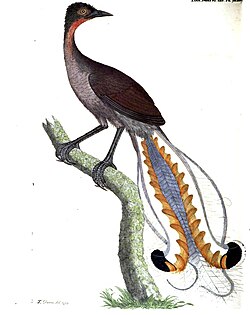
The classification of the lyrebird was a point of significant debate among early European scientists. When specimens first arrived in England after 1798, they were initially mistaken for Galliformes (game birds) such as partridges and pheasants due to their appearance. They were even referred to as "native pheasants" or "peacock-wrens."
This misconception was corrected when scientists observed that lyrebird chicks are altricial (born blind, featherless, and dependent on parents), unlike the precocial chicks of pheasants. By 1840, they were officially classified as passerines. While Major-General Thomas Davies first described the species as Menura superba in 1800, the name Menura novaehollandiae, coined by John Latham in 1801, became the accepted scientific name due to nomenclatural priority.
Species and Distribution
There are two extant (living) species of lyrebird, both endemic to Australia. The Superb Lyrebird is the more widespread of the two, found in the rainforests of Victoria, New South Wales, and south-east Queensland, as well as in Tasmania where it was introduced in the 19th century. The Albert's Lyrebird, named after Prince Albert, has a much more restricted range, found only in small areas of southern Queensland rainforest.
| Feature | Superb Lyrebird (M. novaehollandiae) | Albert's Lyrebird (M. alberti) |
|---|---|---|
| Common Names | Weringerong, Woorail, Bulln-bulln | Northern Lyrebird |
| Range | SE Australia (VIC, NSW, QLD, TAS) | Southern Queensland |
| Courtship Platform | Mound of bare soil | Pile of twigs |
| IUCN Status | Least Concern (LC) | Near Threatened |
Physical Characteristics and Behavior
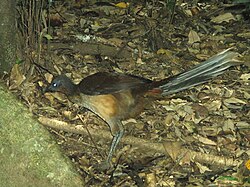
Lyrebirds are large, ground-living birds with strong legs and short, rounded wings. They rarely fly, typically only engaging in downhill gliding. They range from 31 to 39 inches in length, including the tail. Males are generally larger, weighing around 2.4 pounds compared to the female's 2.0 pounds.
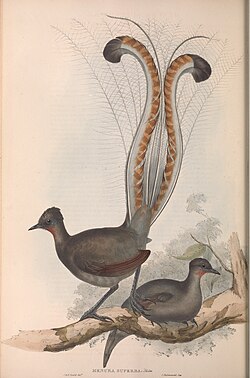
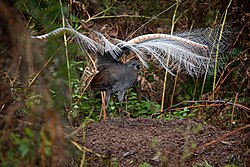
The most striking feature of the male is his tail, consisting of 16 modified feathers. While early taxidermy mistakenly suggested the tail resembles a lyre (hence the name), in reality, the male fans his tail forward during courtship, completely covering his head and back.
Diet and Breeding
Lyrebirds can live up to 30 years. Their breeding process is slow and solitary for the female. After a male performs his winter dance on a display mound to attract mates, the female builds a water-resistant, hidden nest. She lays a single egg, which she alone incubates for over 50 days and subsequently raises the chick without male assistance.
The Art of Mimicry
The superb lyrebird is world-renowned for its vocal capabilities. These birds learn calls from their local environment. In Tasmania, populations have retained the songs of non-native species while adding local endemic calls to their repertoire. Even females are capable of complex vocalizations, though they remain silent during courtship, using their voices instead for foraging and nest defense.
Some accounts describe lyrebirds mimicking human music. In the New England National Park, recordings of flute-like tunes were traced back to a pet lyrebird that had lived with a flute player in the 1930s. While some musicologists suggest these songs resemble tunes like "The Keel Row," researchers have found mixed evidence regarding the persistence of these specific melodies in the wild.
Conservation Status
While the superb lyrebird was long considered common, the devastating Australian bushfires of 2019–2020 have raised alarms. These fires destroyed vast tracts of the wet-forest habitats that previously acted as natural firebreaks due to their moisture content. This loss, combined with predation by foxes and cats and human urban pressure, may lead to a reclassification of the species as threatened.
Cultural Significance
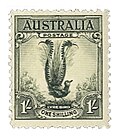
The lyrebird is a prominent symbol in Australian culture. It appears on the reverse of the 10-cent coin, the 100-dollar note, and a 1932 postage stamp. It also serves as the logo for the Australian Film Commission and the New South Wales National Parks and Wildlife Service.
Frequently Asked Questions
Why are they called lyrebirds?
They were named after the lyre because an early 19th-century taxidermist, who had never seen a live specimen, mistakenly arranged the male's tail feathers to look like the musical instrument. This incorrect depiction was later popularized in paintings by John Gould.
Can female lyrebirds also mimic sounds?
Yes, females of both species are capable of complex mimicry. While they do not sing during courtship, they use sophisticated vocal displays while foraging or defending their nests.
How long do lyrebirds live?
Lyrebirds are long-lived passerines that can live for up to 30 years.
What is the difference between the two lyrebird species?
The Superb Lyrebird is larger and found across south-eastern Australia, using soil mounds for courtship. Albert's Lyrebird is found only in southern Queensland and uses piles of twigs for its display platforms.
Are lyrebirds endangered?
Albert's Lyrebird is currently listed as Near Threatened. The Superb Lyrebird is generally Least Concern, but conservationists are concerned that habitat loss from the 2019–2020 bushfires may change its status.