Lyon Village: The History and Evolution of an Arlington Landmark
Nestled in the heart of Arlington, Lyon Village stands as a testament to the shifting tides of American urban planning, from colonial land grants to the modern pressures of urbanization. Once a sprawling dairy farm and summer retreat, this neighborhood was meticulously designed to reflect the aspirations of the early 20th-century upper-middle class, blending aesthetic beauty with the emerging convenience of automotive transit.
Colonial Roots and the Cruit Era
The origins of Lyon Village date back to the colonial era, when the land was part of the expansive Northern Neck land grant. In 1709, William Struttfield of Westmoreland County purchased 500 acres from Thomas Fairfax, the 5th Lord Fairfax of Cameron. Over the next two centuries, the property changed hands several times, including ownership by George Mason and his son, John.
In July 1846, Robert Cruit, a butter merchant from Washington, acquired the land from Robert and Mary Witticomb. Cruit transformed the property into a dairy farm and summer retreat, operating it with enslaved labor from 1847 until the early years of the American Civil War. A remnant of this era still exists today: the Cruit farmhouse on North Highland Street, which served as a hospital for six months during the war for the 3rd and 8th Pennsylvania Cavalry Regiments.
The Vision of Frank Lyon
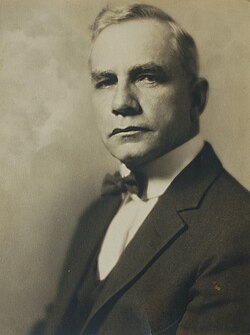
The transition from farmland to residential suburb began in 1912 when Robert Cruit's granddaughters started subdividing the land. In 1923, Frank Lyon—a land developer and newspaper publisher from Petersburg, Virginia—purchased 165 acres for $185,000. Having already developed the neighboring Lyon Park in 1922, Lyon envisioned Lyon Village as an upscale community inspired by the City Beautiful movement, an architectural philosophy that promoted beautification and monumental grandeur to improve social order.
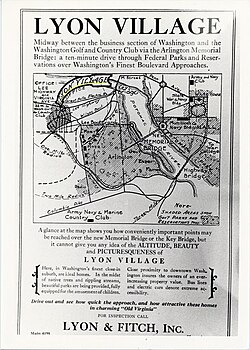
Marketing for the new subdivision highlighted its strategic location, emphasizing easy commutes to Washington via trolley and the planned Arlington Memorial Bridge. This shift mirrored a broader societal trend moving away from rail-dependency toward car-based transit.
Segregation and Social Barriers
Despite its aesthetic appeal, the development was rooted in the systemic inequalities of the Jim Crow era. Promotional materials explicitly highlighted racial segregation, and racially restrictive covenants—legal clauses in property deeds—prevented African Americans and other minority groups from purchasing homes. These discriminatory practices remained in place until the Civil Rights Act of 1968 abolished de jure (legal) housing segregation across the United States.
Growth and Community Development
The first 148 acres were platted in 1923 by Lyon & Fitch. Landscape architect William F. Sunderland divided the area into nine sections, incorporating parts of the existing Aurora Heights (developed starting in 1906) and Clarendon (platted in 1900) communities. The growth of the Federal workforce in the 1920s drove high demand; by 1929, approximately 134 buildings stood east of North Highland Street, while the Aurora Heights section featured over 135 buildings, including a school and various stores.
While the Great Depression slowed progress, development surged during the economic recovery. By 1950, the neighborhood had grown to over 800 buildings, with construction continuing into the mid-1960s.
The Battle for Community Amenities
A point of contention arose regarding a trust fund created by Lyon's firm, which retained 10% of each lot's purchase price for infrastructure maintenance. In 1940, the Lyon Village Citizens Association (established in 1926) sued Lyon Incorporated to claim these funds for a community center and park. After a legal battle that reached the Supreme Court of Virginia, an agreement was reached in October 1944. Lyon provided $20,000 and eight lots, leading to the 1949 completion of a one-story Colonial Revival community house designed by resident Eimer Cappelmann.
Modern Era and Preservation
Lyon Village earned official recognition for its historical significance when it was added to the Virginia Landmarks Register on December 5, 2001, and the National Register of Historic Places on May 10, 2002. However, these designations do not impose architectural restrictions, allowing homeowners to renovate or demolish historic structures.
In recent years, the neighborhood has faced significant development pressure due to its proximity to the urbanized Clarendon area and the Orange and Silver Metro lines. This has led to conflicts over missing middle housing—the gap between single-family homes and large apartment complexes. Examples include the First Baptist Church's 2011 construction of a 10-story low-income apartment building and a proposed 6-story senior housing project by the Clarendon Presbyterian Church, which was canceled in the early 2020s due to rising construction costs linked to federal tariff policies.
Key Facts
- Founded: Platted in 1923 by Frank Lyon and his firm, Lyon & Fitch.
- Design Influence: Based on the City Beautiful movement for an upper-middle-class aesthetic.
- Historic Status: Listed on the Virginia Landmarks Register (2001) and National Register of Historic Places (2002).
- Civil War History: The Cruit farmhouse served as a hospital for the 3rd and 8th Pennsylvania Cavalry Regiments.
- Legal Milestone: A 1944 Supreme Court of Virginia ruling secured funding for the neighborhood's community house.
| Period/Year | Key Event |
|---|---|
| 1709 | William Struttfield purchases 500 acres from Lord Fairfax. |
| 1846 | Robert Cruit establishes a dairy farm and summer retreat. |
| 1923 | Frank Lyon purchases 165 acres to develop Lyon Village. |
| 1926 | Establishment of the Lyon Village Citizens Association. |
| 1949 | Completion of the Colonial Revival community house. |
| 2001-2002 | Added to State and National historic registers. |
Frequently Asked Questions
Who was Frank Lyon?
Frank Lyon was a newspaper publisher and land developer from Petersburg, Virginia, who purchased the land in 1923 to create the Lyon Village subdivision, following his development of Lyon Park in 1922.
What was the City Beautiful movement?
The City Beautiful movement was an urban planning philosophy that emphasized aesthetic grandeur and beautification to promote social harmony and civic virtue, which heavily influenced the design of Lyon Village.
How did racial segregation affect the neighborhood?
Lyon Village utilized racially restrictive covenants to ensure only white buyers could purchase property, a common practice in Jim Crow era Arlington that persisted until the Civil Rights Act of 1968.
Does the National Register of Historic Places prevent home demolition?
No. In Lyon Village, the historic designations do not mandate architectural restrictions, meaning property owners are still permitted to substantially renovate or demolish their homes.
What is the current zoning conflict in Lyon Village?
The neighborhood is currently under single-family zoning but faces pressure for higher-density "missing middle" housing and affordable housing projects due to its proximity to the urban center of Clarendon and Metro access.