Luminiferous Aether and the Evolution of Modern Physics
For centuries, scientists grappled with a fundamental question: how does light travel through the void of space? In the 19th century, the prevailing answer was the luminiferous aether (from the Latin for "light-bearing"). This hypothesized medium was envisioned as a spatial plenum—a space completely filled with matter—that served as the necessary substrate for light waves to propagate. Because wave theories of the time suggested that waves cannot travel through a total vacuum, the aether provided the theoretical framework required to explain the behavior of light.
However, the aether presented a paradox. To remain undetected, it had to be an invisible, infinite material that did not interact with physical objects, yet it had to possess the physical properties necessary to carry high-frequency electromagnetic waves. As the century progressed, these required qualities became increasingly contradictory, leading to a series of experiments that would eventually dismantle the hypothesis and pave the way for modern physics.
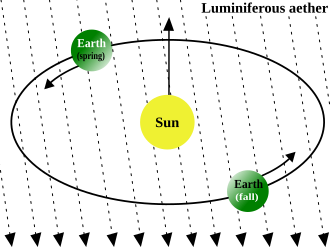
Key Facts
- Definition: The luminiferous aether was a postulated medium used to explain how light waves propagate through space.
- The Conflict: Wave theory required a medium, but the aether had to be invisible and non-interactive with matter.
- The Turning Point: The 1887 Michelson–Morley experiment failed to detect "aether wind," providing a null result.
- The Resolution: Albert Einstein's special theory of relativity removed the need for a physical aether.
- Legacy: The search for the aether led to the discovery of length contraction, time dilation, and quantum theory.
Models of Aether Motion
As scientists attempted to reconcile the aether with the Earth's movement through space, two primary models emerged to describe the relative motion between the planet and the medium.
Stationary Aether and Partial Drag
Proposed by Augustin-Jean Fresnel in 1818, this model suggested that the aether was nearly stationary. Fresnel introduced a "dragging coefficient" to explain how a medium with a refractive index n moving at velocity v would slightly increase the speed of light traveling in the same direction. This theory gained support in 1851 through Fizeau's experimental confirmation.
Complete Aether Drag
George Gabriel Stokes proposed in 1844 that the Earth completely dragged the aether along with it. This model was eventually rejected because it was incompatible with the aberration of light and was later proven untenable by the Sagnac effect in 1913.
The Quest for Aether Drift
If the aether were stationary, the Earth's orbit should create an "aether wind." Scientists conducted various experiments to detect this drift, categorized by the mathematical order of the effects they sought to measure.
First-Order Experiments
These experiments looked for linear effects of the aether. While Fizeau initially reported a positive result in 1860 regarding the rotation of polarization planes, subsequent repetitions by DeWitt Bristol Brace (1905) and Strasser (1907) yielded negative results, suggesting no first-order drift existed.
Second-Order Experiments: Michelson–Morley
The most famous attempt to detect the aether was the 1887 Michelson–Morley experiment. By comparing light reflecting in two orthogonal directions, the researchers looked for phase changes caused by the Earth's velocity through the aether.
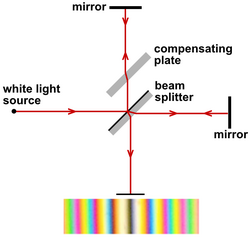
The result was a null result. While they observed a tiny shift (0.01 of a fringe), it was far below the expected 0.4 shift required by the aether wind hypothesis. This demonstrated that the aether wind did not exist as predicted. Other experiments, such as the Trouton–Noble experiment (1903) and work by Rayleigh and Brace, similarly failed to find evidence of the medium.
Theoretical Attempts to Save the Aether
Rather than abandon the theory, some scientists attempted to add complexity to the aether's properties. One such effort was the aether entrainment hypothesis, which suggested that massive objects could drag the aether. However, experiments by Lodge, Zehnder, and the 1935 Hammar experiment (using massive lead blocks) all returned null results.
The Lorentz Aether Theory
Between 1892 and 1904, Hendrik Lorentz developed a model where the aether was completely motionless. To explain the null results of the Michelson–Morley experiment, he introduced the concept of physical length contraction and a mathematical artifice called local time. These ideas were further refined by Henri Poincaré, who formulated the Principle of Relativity and interpreted local time as a result of clock synchronization via light signals.
The Transition to Modern Physics
The aether hypothesis finally collapsed with the advent of the special theory of relativity. Albert Einstein proposed that the speed of light is constant in all inertial frames, rendering the aether unnecessary. This shift, combined with the study of the photoelectric effect and blackbody radiation, led to the birth of quantum theory, which explains the particle-like nature of light.
Interestingly, in his later years, Einstein noted that within the context of general relativity, one could speak of a "new aether" in terms of the properties of space itself, though this new version did not allow for motion relative to the medium.
| Model/Experiment | Key Proponent | Core Concept | Outcome |
|---|---|---|---|
| Fresnel Model | A.J. Fresnel | Stationary aether with partial drag | Supported by Fizeau (1851) |
| Stokes Model | G.G. Stokes | Complete aether drag | Rejected (Aberration conflict) |
| Michelson–Morley | A. Michelson & E. Morley | Detection of aether wind | Null Result |
| Lorentz Theory | H. Lorentz | Length contraction & local time | Mathematical precursor to Relativity |
Frequently Asked Questions
What exactly was the luminiferous aether?
It was a hypothesized invisible medium that scientists believed filled all of space, acting as the carrier for light waves, similar to how air carries sound waves.
Why was the Michelson–Morley experiment so important?
It provided the first clear experimental evidence that the aether wind did not exist, creating a crisis in physics that eventually led to the development of the theory of relativity.
How did Einstein's theory replace the aether?
Einstein's special relativity postulated that light travels at a constant speed regardless of the observer's motion, meaning no external medium (aether) was required for its propagation.
What is the difference between aether drag and a stationary aether?
A stationary aether remains fixed while the Earth moves through it (creating a "wind"), whereas aether drag suggests that the Earth pulls the medium along with it as it moves.
Did the aether theory contribute anything to science?
Yes. The attempt to explain the aether's behavior led to the discovery of the Lorentz transformations, length contraction, and time dilation, all of which are fundamental to modern physics.