Luitpold Gymnasium: A Legacy of Academic Excellence in Munich
Located in the heart of the Lehel city district, near Munich's historic Old Town, the Luitpold Gymnasium stands as a distinguished secondary school with a rich history of academic achievement. From its royal foundations in the late 19th century to its modern role as a co-educational institution, the school has remained a cornerstone of education in the Bavarian capital.
Key Facts
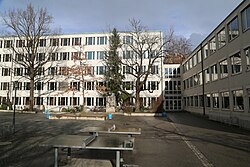
- Founded: 1891 by Prince Luitpold of Bavaria.
- Location: Seeaustraße 1, Lehel district, Munich, Germany.
- Original Name: Luitpold-Kreisrealschule.
- Co-education: Introduced in 1983.
- Specialization: Offers focused study in natural sciences or foreign languages.
A History of Resilience and Growth
The institution was established in 1891 as the Luitpold-Kreisrealschule, intended to serve the suburbs and the eastern regions of Munich. Its original campus was situated on Alexandrastrasse, directly opposite the National Museum. However, the school faced a devastating turning point in 1944 when incendiary bombing during World War II destroyed the building, leaving only the gymnasium (sports hall) and fragments of the exterior walls intact.
Following the war, the school operated out of the facilities of the Wilhelmsgymnasium. This temporary arrangement lasted until 1958, when the Luitpold Gymnasium moved into its current permanent home at Seeaustraße 1.
Evolution of the Educational Model
The school has continuously evolved its pedagogical approach to meet modern standards. In 1975, it implemented the Kollegstufe system—a specialized upper-secondary phase that allows students to pursue an individualized course of study during their final two years before graduation. Further modernization occurred in 1983, when the school transitioned to a co-educational model, welcoming both male and female students.
Academic Curriculum and Opportunities
The Luitpold Gymnasium provides a rigorous academic environment where students can tailor their education to their strengths. The curriculum is designed to allow students to select a primary area of study, choosing between natural sciences or foreign languages.
Beyond the core subjects, students in the Kollegstufe phase can select various electives to further specialize their knowledge. To foster global perspectives, the school also facilitates several student exchange programs, connecting Munich's youth with international peers.
| Feature | Details |
|---|---|
| Founder | Prince Luitpold of Bavaria |
| Established | 1891 |
| Current Address | Seeaustraße 1, Munich |
| Academic Focus | Natural Sciences & Foreign Languages |
| Key Milestone | Kollegstufe system introduced (1975) |
Notable Alumni
The school's commitment to excellence is reflected in the achievements of its former students. The Luitpold Gymnasium has been the alma mater of world-renowned intellectuals and artists, including:
- Albert Einstein (1879–1955): The legendary physicist.
- Abraham Fraenkel (1891–1965): An influential mathematician.
- K. Peter C. Vollhardt (b. 1946): A distinguished chemist who graduated in 1965 and served as a pupil representative.
- Michael Reinhardt (b. 1938): A celebrated photographer.
Frequently Asked Questions
What is a Gymnasium in the German education system?
In Germany, a Gymnasium is a type of secondary school that prepares students for the Abitur, the qualification required to enter university.
When did the Luitpold Gymnasium become co-educational?
The school began admitting both male and female students in 1983.
What is the Kollegstufe system?
Introduced at the school in 1975, the Kollegstufe is a system that permits students to follow an individual course of study during their final two years of high school.
Where was the school located before moving to Seeaustraße?
The school was originally located on Alexandrastrasse, opposite the National Museum, before the building was destroyed in 1944.
What study paths can students choose at Luitpold Gymnasium?
Students can choose to focus their main area of study on either the natural sciences or foreign languages.