Louisiana Coastal Erosion: A State Fighting for Its Shoreline
Coastal erosion in Louisiana is the steady depletion of wetlands—including marshes, swamps, and barrier islands—along the state's coastline. This crisis primarily affects the alluvial basin surrounding the mouth of the Mississippi River. Over the last century, the state has lost an estimated 4,833 square kilometers (1,866 sq mi) of land, an area roughly equivalent to the size of Delaware.
The rate of this loss has fluctuated over time, ranging from 28.01 to 83.5 square kilometers annually, with the most severe depletion occurring during the 1970s. This disappearing landscape does more than change the map; it increases the vulnerability of the New Orleans metropolitan area and other regional communities to devastating hurricane storm surges.
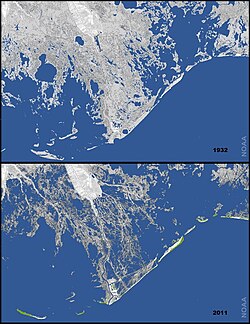
Key Facts
- Total Land Loss: Approximately 4,833 sq km lost over the last century.
- Annual Rate: Equivalent to losing a football-field-sized area of wetlands every 30 minutes.
- Primary Drivers: A combination of sea level rise, land subsidence, and human intervention.
- Economic Impact: Threatens a commercial fishing industry worth over $300 million.
- High-Risk Areas: Terrebonne and Lafourche Parishes could be underwater within 50 to 80 years.
The Drivers of Wetland Loss
Coastal erosion is defined as the loss of coastal lands due to the net removal of sediments or bedrock from the shoreline. In South Louisiana, this is not caused by a single factor, but by a complex intersection of natural and man-made forces.
Geological and Environmental Factors
The region suffers from subsidence—the gradual sinking of land. This is dominated by Glacial Isostatic Adjustment (GIA) and the compression of organic sediments. While global warming-induced sea level rise is not the root cause, it is a significant contributing factor and a major future concern.
Human Intervention and Infrastructure
The extensive levee system, locks, and dams built to prevent flooding along the lower Mississippi River have created a paradox. While they protect inland areas, they prevent silt from being distributed into the downriver marshes. Without this new accretion (the gradual accumulation of sediment), wetlands are replaced by encroaching saltwater from the Gulf of Mexico.
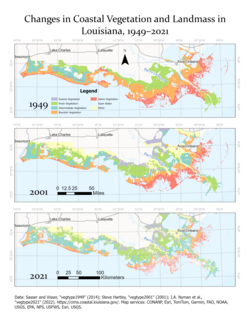
Industrial Impact
Oil and gas extraction, which peaked in 1970, has left a lasting mark. The construction of canals and pipelines has altered hydrologic flow, allowing saltwater to intrude into freshwater marshes. A prominent example is the now-closed Mississippi River Gulf Outlet (MRGO), which facilitated significant erosion in St. Bernard Parish. Legal actions have since claimed that these industry canals "shredded" the marsh swamps that once buffered the region from Gulf storms.
Biological Threats
The introduction of the nutria, an invasive rodent from South America, in the 1930s accelerated vegetation loss. By grazing on plants and removing dead organic matter that would otherwise form peat, nutria prevent the marsh from raising its elevation. Natural predation by large alligators remains one of the few biological controls for this species.
Regional Impact Analysis
The loss is not uniform across the coast. Some basins have seen catastrophic declines, while others have seen slight gains due to river dynamics.
| Basin | Estimated Change | Percentage of Starting Area |
|---|---|---|
| Terrebonne | −1,302 km (−503 sq mi) | –29% |
| Barataria | −1,120 km (−430 sq mi) | –29% |
| Calcasieu – Sabine | −517 km (−200 sq mi) | –24% |
| Mermentau | −488 km (−188 sq mi) | –20% |
| Pontchartrain | −472 km (−182 sq mi) | –17% |
| Breton Sound | −426 km (−164 sq mi) | –38% |
| Mississippi River | −375 km (−145 sq mi) | –55% |
| Teche – Vermilion | −149 km (−58 sq mi) | –10% |
| Atchafalaya River | +16 km (6.2 sq mi) | +3% |
Ecological and Economic Consequences
Louisiana's wetlands provide critical ecological services, including carbon storage, water filtration, and fisheries production. The economic stakes are high: commercial fishing contributes over $300 million to the state economy, with 70% of that coming from shrimp, oysters, and blue crabs that rely on wetlands as nurseries.
Beyond commerce, the wetlands support a diverse array of wildlife, including manatees, alligators, and various heron and egret species. Native plants like the bald cypress and tupelo gum act as natural filters, removing pesticides and sewage from the water before it reaches the Gulf of Mexico.
Restoration and the Path Forward
The Louisiana Coastal Protection and Restoration Authority (CPRA) manages a comprehensive master plan, updated every six years (the 4th edition was released in 2023), to guide restoration and flood protection. Strategies include freshwater diversions—projects designed to mimic natural flooding by redirecting river sediment into depleted marshes.
Funding for these efforts comes from oil and gas revenue royalties, though state access to these funds is limited by federal arrangements. Additional funding has been sourced from federal fines and BP Deepwater Horizon oil spill lawsuits. While the state aims for recovery, experts acknowledge that not all depleted wetlands can be rehabilitated, meaning certain zones must be prioritized.
Frequently Asked Questions
What is the main cause of coastal erosion in Louisiana?
It is a combination of natural subsidence (sinking land), sea level rise, and human activities such as the construction of levees and oil/gas canals, which block sediment flow and allow saltwater intrusion.
How does the Mississippi River levee system contribute to land loss?
Levees prevent the river from flooding its banks, which stops the natural distribution of silt and sediment into the marshes. Without this new sediment to build up the land, the wetlands sink and are overtaken by the sea.
What role do nutria play in wetland depletion?
Nutria are invasive rodents that overgraze wetland vegetation. This removes the organic matter necessary to create peat, which prevents the marsh from maintaining its elevation against rising waters.
Can the lost wetlands be recovered?
Some areas can be reversed through large-scale restoration, such as removing levees to allow sediment accretion or using freshwater diversions. However, it is unlikely that all lost wetlands can be fully rehabilitated.
How does wetland loss affect the local economy?
It threatens the $300 million commercial fishing industry, as species like shrimp and blue crabs lose the nursery habitats they need to survive. It also impacts recreational hunting and fishing licenses.