Louis de Broglie and the Wave Nature of Matter
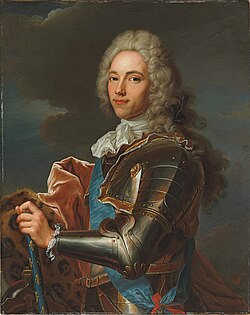
Louis Victor Pierre Raymond, the 7th Duc de Broglie, was a French theoretical physicist and aristocrat who fundamentally altered our understanding of the physical universe. He is most famous for proposing that the duality observed in light—behaving as both a particle and a wave—is not unique to light, but is a universal property of all matter.
This revolutionary concept, known as the de Broglie hypothesis, suggests that every moving particle or object has an associated wave. This insight provided a cornerstone for the development of quantum mechanics, the branch of physics that describes the behavior of nature at the smallest scales.
Key Facts
- Major Discovery: Postulated the wave nature of electrons and the general wave-particle duality of matter.
- Nobel Prize: Awarded the Nobel Prize in Physics in 1929.
- Core Contribution: Developed mécanique ondulatoire (wave mechanics), uniting the physics of energy and matter.
- Academic Legacy: Served as the perpetual secretary of the Académie des sciences from 1942.
- Interdisciplinary Background: Held degrees in both history (1910) and science (1913).
Early Life and Education
Born on August 15, 1892, in Dieppe, France, Louis de Broglie belonged to the House of Broglie, a noble family of Italian origin with a long history of military and political influence in France. His family connections were extensive; his brother, Maurice de Broglie, was also a renowned experimental physicist.
Initially, Louis was drawn to the humanities and earned his first degree in history in 1910. However, he later shifted his focus to the sciences, graduating in 1913. When World War I broke out in 1914, he contributed to the war effort by working on the development of radio communications for the army.
The Path to Quantum Discovery
In the early 1920s, Louis worked in his brother Maurice's laboratory, focusing on X-rays and the photoelectric effect (the emission of electrons when light hits a material). These studies helped clarify the internal electron shells of atoms and highlighted the limitations of existing scientific formulas of the time.
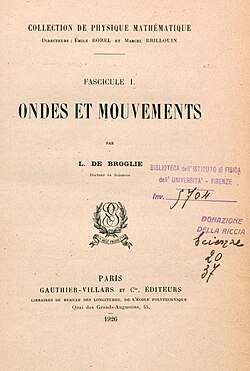
Inspired by Albert Einstein's work on light quanta, de Broglie began to wonder if matter also possessed wave-like properties. In 1923, he presented a short note titled "Waves and Quanta," which laid the groundwork for his doctoral thesis, Recherches sur la théorie des quanta (Research on the Theory of the Quanta), completed in 1924.
The de Broglie Hypothesis
De Broglie proposed that a moving particle with energy and velocity is characterized by an internal periodic process. He associated a "phase wave" (now called a matter wave or de Broglie wave) with any moving body. He mathematically defined the de Broglie wavelength (λ) as the Planck constant (h) divided by momentum (p).
This theory was a breakthrough because it explained the quantization of angular momentum in atoms and provided the theoretical basis for Erwin Schrödinger to formulate wave mechanics. The hypothesis was experimentally confirmed in 1927, leading to de Broglie receiving the Nobel Prize in Physics in 1929.
Later Research and Theoretical Evolutions
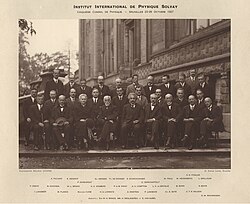
Beyond his primary hypothesis, de Broglie explored several other complex theories. At the 1927 Solvay Conference, he introduced the pilot-wave concept, an alternative interpretation of quantum mechanics. While he initially abandoned it, the idea was later revived and expanded by David Bohm in 1952, resulting in the de Broglie–Bohm theory.
In 1934, he proposed the neutrino theory of light, suggesting that a photon is equivalent to the fusion of two Dirac neutrinos. Although this theory was largely discontinued by 1938 due to issues with rotational invariance, it demonstrated his lifelong commitment to unifying the laws of nature.
Summary of Achievements
| Category | Details |
|---|---|
| Primary Theory | Wave-particle duality of matter |
| Nobel Prize | Physics (1929) |
| Other Major Awards | Max Planck Medal (1938), Kalinga Prize (1952) |
| Key Institutions | University of Paris, Académie des sciences, Académie Française |
| Lifespan | 1892 – 1987 (94 years) |
Frequently Asked Questions
What is the de Broglie hypothesis?
The de Broglie hypothesis is the proposal that all matter, not just light, exhibits wave-particle duality. It suggests that every moving particle has an associated wavelength inversely proportional to its momentum.
How did de Broglie's work influence other scientists?
His theory of matter waves was essential for Erwin Schrödinger, who used these concepts to develop the wave equation that is central to modern quantum mechanics.
What is the de Broglie–Bohm theory?
It is a causal interpretation of quantum mechanics based on de Broglie's original "pilot-wave" concept, which was further developed by physicist David Bohm in 1952.
Why did Louis de Broglie win the Nobel Prize?
He was awarded the Nobel Prize in Physics in 1929 specifically for his discovery of the wave nature of electrons, which was experimentally confirmed in 1927.
Was Louis de Broglie only a scientist?
No, he was also a member of the French aristocracy (the 7th Duc de Broglie) and held a degree in history before pursuing his career in theoretical physics.