Wave-Particle Duality: The Quantum Nature of Light and Matter
At the heart of quantum mechanics lies a concept that challenges our most basic intuitions about reality: wave-particle duality. This principle posits that fundamental entities, such as photons (particles of light) and electrons, can exhibit either particle-like or wave-like properties depending on how they are measured. In the classical world, an object is either a discrete particle or a continuous wave; however, quantum objects defy this binary, proving that classical concepts are insufficient to fully describe the behavior of the universe at its smallest scales.
Key Facts
- Dual Nature: Quantum entities like electrons and photons behave as both particles and waves.
- Light's Evolution: Light was first viewed as particles (Newton), then waves (Young), and finally as both (Einstein/Compton).
- Matter's Evolution: Electrons were first viewed as particles (Thomson), then as waves (de Broglie/Schrödinger).
- Observation Effect: Measuring which path a particle takes (the "which-way" experiment) destroys the wave-like interference pattern.
- Universal Property: Wave behavior is not limited to electrons but is a general property of all microscopic matter, including atoms and molecules.
The Evolution of Light: From Corpuscles to Photons
The debate over the nature of light began in the 17th century. Sir Isaac Newton advocated for a corpuscular (particulate) theory, while Christiaan Huygens proposed a wave description. For a time, the wave model prevailed, supported by Thomas Young's 1801 interference experiments and François Arago's 1819 detection of the Poisson spot.
The tide shifted in 1901 when Max Planck addressed black-body radiation. He proposed that energy is emitted in minimal increments, or quanta, proportional to the frequency of the electromagnetic wave. In 1905, Albert Einstein expanded this by explaining the photoelectric effect—the emission of electrons from a metal surface when hit by light. Einstein postulated that light consists of discrete units called photons, where the energy (E) is defined by the formula E = hf (where h is the Planck constant and f is the frequency).
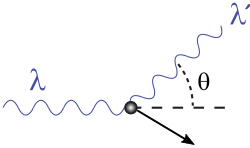
Despite these breakthroughs, the particle nature of light remained controversial until Arthur Compton's experiments (1922–1924) demonstrated that light possesses momentum, a characteristic typically associated with particles.
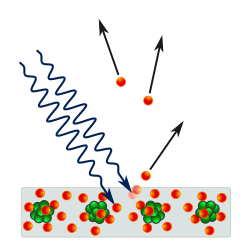
The Compton effect further solidified this duality by showing how a photon collides with a target, transferring momentum and changing wavelength.
The Wave Nature of Matter
While light was moving from a wave to a particle description, electrons followed the opposite path. Early work by J.J. Thomson, Robert Millikan, and Charles Wilson established electrons as particles, notably through Thomson's 1897 measurement of the charge-mass ratio.
In 1924, Louis de Broglie proposed a revolutionary idea: if light could be a particle, then matter could be a wave. He suggested that electrons are wave packets—bundles of waves moving with a group velocity. This theory provided the foundation for Erwin Schrödinger to develop the Schrödinger equation (wave mechanics) between 1925 and 1926, describing the motion of electrons as waves.
Empirical confirmation arrived in 1927 through two landmark studies. The Davisson-Germer experiment and the work of George Paget Thomson (and Alexander Reid) both observed electrons scattering and creating diffraction rings, a behavior exclusive to waves. These findings earned Davisson and Thomson the Nobel Prize in 1937. Later, Otto Stern demonstrated similar wave behavior in helium atoms and hydrogen molecules, proving that duality is a general property of all matter.
Comparing Classical and Quantum Models
To understand duality, it is helpful to distinguish between classical models. Classical waves (like sound or water waves) are continuous and exhibit diffraction (bending around obstacles) and interference (overlapping to reinforce or cancel each other). Classical particles, conversely, follow distinct trajectories and collide discretely.
| Characteristic | Classical Wave | Classical Particle | Quantum Entity |
|---|---|---|---|
| Spatial Extent | Continuous/Spread out | Localized point | Dual (Wave packet) |
| Interaction | Interference/Diffraction | Collision/Trajectory | Context-dependent |
| Examples | Sound, Radio waves | Billiard balls, Dust | Electrons, Photons |
The Double-Slit Experiment: Duality in Action
The electron double-slit experiment is the definitive demonstration of this phenomenon. When a beam of electrons is fired at two slits, an interference pattern of light and dark bands emerges on the detector, behaving exactly like a wave.
![Left half: schematic setup for electron double-slit experiment with masking; inset micrographs of slits and mask; Right half: results for slit 1, slit 2 and both slits open.[23]](/images/cc/76/cc764c307407a5892a89231fdd8433e5590bf1c28208fa729e66cdb3a25b7f9e.jpg)
The mystery deepens when the intensity is lowered so that only one electron is released at a time. Initially, each electron appears as a single dot (particle behavior). However, over time, these individual dots accumulate to form the same wave-like interference pattern. This proves that a single electron somehow "interferes with itself," exhibiting both natures simultaneously.
The "Which-Way" Paradox
A critical aspect of quantum mechanics is the role of the observer. In "which-way" experiments, detectors are placed at the slits to determine which path the electron actually takes. The moment the trajectory is detected, the interference pattern vanishes, and the electrons behave strictly as particles.
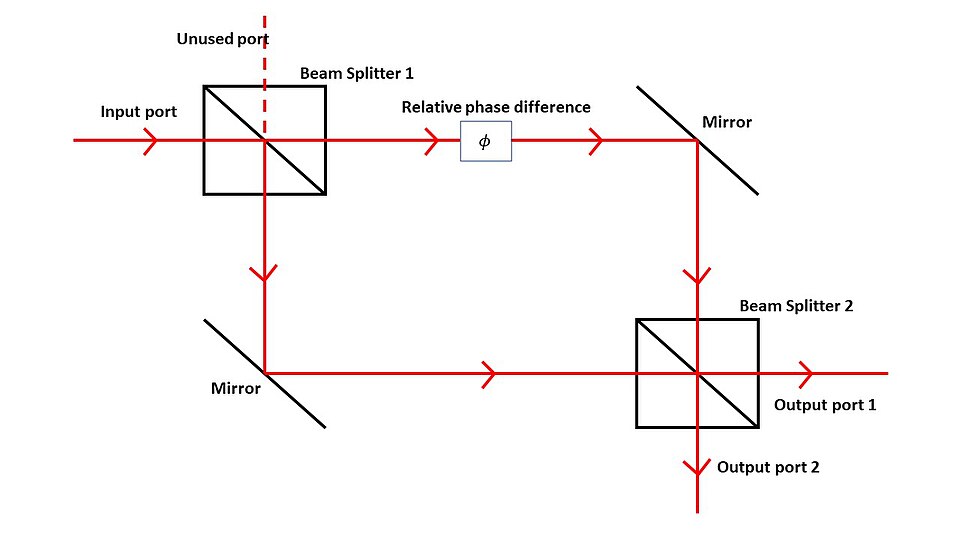
This loss of coherence suggests that the act of measurement forces the quantum system to "choose" one state, collapsing the wave-like behavior into a particle-like trajectory.
Frequently Asked Questions
Does wave-particle duality apply to large objects?
Theoretically, yes. All matter has a wavelength. However, for macroscopic objects, the wavelength is so infinitesimally small that wave effects are undetectable, making them appear strictly as particles.
What is a photon?
A photon is a discrete quantum (or particle) of light. It carries a specific amount of energy proportional to its frequency and possesses momentum, despite having no mass.
Why does the interference pattern disappear when we observe the electron?
This is due to the loss of coherence. In quantum mechanics, the act of measurement interacts with the system, destroying the superposition of paths and forcing the entity to behave as a particle.
Who first proposed that matter could behave as a wave?
Louis de Broglie proposed the theory of matter waves in his 1924 PhD thesis, suggesting that particles like electrons could be viewed as standing waves.
What is the difference between diffraction and interference?
Diffraction is the bending of a wave around an obstacle or through an opening. Interference occurs when two or more waves overlap, either amplifying (constructive) or canceling (destructive) each other.