Quantum Mechanics: The Fundamental Theory of Matter and Light
Quantum mechanics, also known as quantum physics, is the fundamental physical theory that describes the behavior of matter and light. While classical physics effectively explains the world at macroscopic and optical microscopic scales, it fails when applied to the submicroscopic realm of atoms and subatomic particles. At these scales, nature behaves in ways that often seem peculiar and mysterious.
The reach of quantum mechanics extends far beyond theoretical physics, providing the essential framework for diverse fields such as quantum chemistry, quantum biology, quantum field theory, quantum technology, and quantum information science. Interestingly, classical mechanics is not a separate entity but can be derived from quantum mechanics as an approximation valid at ordinary scales.
Key Facts
- Scale: Primarily describes phenomena at and below the atomic scale.
- Probabilistic Nature: Unlike classical physics, it uses probability amplitudes to predict measurement outcomes.
- Quantization: Certain physical properties, such as energy and angular momentum, take only discrete values.
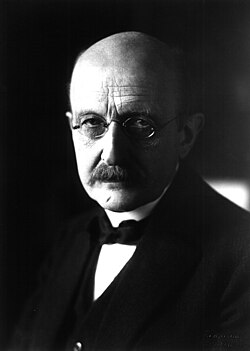
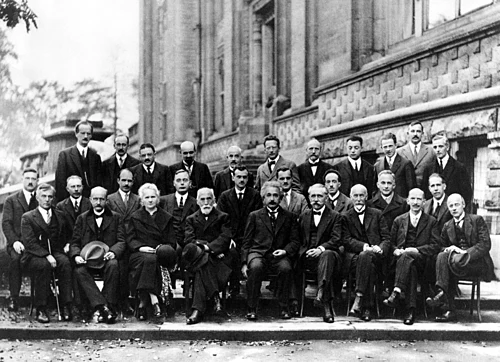
- Foundational Figures: Developed by pioneers including Max Planck, Albert Einstein, Niels Bohr, Erwin Schrödinger, Werner Heisenberg, Max Born, and Paul Dirac.
- Core Tool: The wave function is the primary mathematical entity used to describe the state of a system.
The Evolution of Quantum Theory
Quantum mechanics did not emerge overnight; it developed gradually to explain observations that classical physics could not reconcile. In 1900, Max Planck provided a solution to the black-body radiation problem, marking the beginning of the quantum era. This was followed in 1905 by Albert Einstein, whose work on the photoelectric effect established a critical correspondence between energy and frequency.
These early contributions, collectively known as the "old quantum theory," paved the way for the full formalization of quantum mechanics in the mid-1920s. This era saw the introduction of various mathematical formalisms, most notably the use of the wave function. This mathematical entity provides information about the probability amplitudes of a particle's energy, momentum, and other physical properties.
Fundamental Concepts and Mathematical Models
The Wave Function and Probability
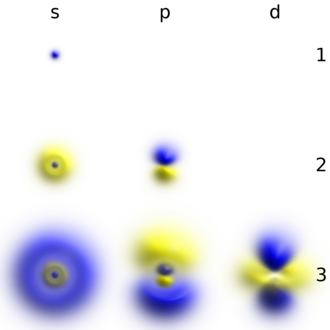
In quantum mechanics, a particle is not described by a precise location but by a wave function. This function allows scientists to calculate the probability of finding a particle in a specific region of space. The brighter or denser areas of a probability density map indicate a higher likelihood of the particle being present during a measurement.
![Wave functions of the electron in a hydrogen atom at different energy levels. Quantum mechanics cannot predict the exact location of a particle in space, only the probability of finding it at different locations.[1] The brighter areas represent a higher probability of finding the electron.](/images/c9/ff/c9ff6bb120394a7408b13469aac6a3938d26330ee34b482e426dd046176fdca6.webp)
Quantum Tunneling and Superposition
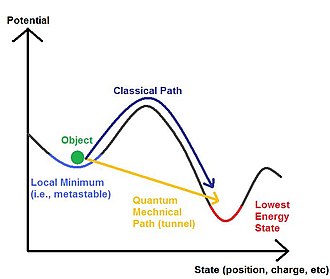
One of the most striking departures from classical physics is quantum tunneling, a phenomenon where a particle passes through a potential barrier that would be impassable under classical laws. Another core concept is superposition, where a system can exist in multiple states simultaneously until a measurement is made.
The Uncertainty Principle
The theory posits that certain pairs of physical properties, such as position and momentum, cannot be known simultaneously with arbitrary precision. This inherent limit is a fundamental property of quantum systems, not a limitation of measurement tools.
Quantum Systems in Practice
The Particle in a Box
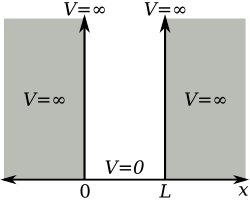
A classic example used to illustrate quantization is the "particle in a box" (or infinite potential well). In this model, a particle is confined to a small region. Because the wave function must satisfy specific boundary conditions, the particle can only possess certain discrete energy levels, rather than a continuous range of energies.
The Quantum Harmonic Oscillator
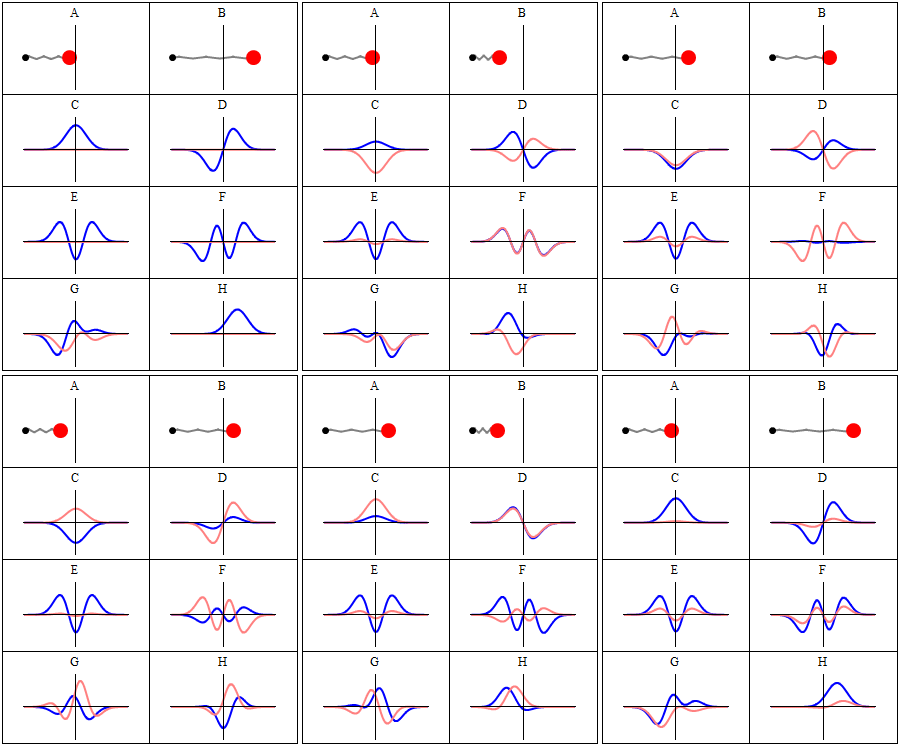
Unlike a classical harmonic oscillator (like a ball on a spring) which can have any energy level, the quantum version is quantized. Its position is represented by a wave function, and its possible energy levels are proportional to specific standing-wave frequencies.
Interferometry and Wave Packets
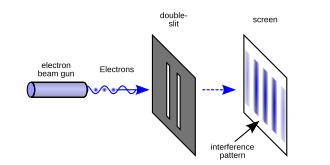
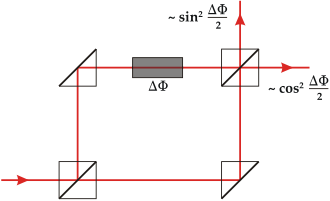
Quantum behavior is often demonstrated using devices like the Mach–Zehnder interferometer, which explores the wave-like nature of particles. Additionally, the movement of particles in free space can be modeled as a Gaussian wave packet, representing the probability density of the particle's position over time.

Summary of Quantum vs. Classical Mechanics
| Feature | Classical Mechanics | Quantum Mechanics |
|---|---|---|
| Scale | Macroscopic / Optical Microscopic | Atomic / Subatomic |
| Predictability | Deterministic (Exact positions) | Probabilistic (Wave functions) |
| Energy Levels | Continuous | Quantized (Discrete) |
| Barriers | Impassable if energy is insufficient | Possible to tunnel through |
Philosophical Implications
The nature of quantum mechanics has led to various interpretations of reality. One famous thought experiment, Schrödinger's cat, illustrates the concept of superposition and is often used to discuss the "many-worlds interpretation," where the universe branches into different states based on quantum outcomes.

Further complexities arise in the study of entanglement, where composite systems become linked such that the state of one particle instantaneously influences the state of another, regardless of the distance between them.
Frequently Asked Questions
What is the difference between quantum physics and classical physics?
Classical physics describes the world at a macroscopic scale where objects have definite positions and continuous energy. Quantum physics describes the subatomic scale, where particles behave like waves, energy is quantized into discrete packets, and outcomes are probabilistic.
What is a wave function?
A wave function is a mathematical description of the quantum state of a system. It provides probability amplitudes, which allow physicists to calculate the likelihood of finding a particle with a specific energy, momentum, or position upon measurement.
What is quantum tunneling?
Quantum tunneling is a phenomenon where a particle crosses a potential energy barrier that it classically should not have enough energy to overcome. This is possible because the particle's wave function extends through the barrier.
Who are the primary founders of quantum mechanics?
The theory was developed through the contributions of many scientists, including Max Planck (black-body radiation), Albert Einstein (photoelectric effect), Niels Bohr, Erwin Schrödinger, Werner Heisenberg, Max Born, and Paul Dirac.
What does "quantized" mean in this context?
Quantized means that a physical property, such as energy or angular momentum, can only exist in specific, discrete amounts (quanta) rather than any arbitrary value along a continuous spectrum.