Lorentz Scalars in Relativistic Physics
In the realm of relativistic physics, observers moving at different constant velocities may disagree on the distance between two points or the time elapsed between two events. However, certain quantities remain absolute. These are known as Lorentz scalars: scalar expressions whose values are invariant under any Lorentz transformation.
A Lorentz scalar is typically generated through the scalar product of vectors or by contracting a tensor (a mathematical object that generalizes scalars and vectors). While the individual components of these quantities may shift depending on the observer's inertial frame, the resulting scalar remains unchanged, providing a consistent foundation for the laws of physics across all frames of reference.
Key Facts
- Invariance: Lorentz scalars do not change their value regardless of the observer's velocity.
- Spacetime Distance: The interval between two fixed events in Minkowski spacetime is a primary example of a Lorentz scalar.
- Physical Constants: The rest mass of a particle is a Lorentz scalar.
- Geometric Nature: In spacetime, acceleration acts as a rotation of the 4-velocity, keeping their inner product at zero.
Foundations of Spacetime Scalars
The Minkowski Metric and Spacetime Distance
In special relativity, we describe the location of a particle using 4-dimensional spacetime. The distance between two events is calculated using the Minkowski metric, which defines the geometry of spacetime. Depending on the convention used, the metric may be time-like or space-like. In a space-like metric, the spacetime distance remains invariant under Lorentz transformations, ensuring that all inertial observers agree on this "length."
The 4-Velocity and Proper Time
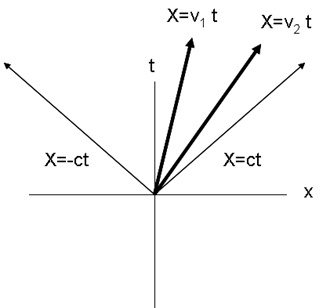
The 4-velocity represents the rate of change of a particle's position in spacetime. A critical Lorentz scalar derived from this is the "length" of the 4-velocity vector. This magnitude is directly related to proper time—the time measured by a clock moving with the particle in its own rest frame.
Dynamics: Acceleration and Momentum
Acceleration as Spacetime Rotation
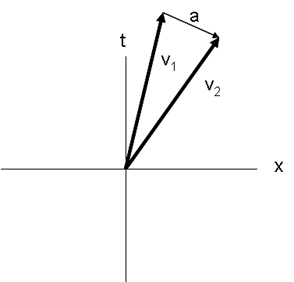
The 4-acceleration is defined as the derivative of the 4-velocity. A fundamental property of relativistic motion is that the 4-acceleration is always perpendicular to the 4-velocity. Because their inner product is always zero, acceleration in spacetime can be viewed as a rotation of the 4-velocity vector. This geometric relationship is a direct expression of energy conservation, relating the 3-force on a particle to its energy.
4-Momentum and Rest Mass
The 4-momentum of a particle combines its relativistic energy and its 3-momentum. From this vector, we can derive several essential Lorentz scalars:
- Rest Mass (m): The inner product of a particle's 4-momentum with itself yields the rest mass. This value is invariant and is often denoted as $m_0$ to distinguish it from relativistic mass.
- Relative Energy: The inner product of the 4-momentum of one particle and the 4-velocity of another is proportional to the energy of the first particle as measured in the second particle's frame.
- 3-Momentum Magnitude: The square of the magnitude of the 3-momentum, as measured in a specific frame, can be constructed as a Lorentz scalar.
Advanced Scalar Constructions
Beyond simple vectors, more complex scalars are constructed through the contraction of tensors. An example from general relativity is the Ricci curvature at a point in spacetime, which is derived from the contraction of the Riemann curvature tensor. These complex scalars allow physicists to describe the curvature of the universe in a way that is independent of the coordinate system used.
| Quantity | Physical Meaning | Derivation Method |
|---|---|---|
| Spacetime Interval | Distance between two events | Minkowski metric application |
| Rest Mass | Intrinsic mass of a particle | Inner product of 4-momentum |
| Proper Time | Time in the particle's rest frame | Length of the 4-velocity vector |
| Ricci Curvature | Spacetime curvature at a point | Contraction of Riemann tensor |
Frequently Asked Questions
What exactly is a Lorentz scalar?
A Lorentz scalar is a physical quantity or mathematical expression that remains unchanged (invariant) when moving from one inertial reference frame to another via a Lorentz transformation.
Why is the rest mass considered a Lorentz scalar?
The rest mass is derived from the inner product of the 4-momentum vector. Since the inner product of 4-vectors is invariant under Lorentz transformations, the rest mass remains the same for all observers.
How does acceleration relate to rotation in spacetime?
Because the 4-acceleration is always perpendicular to the 4-velocity, any change in velocity (acceleration) does not change the magnitude of the 4-velocity; it only changes its direction in 4-dimensional spacetime, which is mathematically equivalent to a rotation.
What is the difference between a 3-vector and a 4-vector in this context?
A 3-vector refers to quantities in standard three-dimensional space (like 3-momentum), which can change depending on the observer's speed. A 4-vector includes time as a fourth dimension, allowing for the calculation of Lorentz scalars that are universal across all frames.