Lithuanian Language: History, Structure, and Linguistic Heritage
The Lithuanian language (lietuvių kalba) is a fascinating linguistic treasure, recognized by scholars as one of the most archaic living Indo-European languages. Spoken primarily in Lithuania, it serves as a vital link to the ancient linguistic structures of Europe, preserving features that have vanished from many of its sister languages.
With approximately 4 million native speakers as of 2022, Lithuanian is not only a symbol of national identity but also a subject of intense scientific study due to its conservative nature and its relationship with other Baltic and Slavic tongues.
![Map of the prevalence of hydronyms of Baltic origin[8]](/images/16/30/16303125f0491661d8a8a0d37a6ab7df319978eb53b426504cff23f35c042d60.png)
Key Facts
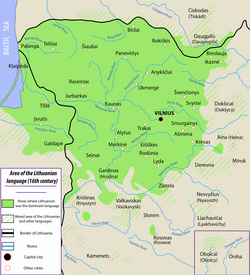
- Language Family: Indo-European > Balto-Slavic > Baltic > East Baltic.
- Native Speakers: Approximately 4.0 million (2022).
- Official Status: Sole official language of Lithuania and an official language of the European Union.
- Dialects: Primarily divided into Aukštaitian and Samogitian.
- Writing System: Latin alphabet (with specific diacritics) and Lithuanian Braille.
- Archaism: Widely regarded as the most archaic living Indo-European language.
Historical Evolution
Pre-Statehood and the Grand Duchy
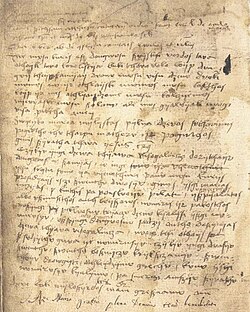
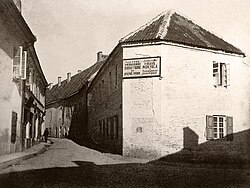
The roots of Lithuanian stretch back to the Baltic tribes. During the era of the Grand Duchy of Lithuania, the language navigated a complex political landscape. By 1501, Grand Duke Alexander Jagiellon mandated that Roman Catholic priests in 28 specific churches must be proficient in Lithuanian to better serve the population.
![The Grand Duke of Lithuania, Alexander Jagiellon, specified that the Roman Catholic priests in these 28 churches must know the Lithuanian language, according to his letter of 18 September 1501, which was addressed to the Bishop of Vilnius Albertas.[41][42]](/images/db/84/db8437b11e989e5989765667637600e701e9de34f799b4035b08f37ba654b768.webp)
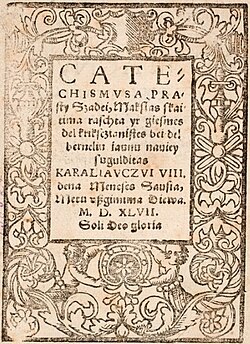
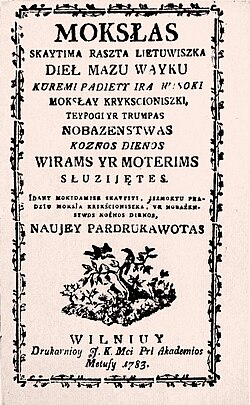
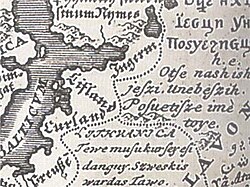
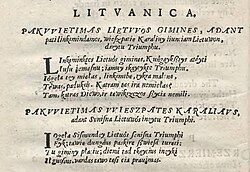
The 16th century marked a pivotal moment for the written word. On January 8, 1547, Hans Weinreich printed the Catechism of Martynas Mažvydas in Königsberg, which stands as the first printed book in the Lithuanian language.
Challenges and Resilience
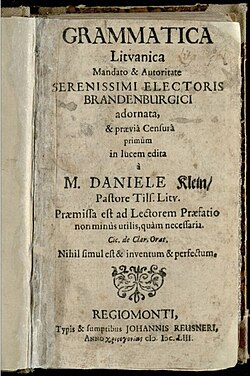
The early 18th century brought immense hardship. The Great Northern War plague (1700–1721) devastated the population, killing 49% of residents in the Grand Duchy of Lithuania and 53% in Lithuania Minor. Despite this demographic collapse, academic interest grew, with Lithuanian language seminars established at the University of Königsberg in 1718 and the University of Halle in 1727.
Modern Statehood and Official Status
Following the restoration of statehood in 1918, the language became a cornerstone of the new republic. The 1922 Constitution formally established Lithuanian as the sole official language of the state.
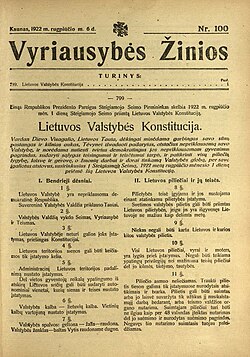
After decades of Soviet and Nazi occupations (1940–1990), the Act of the Re-Establishment of the State of Lithuania was passed on March 11, 1990. The 1992 Constitution reaffirmed Lithuanian's status as the official state language.
Linguistic Classification and Distribution
Family Tree
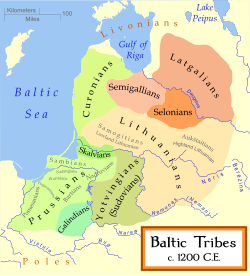
Lithuanian belongs to the Balto-Slavic branch of the Indo-European family. Linguists debate the exact relationship, with some suggesting Proto-Slavic formed from peripheral Baltic dialects, while others believe the Slavic type formed from a Baltic structural model.

Geographic Reach
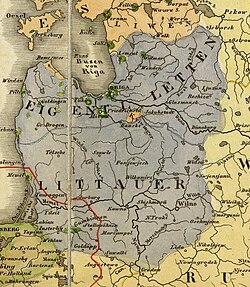
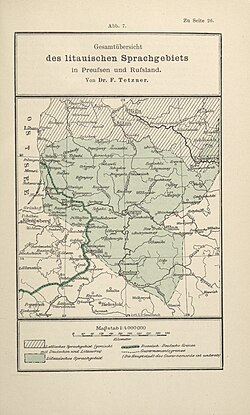
The vast majority of speakers reside in Lithuania, where about 86% of the 2015 population were native speakers. Globally, the Lithuanian-speaking population is estimated at 3.2 million. The language is also recognized as a minority language in Poland.
Language Structure and Phonology
Dialects
The language is characterized by two primary dialect groups: Aukštaitian (Highland) and Samogitian (Lowland). These are further divided into various sub-dialects based on regional linguistic shifts.
![Dialects of Lithuanian.[111] Map of the dialects of the Lithuanian language based on the classification by linguist and Baltist academic Zigmas Zinkevičius. Samogitian dialect: Western Samogitian Western Samogitian sub-dialect Northern Samogitian Southern Samogitian Aukštaitian dialect: Western Aukštaitian Eastern Aukštaitian Southern Aukštaitian](/images/ae/93/ae933d26f06db3cba553037d2e50abee424c1cffc7f981be9b880171ce4159a2.webp)
Orthography and Sound
Lithuanian uses a modified Latin alphabet. Its phonology is complex, featuring a wide array of consonants (including palatalized versions) and a sophisticated system of vowels and diphthongs. A distinguishing feature is the pitch accent, which can alter the meaning of words.
Grammar and Vocabulary
Lithuanian grammar is highly inflected. Verbs can be conjugated across various moods (Indicative, Indirect, Imperative, and Conditional/Subjunctive) and up to eleven different tenses, including simple and compound forms.
The vocabulary reveals the language's ancient lineage. Many basic words share striking similarities with Sanskrit and Latin, illustrating their common Indo-European origin:
| English | Lithuanian | Sanskrit | Latin |
|---|---|---|---|
| Son | sūnus | sūnu | - |
| Fire | ugnis | agni | ignis |
| Tooth | dantis | danta | dens |
| Night | naktis | naktam | noctes |
| Man | vyras | vīra | vir |
Frequently Asked Questions
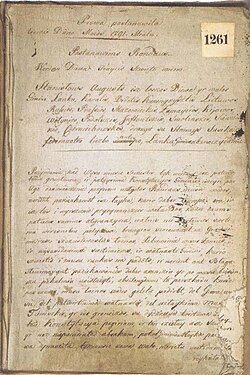
![Written oath in Lithuanian (1680) where Lithuanians names and surnames has endings with "-as" (e.g. Jonas Miteykienas, Kazimieras Wikszcialunas, etc.)[136]](/images/f6/4f/f64fce48ae5431874c3c1495dc8b6beda2ae852f8c602f5e7b13621da2328fa8.png)
Why is Lithuanian considered an archaic language?
Lithuanian is considered archaic because it has preserved many phonetic and grammatical features of Proto-Indo-European that have been lost in almost all other living Indo-European languages.
What are the main dialects of Lithuanian?
The two primary dialect groups are Aukštaitian and Samogitian, each containing several regional sub-dialects.
When was the first Lithuanian book printed?
The first printed book in Lithuanian was the Catechism of Martynas Mažvydas, printed on January 8, 1547, in Königsberg.
What is the official status of the language today?
Lithuanian is the sole official language of the Republic of Lithuania and is also an official language of the European Union.
How many people speak Lithuanian worldwide?
The total worldwide Lithuanian-speaking population is approximately 3.2 million, with the majority residing in Lithuania.