Linnaean Taxonomy: The Foundation of Biological Classification
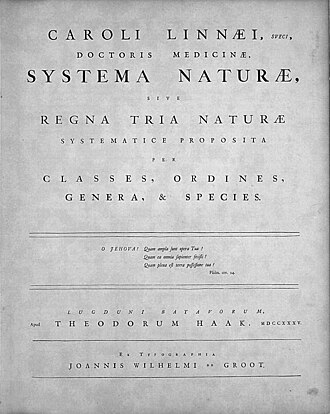
In the history of science, few names carry as much weight as Carl Linnaeus. His work transformed the way humans perceive and organize the natural world. While the term "Linnaean taxonomy" is often used to describe the ranked classification of organisms, it actually refers to two distinct concepts: the specific hierarchical system established by Linnaeus in his seminal work, Systema Naturae (1735), and the broader, rank-based method of scientific classification used today.
Before Linnaeus, biological naming was often inconsistent and localized. By introducing a structured approach, he provided a universal language for scientists, creating a framework that remains the bedrock of biological nomenclature.
Key Facts
- Systema Naturae: The foundational work published by Linnaeus in 1735.
- Binomial Nomenclature: The practice of using a two-part name (genus and species) to uniquely identify every organism.
- Three Kingdoms: Linnaeus originally categorized life into Animal, Vegetable, and Mineral.
- Sexual System: A botanical classification method based on the number and arrangement of reproductive organs.
- Nomenclature Priority: Linnaeus's species names often take priority in modern science due to his 1753 and 1758 publications.
The Core of the System: Binomial Nomenclature
Perhaps Linnaeus's greatest innovation was binomial nomenclature. This system assigns every species a unique two-part name consisting of a genus (a group of closely related organisms) and a specific epithet. For example, the human species is identified as Homo sapiens. This method replaced cumbersome descriptive phrases with a stable, universal identifier that transcends language barriers.
This approach was an evolution of earlier Scholastic traditions, which used a genus and a distinguishing characteristic (such as Animal rationalis) to define species. Linnaeus refined this into a practical tool for biological taxonomy, ensuring that no two species share the same binomen within their respective kingdoms.
The Hierarchical Structure of Life
Linnaean taxonomy relies on a ranked hierarchy. In this system, organisms are organized into nested groups, or taxa. While the specific number of ranks has expanded over time, the traditional progression moves from broad categories to increasingly specific ones:
- Kingdoms: The highest level (e.g., Animalia).
- Phyla: (or Divisions in botany and fungi).
- Classes: Major groupings within a phylum.
- Orders: Subdivisions of classes.
- Families: Groups of related genera.
- Genera: The plural of genus.
- Species: The most specific level of classification.
In modern zoology, further subdivisions like subspecies are used, while botany may include ranks such as variety and form.
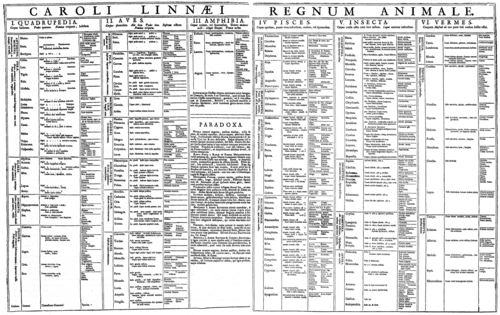
Linnaeus's Three Kingdoms
In his Imperium Naturae, Linnaeus divided the world into three primary kingdoms. While some of these have evolved significantly, they shaped the scientific mindset for centuries.
The Animal Kingdom
The classification of animals remains the most recognizable part of his system. In the tenth edition of Systema Naturae (1758), he divided animals into six classes:
- Mammalia: Mammals
- Aves: Birds
- Amphibia: Amphibians
- Pisces: Fishes
- Insecta: Arthropods
- Vermes: Worms
The Vegetable Kingdom and the Sexual System
For plants, Linnaeus developed the Sexual System (Systema Sexuale). Unlike his ordines naturales, which he intended to represent natural groups, the Sexual System was designed primarily for easy identification. It categorized plants based on the number and arrangement of their male stamens and female pistils.
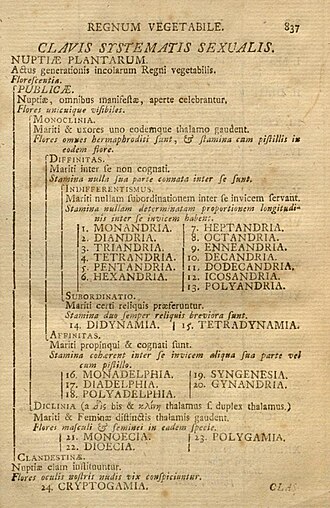
For instance, a plant might be classified under Classis Decandria if it possesses ten stamens. If it also has only one pistil, it would be further specified as Hexandria monogynia (though the specific class names varied by edition). This method allowed botanists to quickly sort through the vast diversity of plant life.

The Mineral Kingdom
Linnaeus also included a kingdom for minerals, divided into classes such as Petræ, Mineræ, Fossilia, and Vitamentra. However, this classification has long since been abandoned by the scientific community.
Evolution of Taxonomy: From Structure to Phylogeny
The understanding of biological relationships changed profoundly with the publication of Charles Darwin's On the Origin of Species in 1859. While Linnaeus based his system on structural similarities, modern science focuses on phylogeny—the evolutionary descent of organisms.
This shift led to several new methodologies:
- Evolutionary Taxonomy: Linking extant (living) and extinct species to construct evolutionary trees.
- Cladistics: A method where taxa are grouped into clades, ensuring each group includes a common ancestor and all its descendants (monophyletic groups).
Today, the original three-kingdom model has been replaced by more complex systems, such as the three-domain system (Bacteria, Archaea, and Eukaryota), which is based on genomic data rather than just physical traits.
Summary of Linnaean Classifications
| Kingdom | Linnaean Classes (1758) | Modern Status |
|---|---|---|
| Animal | Mammalia, Aves, Amphibia, Pisces, Insecta, Vermes | Highly recognizable; many names still in use. |
| Vegetable | Based on stamen/pistil count (e.g., Monandria, Decandria) | Replaced by phylogenetic and genomic systems. |
| Mineral | Petræ, Mineræ, Fossilia, Vitamentra | No longer used in biological taxonomy. |
Frequently Asked Questions
What is the difference between Linnaean taxonomy and cladistics?
Linnaean taxonomy is a rank-based system that organizes organisms into hierarchical levels like class, order, and genus. Cladistics, however, groups organisms into clades based on shared evolutionary ancestry, focusing on the relationships between species rather than just assigned ranks.
Why is binomial nomenclature so important?
It provides a unique, stable, and universal name for every species. This prevents the confusion caused by common names, which can vary by language and region, ensuring scientists worldwide are referring to the exact same organism.
Did Linnaeus invent the concept of ranking organisms?
No. The concept of ranked classification dates back to Plato and Aristotle. Linnaeus's contribution was the systematic application and popularization of this method, particularly through his specific hierarchical structure and binomial naming.
How has the classification of plants changed since Linnaeus?
Linnaeus's "Sexual System" was a practical tool for identification based on reproductive organs. Modern botany has moved toward systems that reflect the actual evolutionary relationships (phylogeny) of plants, often using DNA sequencing to determine how species are related.
What are the three domains of life?
Modern taxonomy has largely moved beyond the kingdom model to a three-domain system: Bacteria and Archaea (which contain prokaryotes) and Eukaryota (which includes all organisms with complex cells, such as plants, animals, and fungi).